
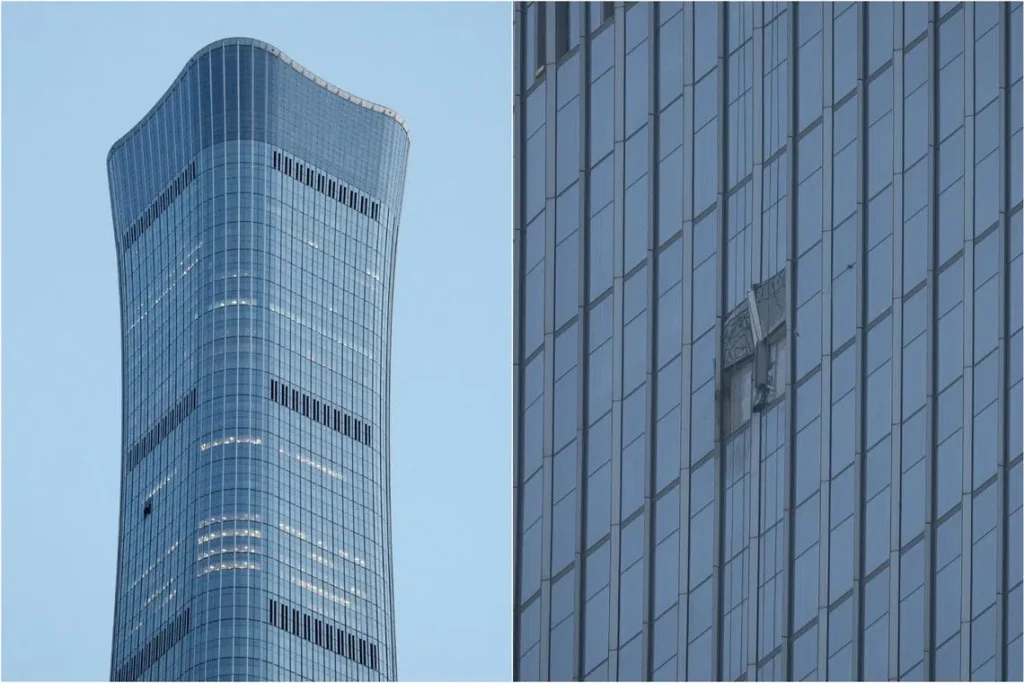
SINGAPORE – A fatal crash by a light aircraft into Beijing’s tallest skyscraper underscores the challenges in securing urban airspaces, aviation experts say, as the Chinese authorities released their investigation findings on July 2, nearly a week after the accident.
In a statement posted on WeChat, the local Chaoyang district government described the crash as a case of public safety endangerment caused by personal reasons.
The lone pilot of the Sunward SA60L Aurora light sport aircraft that struck the 109-storey CITIC Tower in Beijing’s Central Business District on June 26 was identified only by his surname Liu.
The authorities said the 66-year-old Beijing native was a divorced freelancer who lived alone and suffered from long-term insomnia and anxiety. The phrase “end life” appeared multiple times in his diary, investigations found.
Liu obtained a sport pilot licence in 2021 and a private pilot licence in 2024.
On the afternoon of June 26, he first did an accompanied flight before going solo, and it was during the solo flight that he deviated from the designated flight area and lost contact with the airport.
The authorities said relevant departments immediately initiated an investigation and emergency response after being notified.
The pilot died on the spot. Of the 13 people injured in the crash, all are out of life-threatening danger, with one already discharged from the hospital.
Observers say the crash is highly unusual, given that Beijing’s airspace is among the world’s most restricted. A permanent 100 sq km no-fly zone covers the city’s inner core, which houses the offices of China’s top political leadership. CITIC Tower lies just outside this no-fly zone.
While it is too early to blame systemic failures, Marco Chan, a senior lecturer at Buckinghamshire New University, noted the apparent gap between stringent regulations on paper and the authorities’ ability in practice to respond quickly to a rogue aircraft.
“This is not unique to China; it reflects a broader global challenge. However, the sensitivity of Beijing’s airspace makes the case particularly significant,” said the former commercial pilot.
Based on public reporting, the SA60L light aircraft, which was registered to a local general aviation company, struck the CITIC Tower at 5.55pm.
Flight data shows the plane took off at 5.30pm from Shifosi Airport, a base for private pilot training and low-altitude tourism located 50km north-east of downtown Beijing.
The aircraft flew towards the downtown Chaoyang district at 5.40pm, crossing a busy corridor used by commercial jets landing at and departing from Beijing Capital International Airport, the city’s main aviation hub.
Flying at an altitude between 700m and 900m, the plane came dangerously close to an arriving Hainan Airlines Airbus A330 jet, forcing the passenger plane to abort its descent and perform a go-around.
Citing unnamed sources, Ming Pao reported on June 27 that the pilot of the light aircraft did not respond to multiple calls from Beijing’s air traffic control towers.
According to the Hong Kong newspaper, while the military deployed helicopters in response, they arrived too late to intervene.
Hassan Shahidi, chief executive of the Flight Safety Foundation, said the crash appears to have been a “highly unusual event”, noting China’s generally strong aviation safety record and carefully managed airspace.
The last aircraft crash in Beijing occurred in 2022, involving a tourist helicopter. Nationally, there were 14 fatal general aviation accidents between January 2024 and May 2026, according to Civil Aviation Administration of China records.
General aviation refers to civilian flights outside of those operated by commercial airlines, including pilot training, recreational flying and emergency medical services.
Chinese regulations require all flights, including non-airline general aviation, to be approved in advance, with detailed flight plans to be submitted before 3pm the day before. Beijing is particularly strict, typically restricting low-altitude activities to the suburbs.
Low-altitude flights are defined as those within 1,000m from ground level. In May, Beijing further tightened controls, banning drones and other aircraft from flying over the entire city.
The incident has raised an obvious question: Why was the aircraft not intercepted before it reached the city centre?
Chan, the aviation lecturer, explained that managing general aviation activities in dense urban airspaces usually involves multiple layers of control, including designated flight corridors, radar surveillance, and communication with air traffic control.
Citing London, Washington DC and Singapore as examples, he said the approach in most major cities is to keep light aircraft away from sensitive airspace and urban centres rather than to manage them reactively and rely on interception when deviations occur.
US-based aviation safety analyst Todd Curtis said such traffic separation relies on pilot cooperation. “If those crews don’t cooperate, few options usually remain to stop an aircraft,” he said. These options include law enforcement or military intervention.
However, analysts noted that intercepting a civilian plane in a crowded urban area carries significant risk, potentially creating ground threats and panic disproportionate to the aircraft’s actual threat.
Small, low-flying aircraft also present technical challenges, as they have small radar cross-sections and are hard to distinguish from other benign objects in urban environments.
Chan said traditional air defences are generally not designed to manage slow-moving civilian aircraft over cities, noting that even the comprehensive layered response that has been set up around Washington DC is not fully immune to unauthorised deviations.
Response time is another critical issue, with Curtis noting that the authorities may have only seconds to act in some cases. “Any law enforcement or military response will be effective only if appropriate assets are already in place or can be deployed immediately,” he added.
In the Beijing crash, tracking data suggests the plane’s transponder may have ceased transmitting before impact. “If accurate, that would significantly reduce situational awareness and compress the intervention window,” Chan said.
The crash comes amid a strategic push by China to expand its low-altitude economy, which is projected to reach 3.5 trillion yuan (S$667 billion) by 2035.
Over the past decade, the number of general aviation airports in China has grown exponentially from 60 in 2015, to more than 500 today. The general aviation aircraft fleet now includes more than 3,100 aircraft, with annual flight hours surpassing 1.2 million in 2025.
As activity increases, so does airspace complexity, Chan said, noting that Beijing’s earlier move to tighten low-altitude restrictions in May indicates it is aware of the risks. Reports suggest that following the June 26 crash, some light aircraft operators were instructed to suspend operations.
Flight Safety Foundation’s Shahidi emphasised that as the low-altitude sector continues to grow in China and elsewhere in the world, regulators and operators must ensure that safety systems, training and oversight keep pace.
Chan added: “This event will likely accelerate regulatory attention in two directions: stricter enforcement around sensitive urban airspace and more intensive debate on how to safely scale low-altitude operations in major cities.”