
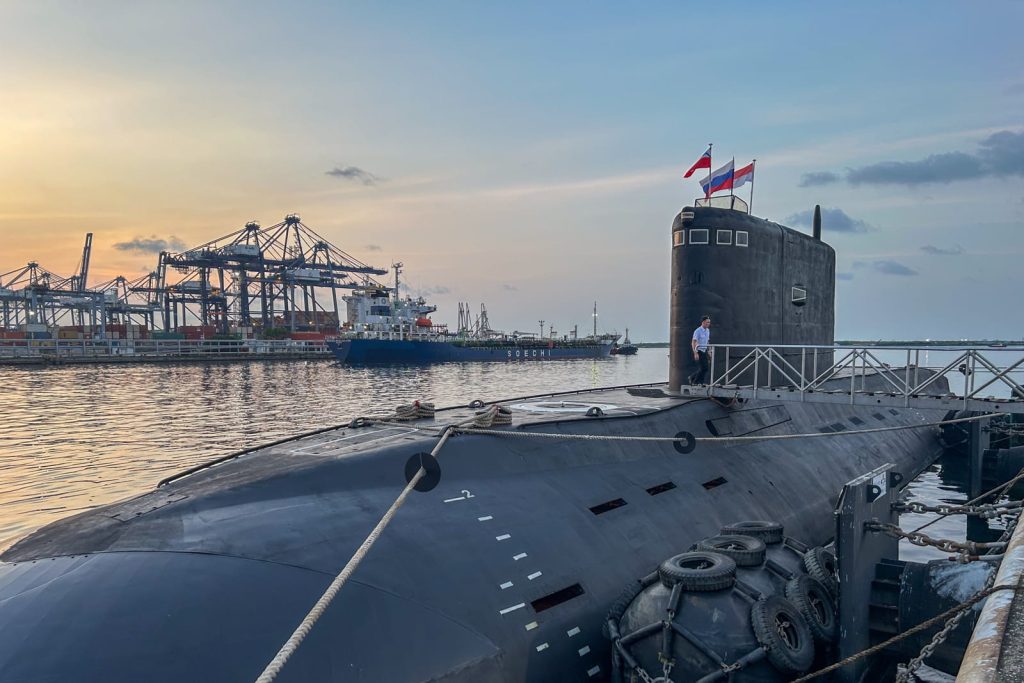
A Russian naval visit to Jakarta in recent days has passed with little media notice in Australia. Drawn from the Pacific Fleet, the task group included a corvette, a submarine, and a standard support vessel. To most Australians, such a visit may appear irregular, rare, or simply part of background activity. It is better understood as part of a consistent pattern.
Russia has always been present in the Indo-Pacific – just not always visible to the wider Australian audience. That has shaped how it is assessed, and often how little emphasis it receives.
Russia’s activity in the near region rarely dominates headlines. When it does, it tends to generate a short-lived domestic stir – the reported interest in staging long-range aviation from Indonesia in early 2025, or maritime deployments associated with the 2014 G20 “shirtfront” episode. These moments attract attention, but they can also narrow how Russia is viewed as an actor in the region.
In the final years of the Cold War, Soviet activity in the Indo-Pacific was constant. Fishing fleets operated deep into the Southwest Pacific. Naval units staged from Vietnam’s Cam Ranh Bay and deployed into the Indian Ocean. That was normal operating behaviour. Its proximity to Australian interests contributed to shaping capability requirements, including sustained investment in language, analysis, and assessment.
After the collapse of the Soviet Union, Russia came to be seen as a less adversarial power. Australia doubled down on the near north and, with allies, expanded into the Middle East. Capability decisions followed. Russian language training declined as other language proficiencies took priority, reducing both depth of understanding and recognition of Russia as an active player in the region. This shift sat within a broader post–Cold War adjustment shaped by fiscal constraint and the anticipated peace dividend.
Russia does not need to dominate the Indo-Pacific to shape it. It only needs to remain present – and to act when opportunity arises.
Through the 1990s and into the 2000s, engagement reflected that change. Maritime interaction continued, including port visits to Vladivostok, and Russia became a participant in multinational activity, including exercises such as RIMPAC as late as 2012.
Russia did not leave the Indo-Pacific. It has adjusted how it operates within it.
Russian naval vessels have rarely sailed south of the Indonesian archipelago. That has often been read as a limitation. It is more likely a reflection of choice. The scale of activity should not be overstated, but nor should its consistency be discounted.

The Jakarta visit fits a longer pattern. It is not significant for its size, but for what it represents – continued access, continued engagement, continued intent. The inclusion of a modern Kilo-class submarine, consistent with the Orruda exercises off Surabaya in 2024, reinforces continuity of capability alongside presence. Reports in April 2025 of a Russian request to base long-range aviation at the Manuhua Air Force Base in eastern Indonesia sit alongside this activity. Together, they point to a steady, if measured, approach.
Australian policy discussion of the Indo-Pacific is heavily weighted toward the People’s Republic of China. That focus is essential. But its dominance may reduce the aperture on how the wider region is framed. Such framing matters because it shapes where attention is directed, how capability is prioritised, and which relationships are reinforced.
Russia operates differently in the Indo-Pacific maritime domain. It is not constant or dominant. But it is persistent, and it tends to look for opportunity rather than control, including seeking opportunities for engagement where access and relationships can be expanded. It is not competing for primacy in the region. It is positioning itself in ways that can be disruptive – present enough to matter, but not enough to be the primary focus.
That approach extends beyond the maritime domain. Russia remains active in space, cyber, and cognitive activities that are not geographically bounded but still shape regional dynamics and, at times, intersect with Australian interests. These efforts are less visible, but they align with the same pattern of selective engagement, sustained presence, and an ability to act when conditions permit.
Regional perspectives reflect this. Japan continues to treat Russia as a live security consideration alongside China and North Korea. India maintains a longstanding and extensive defence relationship with Moscow that adds complexity to alignment within the Quad. Across Southeast Asia, Russia continues to engage through defence diplomacy and representation, including in Indonesia, Thailand, and Vietnam.
There is also precedent. The Soviet Union built a substantial defence relationship with Indonesia during the Sukarno era. Russia does not have the frequency to replicate that scale today, but it does not need to. Limited engagement – port visits, exercises, and access – remains sufficient to maintain presence.
Since 2014, much of the Western policy focus on Russia has centred on the war in Ukraine. That focus is understandable, but it reinforces a European framing. Russia continues to demonstrate that its interests extend beyond Europe, including into the Indo-Pacific and Antarctic, where it maintains a continuous presence through research stations and supporting logistics.
For Australia, this is not a question of priority. Russia is not the primary strategic challenge in the region. But treating it as peripheral risks narrowing the analytical frame. A broader perspective, one that consistently accounts for Russian activity alongside other regional dynamics, may better reflect how the environment is actually evolving.
Russia does not need to dominate the Indo-Pacific to shape it. It only needs to remain present – and to act when opportunity arises. That presence is not new. But overlooking it would be.