
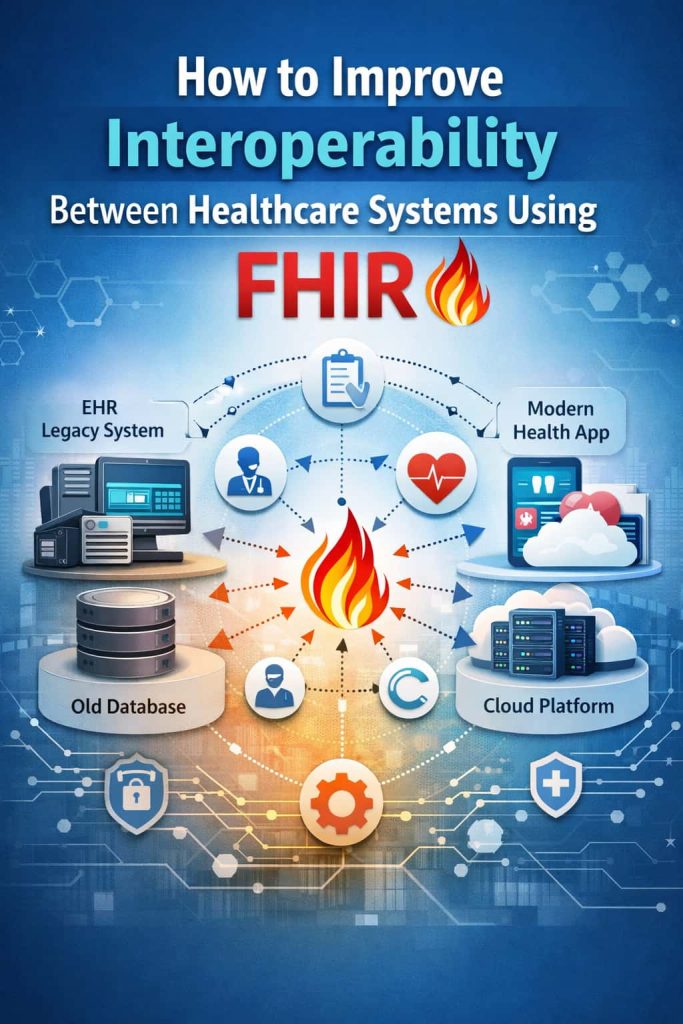
Interoperability remains one of the most critical challenges in modern healthcare IT. Despite significant digitization across the industry, many organizations still operate with fragmented systems that cannot communicate effectively. Electronic health records, laboratory systems, imaging platforms, billing tools, and external applications often exist in isolation, creating data silos that limit efficiency and compromise patient care.
The growing need for real-time, accurate, and secure data exchange has made interoperability a strategic priority rather than a technical afterthought. A modern solution to this challenge is the adoption of HL7 FHIR (Fast Healthcare Interoperability Resources), a framework designed to enable seamless communication between disparate healthcare systems. FHIR combines standardized data models with web-based APIs, making it one of the most effective tools for bridging legacy systems and modern healthcare platforms.
Understanding the Interoperability Challenge
Healthcare organizations face interoperability issues primarily due to the presence of legacy systems and inconsistent data standards.
- Many systems were built decades ago using proprietary architectures.
- Data is often stored in incompatible formats across departments.
- Communication between systems requires custom interfaces or manual processes.
These limitations result in several operational and clinical challenges:
- Fragmented patient records across multiple systems
- Delays in accessing critical clinical information
- Increased administrative burden due to manual data entry
- Higher risk of errors and duplicated procedures
Without a unified approach to data exchange, healthcare providers struggle to deliver efficient and coordinated care.
Why FHIR Is the Foundation of Modern Interoperability
FHIR introduces a modern, standardized approach to healthcare data exchange, addressing many of the limitations of legacy standards.
- FHIR is based on RESTful APIs, making it compatible with modern web technologies
- It uses lightweight data formats such as JSON and XML
- It organizes healthcare data into modular “resources” (e.g., Patient, Observation, Medication)
- It allows systems to access only the required data, improving efficiency
This architecture provides a flexible yet structured way to exchange information across systems, making integration significantly easier.
FHIR also enables incremental adoption, allowing organizations to modernize gradually rather than replacing entire systems at once. This is particularly important in healthcare development, where large-scale system replacements can be costly and risky.
Bridging Legacy Systems with FHIR
One of the most valuable applications of FHIR is its ability to connect legacy healthcare systems with modern infrastructure.
- Legacy systems can remain operational while FHIR acts as an integration layer
- Data from older systems is mapped into standardized FHIR resources
- APIs expose legacy data in a format that modern applications can consume
This approach enables organizations to:
- Avoid costly and disruptive system replacements
- Preserve existing data and workflows
- Introduce modern capabilities without interrupting operations
In essence, FHIR acts as a bridge that allows legacy systems to participate in a modern, interoperable ecosystem.
Standardizing Data Across Healthcare Systems
Data inconsistency is one of the biggest barriers to interoperability. FHIR addresses this by introducing standardized data structures.
- Each type of healthcare data is represented as a defined resource
- Data is stored and exchanged in a consistent format
- Systems interpret information in the same way, reducing ambiguity
This standardization leads to:
- Improved data quality and reliability
- Reduced duplication and errors
- Easier integration between systems
By aligning all systems around a common data model, organizations can ensure that information flows accurately and consistently across the entire healthcare ecosystem.
Enabling Real-Time Data Exchange with APIs
Traditional healthcare systems often rely on batch processing or manual data transfers, which can delay access to important information. FHIR changes this by enabling real-time data exchange.
- Systems communicate through API-based requests and responses
- Data is retrieved instantly when needed
- Applications can integrate directly into clinical workflows
This real-time capability allows healthcare providers to:
- Access up-to-date patient records during consultations
- View recent lab results and imaging data immediately
- Make faster and more informed clinical decisions
FHIR APIs also enable integration with mobile applications, telemedicine platforms, and patient portals, creating a more connected healthcare experience.
Enhancing Security and Compliance
Healthcare data is highly sensitive, making security and compliance essential in any interoperability strategy. FHIR supports modern security standards to ensure safe data exchange.
- Uses secure protocols such as HTTPS for encrypted communication
- Supports authentication and authorization mechanisms like OAuth 2.0
- Allows fine-grained access control for sensitive data
These features help organizations:
- Protect patient privacy and sensitive information
- Comply with regulations such as HIPAA and GDPR
- Maintain audit trails and data governance standards
By integrating security into its framework, FHIR ensures that interoperability does not come at the expense of data protection.
Supporting Scalable and Future-Ready Systems
FHIR is designed to support the evolving needs of healthcare organizations.
- Works well with cloud-based and microservices architectures
- Scales easily as data volumes and system complexity grow
- Supports integration with emerging technologies such as AI and IoT
This makes FHIR a future-ready solution that can adapt to:
- New healthcare applications and digital tools
- Increasing data demands
- Expanding organizational requirements
Organizations that adopt FHIR are better positioned to innovate and evolve without being constrained by legacy limitations.
Implementing FHIR in Healthcare Organizations
A successful FHIR implementation requires careful planning and a phased approach.
- Start by assessing existing systems and identifying integration points
- Define clear interoperability goals and use cases
- Introduce a FHIR-based integration layer for key workflows
- Gradually expand FHIR adoption across the organization
This incremental approach minimizes risk while delivering measurable improvements in interoperability. Over time, organizations can build a fully connected ecosystem where data flows seamlessly across all systems.
Conclusion
Improving interoperability between healthcare systems is no longer optional—it is essential for delivering high-quality, efficient, and patient-centered care. Legacy systems, while still widely used, create barriers that limit the flow of critical information. By adopting HL7 FHIR, healthcare organizations can overcome these barriers and establish a modern, standardized approach to data exchange.
FHIR enables organizations to bridge legacy systems, standardize data, enable real-time communication, and maintain strong security and compliance. Most importantly, it provides a flexible and scalable foundation for future innovation. As healthcare continues to evolve, FHIR stands out as a key enabler of interoperability and a critical component of next-generation healthcare IT systems.