
Published on
June 20, 2026

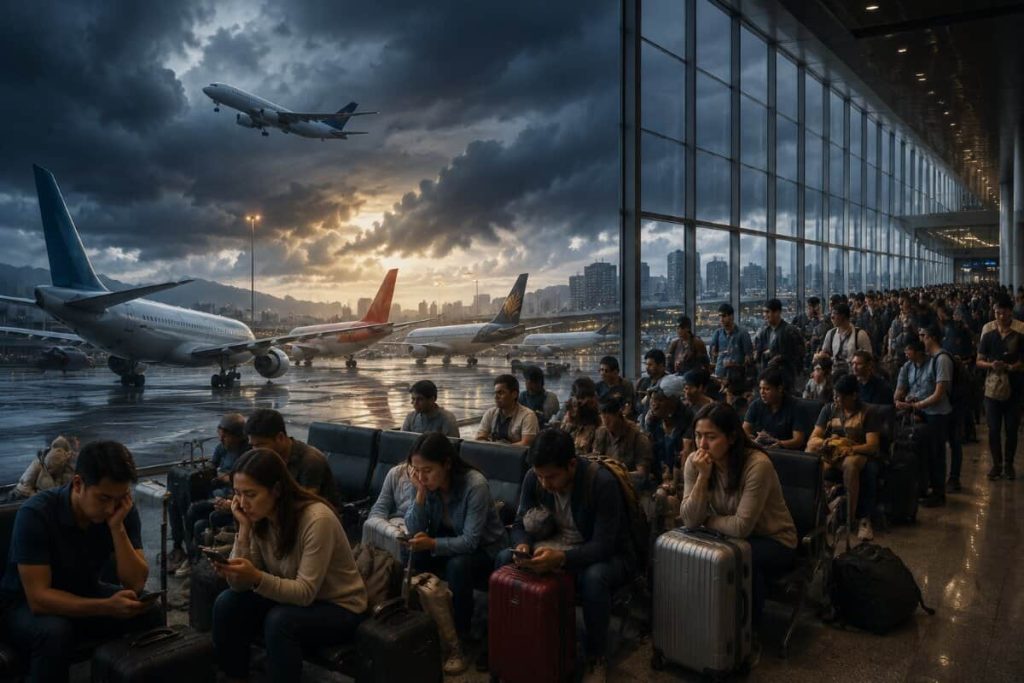
Image generated with Ai
Passengers across Indonesia, China and Japan faced a major wave of aviation disruption after Batik Air, China Eastern, Hainan Airlines, ANA Wings and Chengdu Airlines recorded 81 cancelled flights and 311 delayed flights, affecting 392 flight movements across busy Asian air networks.
The disruption placed pressure on airport operations, airline schedules and passenger travel plans. It also created wider concern for travellers moving through major Asian hubs toward Singapore, Malaysia and other regional destinations. The affected airlines operate across dense domestic and regional routes. So, even a single cancellation can quickly disturb aircraft rotations, crew schedules and connecting journeys.
The latest figures show that delays caused the largest share of disruption. Cancelled flights removed services from the schedule. Delayed flights kept passengers waiting at airports, unsure about boarding times, gate changes and onward connections.
Total Flight Disruption Overview
| Category | Total Number |
|---|---|
| Total Cancelled Flights | 81 |
| Total Delayed Flights | 311 |
| Grand Total Affected Flights | 392 |
| Airlines Affected | 5 |
| Main Countries Affected | Indonesia, China, Japan |
| Wider Regional Travel Concern | Singapore, Malaysia, Asia-Pacific connections |
The total impact reached 392 affected flight movements. This is a serious number because each cancelled or delayed service can affect hundreds of passengers. It can also affect baggage handling, airport counters, boarding gates, aircraft parking stands, and onward connections.
China Eastern faced the biggest pressure. The airline recorded 176 affected flights, including 20 cancellations and 156 delays. ANA Wings followed with 82 affected flights. Hainan Airlines reported 64 affected flights. Batik Air recorded 52 affected flights. Chengdu Airlines recorded 18 affected flights.
Airline-Wise Cancellation and Delay Table
| Airline | Cancelled Flights | Delayed Flights | Total Affected Flights | Main Impact Area |
| Batik Air | 20 | 32 | 52 | Indonesia domestic network |
| China Eastern | 20 | 156 | 176 | China domestic and hub routes |
| Hainan Airlines | 20 | 44 | 64 | China domestic network |
| ANA Wings | 18 | 64 | 82 | Japan domestic routes |
| Chengdu Airlines | 3 | 15 | 18 | China regional network |
| Grand Total | 81 | 311 | 392 | Asia-wide operational disruption |
China Eastern accounted for the largest share of delayed flights. Its 156 delays represented more than half of all delays among the five airlines. This made China Eastern the biggest contributor to the overall disruption count.
Advertisement
Advertisement
Batik Air, China Eastern and Hainan Airlines each recorded 20 cancellations. ANA Wings stood close behind with 18 cancellations. Chengdu Airlines had a smaller cancellation count, but its 15 delays still affected passengers on selected Chinese routes.
Share of Total Disruption by Airline
| Airline | Total Affected Flights | Share of 392 Total Affected Flights |
| China Eastern | 176 | 44.9% |
| ANA Wings | 82 | 20.9% |
| Hainan Airlines | 64 | 16.3% |
| Batik Air | 52 | 13.3% |
| Chengdu Airlines | 18 | 4.6% |
China Eastern carried the heaviest operational burden. Nearly 45% of all affected flights came from China Eastern alone. ANA Wings accounted for about 21%. Hainan Airlines accounted for more than 16%. Batik Air added more than 13%, while Chengdu Airlines made up just under 5%.
Advertisement
Advertisement
This shows that the disruption was not evenly spread. It was led by China Eastern delays, followed by ANA Wings and Hainan Airlines network pressure.
Indonesia Hit as Batik Air Cancels 20 Flights and Delays 32
Batik Air recorded 20 cancellations and 32 delays, bringing its total affected flights to 52. The airline’s disruption mainly affected Indonesia’s domestic network.
Jakarta-Soekarno-Hatta International Airport became one of the most important pressure points. Many cancelled flights either started from Jakarta or arrived there. This made Jakarta a central part of the disruption.
Batik Air’s affected routes included flights linked to Palembang, Pekanbaru, Batam, Surabaya, Semarang, Lombok, Medan, Solo, Jambi and Makassar. The disruption showed how Indonesia’s island-based air network can face strong pressure when multiple services face cancellation or delay on the same day.
Advertisement
Advertisement
Batik Air Cancellation Impact Table
| Airline | Cancelled | Delayed | Total Affected | Key Airports and Cities Affected |
| Batik Air | 20 | 32 | 52 | Jakarta, Palembang, Pekanbaru, Batam, Surabaya, Semarang, Lombok, Medan, Solo, Jambi, Makassar |
For passengers, this meant long airport waits, missed schedules and possible rebooking needs. Domestic travellers in Indonesia often depend on air travel because the country spans thousands of islands. A cancelled service can therefore create more serious inconvenience than a delay on a route with many easy ground options.
Passengers travelling through Jakarta faced a higher risk of connection issues. Jakarta is a major hub for domestic and international transfers. A delay at Jakarta can affect onward flights to other parts of Indonesia and regional destinations.
China Eastern Faces the Biggest Delay Pressure
China Eastern recorded 20 cancellations and 156 delays. With 176 affected flights, it became the most disrupted airline among the five carriers.
The airline’s cancellations affected many Chinese airports, including Shanghai Hongqiao, Shanghai Pudong, Beijing Capital, Beijing Daxing, Hangzhou, Wuhan, Nanjing, Kunming, Xi’an, Guangzhou, Xiamen, Qingdao, Taiyuan and Chengdu.
Shanghai played a major role in the disruption. Shanghai Hongqiao and Shanghai Pudong both appeared among affected points. Beijing also remained important, with both Beijing Capital and Beijing Daxing linked to disrupted services.
China Eastern Cancellation Impact Table
| Airline | Cancelled | Delayed | Total Affected | Key Airports and Cities Affected |
| China Eastern | 20 | 156 | 176 | Shanghai, Beijing, Hangzhou, Wuhan, Nanjing, Kunming, Xi’an, Guangzhou, Xiamen, Qingdao, Taiyuan, Chengdu |
The 156 delays were especially important. Delays can spread across an airline’s network throughout the day. A late aircraft can delay its next route. A late crew can delay another departure. A delayed arrival can cause passengers to miss onward flights.
Advertisement
Advertisement
This creates a chain reaction. It can affect check-in counters, boarding gates, aircraft stands and baggage delivery. Passengers flying through major Chinese hubs may therefore need extra time and stronger backup plans.
Hainan Airlines Disruption Hits Haikou, Guangzhou, Xi’an and Shenzhen
Hainan Airlines recorded 20 cancellations and 44 delays, creating 64 affected flights. The airline’s disruption touched important Chinese cities such as Haikou, Guangzhou, Xi’an, Guilin, Hangzhou, Zhengzhou, Changsha, Ningbo, Harbin, Tianjin, Shenzhen, Shanghai, Beijing and Nanning.
Haikou Meilan International Airport stood out as a key affected airport. Haikou is an important gateway for Hainan Island. Any disruption there can affect both local passengers and leisure travellers.
Hainan Airlines Cancellation Impact Table
| Airline | Cancelled | Delayed | Total Affected | Key Airports and Cities Affected |
| Hainan Airlines | 20 | 44 | 64 | Haikou, Guangzhou, Xi’an, Guilin, Hangzhou, Zhengzhou, Changsha, Ningbo, Harbin, Tianjin, Shenzhen, Shanghai, Beijing, Nanning |
The disruption placed pressure on passengers travelling between southern China, northern China and major eastern cities. Flights linking Haikou with Guangzhou, Beijing, Hangzhou and Zhengzhou are important for tourism, trade and family travel.
When these routes face cancellation, passengers may need to move to later flights or search for alternative connections. This can raise travel stress, especially for families, elderly passengers and those travelling for urgent business.
Japan Domestic Travel Hit as ANA Wings Cancels 18 Flights and Delays 64
ANA Wings recorded 18 cancellations and 64 delays. Its total affected flights reached 82. This made it the second most affected airline in the overall disruption count.
Advertisement
Advertisement
The airline’s affected flights were mainly within Japan. Important airports included Tokyo Haneda, Hachijojima, Kushiro, New Chitose, Hakodate, Aomori, Osaka Itami, Fukuoka and Tsushima.
ANA Wings Cancellation Impact Table
| Airline | Cancelled | Delayed | Total Affected | Key Airports and Cities Affected |
| ANA Wings | 18 | 64 | 82 | Tokyo Haneda, Hachijojima, Kushiro, New Chitose, Hakodate, Aomori, Osaka Itami, Fukuoka, Tsushima |
Tokyo Haneda remained a key point because it is one of Japan’s busiest domestic hubs. New Chitose serves Hokkaido. Fukuoka is a major gateway in southern Japan. Osaka Itami is important for domestic travel. Smaller airports such as Tsushima, Kushiro, Hakodate and Hachijojima depend heavily on stable air links.
For regional and island passengers, cancellations can be more difficult. There may be fewer same-day alternatives. Some passengers may need to wait for the next available flight, while others may need to use rail, road or ferry connections where possible.
Chengdu Airlines Adds More Pressure to China’s Regional Network
Chengdu Airlines recorded 3 cancellations and 15 delays, giving it 18 affected flights. The count was smaller than the other airlines, but the effect still mattered for passengers booked on impacted routes.
Chengdu Airlines Cancellation Impact Table
| Airline | Cancelled | Delayed | Total Affected | Main Impact |
| Chengdu Airlines | 3 | 15 | 18 | China regional flight operations |
Even a small number of cancellations can disturb passengers when route frequency is limited. Delays can also affect aircraft rotations. If the same aircraft operates multiple daily sectors, one delay may affect later services.
Chengdu Airlines’ disruption added to the wider pressure already visible in China’s domestic air travel system.
Advertisement
Advertisement
Major Airports and Cities Affected
| Country | Main Cities and Airports Affected | Travel Impact |
| Indonesia | Jakarta, Palembang, Pekanbaru, Batam, Surabaya, Semarang, Lombok, Medan, Solo, Jambi, Makassar | Domestic passengers faced cancellations, delays and rebooking pressure |
| China | Shanghai, Beijing, Hangzhou, Wuhan, Nanjing, Kunming, Xi’an, Guangzhou, Haikou, Shenzhen, Xiamen, Qingdao, Chengdu | Large domestic network faced heavy delay pressure |
| Japan | Tokyo, Fukuoka, Osaka, New Chitose, Hakodate, Aomori, Kushiro, Tsushima, Hachijojima | Regional and domestic passengers faced schedule disruption |
| Singapore | Regional travellers connecting through Asia faced possible onward travel pressure | Indirect impact through Asia-Pacific connections |
| Malaysia | Passengers connecting via regional hubs faced schedule uncertainty | Indirect impact through regional aviation links |
The strongest direct impact was visible in Indonesia, China and Japan. Singapore and Malaysia appeared more as wider regional concern points because travellers often connect through major Asian hubs for onward travel.
Why Flights May Be Cancelled or Delayed
Airlines can cancel or delay flights for many operational reasons. The exact cause can differ by flight, airline and airport. Passengers should always check the latest airline notice for their specific flight.
Common causes include bad weather, storms, low visibility, air traffic restrictions, late-arriving aircraft, aircraft rotation problems, crew duty limits, technical checks, airport congestion and runway capacity pressure.
Common Causes of Flight Disruption
| Possible Cause | How It Affects Flights |
| Bad weather | Can reduce take-off and landing capacity |
| Low visibility | Can slow airport operations and increase spacing between aircraft |
| Thunderstorms | Can force ground delays or route changes |
| Late-arriving aircraft | Can delay the next scheduled departure |
| Aircraft rotation issues | One delayed flight can affect several later flights |
| Crew duty limits | Crews may run out of legal operating time after long delays |
| Technical checks | Aircraft may need inspection before departure |
| Air traffic restrictions | Flights may wait for clearance or revised slots |
| Airport congestion | Gates, runways and taxiways can become overloaded |
| Rebooking pressure | Cancelled passengers may fill later flights quickly |
Aviation disruption often works like a chain. One late inbound aircraft can delay the next flight. That delay can then affect another route. If the aircraft or crew cannot recover enough time, an airline may cancel a later service to reset the schedule.
This is why delays can sometimes become more damaging than cancellations. A cancellation affects one flight directly. But a delay can spread across many later flights.
Passenger Tips During the Disruption
Passengers should act early and avoid waiting until they reach the airport. They should check airline apps, airport websites and booking messages before leaving home or hotel.
Advertisement
Advertisement
Travellers with cancelled flights should contact the airline or booking agent quickly. They should ask for the next available flight, refund rules, rebooking support and hotel assistance where applicable.
Passengers with connecting flights should ask the airline to protect onward journeys. They should not rely only on airport screens. They should also check mobile alerts and email updates.
Passenger Action Table
| Passenger Situation | What Travellers Should Do |
| Flight cancelled | Contact the airline or travel agent for rebooking or refund options |
| Flight delayed | Monitor gate screens, app alerts and airport announcements |
| Missed connection risk | Ask the airline to protect the next connection |
| Travelling with family | Keep food, medicine, chargers and key documents in hand luggage |
| Urgent travel | Look for earlier alternate flights or nearby airport options |
| Long airport wait | Keep receipts for food, hotel or transport claims |
| Baggage checked in | Speak to airline staff before leaving the airport |
| Travel insurance held | Save cancellation notices and delay proof |
| International connection | Check visa, transit and arrival rules before accepting rerouting |
Passengers should keep boarding passes, booking references, cancellation notices and receipts. These documents may help with claims or insurance support.
They should also avoid very tight connections during periods of disruption. A longer connection time can reduce the risk of missed flights. Families, elderly passengers and travellers with medical needs should carry essential items in cabin baggage.
What This Means for Asian Travel
The disruption shows how deeply connected Asian aviation has become. A delay in Shanghai, Jakarta, Beijing or Tokyo can affect passengers far beyond one airport. Large hubs feed domestic, regional and international networks. So, schedule pressure can move quickly from one route to another.
Indonesia depends heavily on air travel because of its island geography. China has one of the world’s largest domestic aviation markets. Japan relies on strong domestic air links between major cities, regional airports and island communities. When all three markets face disruption at the same time, the effect becomes wider.
Advertisement
Advertisement
Travellers heading toward Singapore, Malaysia or other Asia-Pacific destinations may also face indirect pressure if their first flight is delayed or cancelled before an onward connection.
Conclusion
The combined 81 cancellations and 311 delays across Batik Air, China Eastern, Hainan Airlines, ANA Wings and Chengdu Airlines created a serious aviation disruption across Asia. The total impact reached 392 affected flights.
China Eastern faced the greatest disruption with 176 affected flights. ANA Wings followed with 82. Hainan Airlines recorded 64. Batik Air recorded 52. Chengdu Airlines recorded 18.
The most affected travel markets were Indonesia, China and Japan. Major cities and airports such as Jakarta, Shanghai, Beijing, Haikou, Hangzhou, Tokyo Haneda, Fukuoka, New Chitose and Surabaya saw clear passenger impact.
Passengers should check their flight status early, keep documents ready, contact airlines quickly and allow extra time for airport movement. They should also avoid tight connections where possible.
The disruption proves one clear point. In modern Asian aviation, cancellations and delays do not stay isolated. They move through networks, affect airports, disturb passengers and reshape travel plans across borders.ations and delays can spread across Asian aviation networks. When major airports such as Jakarta, Shanghai, Beijing, Haikou and Tokyo Haneda feel pressure, the impact can move far beyond one airline or one city.
Advertisement
Advertisement
Author’s Observation:
All flight cancellation and delay details have been manually reviewed from FlightAware’s official platform. As flight operations are updated in real time, schedules may change at any moment. Airlines often revise routes, timings and itineraries to protect passenger safety and maintain operational stability. Travellers are advised not to panic during such disruptions. Instead, they should monitor live flight updates, check airline rebooking policies, stay in contact with their carrier, and keep alternative travel options ready. Flexibility, patience and reliance on verified real-time information remain essential for reaching destinations safely.
Source: Different airports and FlightAware
Advertisement
Advertisement
