
Published on
July 18, 2026

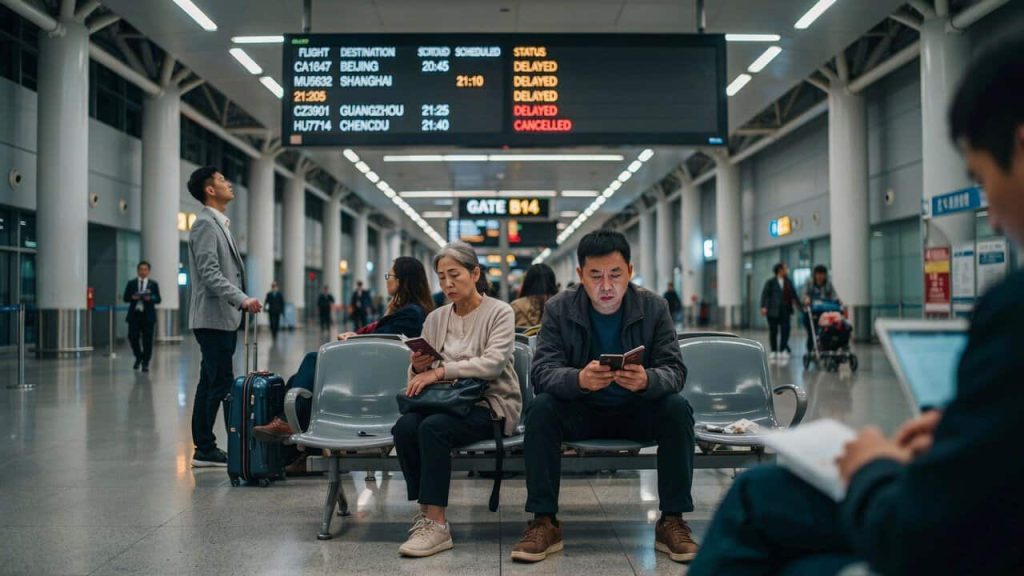
Image generated with Ai
China’s aviation network is facing widespread flight disruption as airports in Beijing, Guangzhou, Shanghai, Haikou and Wuhan record major operational challenges, with 63 flights cancelled and 2,760 flights delayed. The disruption is affecting passengers travelling across China, with major carriers including China Eastern, China Southern Airlines, Spring Airlines, Tibet Airlines and other airlines experiencing schedule interruptions. Shanghai Pudong, Beijing Capital, Beijing Daxing, Guangzhou Baiyun and other major hubs have reported the highest impact. Meanwhile, severe weather conditions, including storms and heavy rainfall affecting parts of China, have recently contributed to aviation disruptions across several regions, forcing airlines and airports to adjust operations. Travellers are facing delays, cancellations and possible connection problems as airlines work to restore normal flight schedules across the country.
What is causing major flight disruptions across China’s airports?
China’s airport network has experienced uneven operational pressure, with some of the country’s busiest aviation hubs reporting hundreds of delayed flights. The latest disruption data shows that large international gateways and major domestic airports have been among the most affected locations.
Shanghai Pudong International Airport (PVG) recorded the highest number of delays among the listed airports, with 506 delayed flights and 10 cancellations. As one of China’s busiest international aviation gateways, disruption at Shanghai Pudong can affect both domestic connections and international travel flows.
Beijing Capital International Airport (PEK) also faced significant operational challenges, reporting 316 delays and 8 cancellations. Meanwhile, Beijing Daxing International Airport (PKX) recorded 274 delayed flights and 6 cancellations, adding further pressure to the capital city’s aviation system.
Advertisement
Advertisement
Other major airports affected included Guangzhou Baiyun International Airport (CAN) with 242 delays and 2 cancellations, Xi’an Xianyang International Airport (XIY) with 220 delays and 5 cancellations, and Haikou Meilan International Airport (HAK) with 202 delays and 4 cancellations.
The disruption extended across several other important Chinese cities. Wuhan Tianhe International Airport (WUH) reported 215 delays and 3 cancellations, while Qingdao Jiaodong International Airport (TAO) recorded 215 delays and 4 cancellations. Jieyang Chaoshan International Airport (SWA) experienced 148 delays and 4 cancellations, while Dalian Zhoushuizi International Airport (DLC) reported 133 delays and 6 cancellations.
Advertisement
Advertisement
Additional affected airports included Nanning Wuxu International Airport (NNG) with 125 delays and 2 cancellations, Changsha Huanghua International Airport (CSX) with 91 delays and 2 cancellations, Korla Airport (KRL) with 39 delays and 4 cancellations, and Lhasa Gonggar Airport (LXA) with 34 delays and 3 cancellations.
Which Chinese cities and airports are experiencing the biggest impact?
The disruption has been concentrated around China’s largest aviation centres, particularly Shanghai and Beijing, where passenger volumes and connecting traffic create a wider impact when operations slow.
Advertisement
Advertisement
Shanghai has emerged as the most affected city based on the available data, with Shanghai Pudong International Airport recording the highest number of delayed flights. The scale of disruption at the airport could create knock-on effects for travellers connecting through one of China’s most important international gateways.
Beijing has also experienced considerable pressure, with both Beijing Capital International Airport and Beijing Daxing International Airport reporting high delay numbers. Together, the two airports represent a major share of air traffic serving China’s political and business capital.
Southern China has also seen notable disruption, with Guangzhou Baiyun International Airport reporting more than 240 delays. Other regional airports, including Haikou, Wuhan, Qingdao and Xi’an, have also experienced significant operational challenges, affecting travellers moving between major tourism, business and regional centres.
Which airlines are most affected by China’s flight disruption?
Several Chinese airlines have reported substantial operational disruption, with the highest number of delayed flights recorded among some of the country’s largest carriers.
Advertisement
Advertisement
China Eastern recorded the highest level of disruption among the listed airlines, with 879 delayed flights and 14 cancellations. The airline operates extensive domestic and international services, making delays across its network particularly significant for travellers.
China Southern Airlines reported 724 delays and 6 cancellations, while Air China recorded 420 delayed flights and 9 cancellations. These three major carriers represent a large portion of China’s aviation market and have experienced widespread schedule interruptions.
Other airlines affected include Hainan Airlines, which reported 254 delays and 3 cancellations, and Shenzhen Airlines, which recorded 299 delays and 1 cancellation.
Additional disruption was reported by China Express Airlines with 149 delays and 11 cancellations, Spring Airlines with 149 delays and 4 cancellations, and Tianjin Airlines with 141 delays and 6 cancellations.
Regional carriers also experienced delays, including Chengdu Airlines with 75 delays and 4 cancellations, Tibet Airlines with 71 delays and 2 cancellations, Qingdao Airlines with 39 delays and 2 cancellations, Beijing Airlines with 3 delays and 2 cancellations, Lucky Air with 107 delays and 1 cancellation, and West Air with 72 delays and 1 cancellation.
What should passengers do if their China flight is delayed or cancelled?
- Passengers affected by the disruption should closely monitor their flight status before travelling to the airport. Checking airline notifications, airport updates and booking platforms can help travellers identify schedule changes early.
- Travellers facing delays should allow additional time for airport procedures, including check-in, security screening and possible rebooking queues. Those with connecting flights should confirm whether their onward journey remains available, especially when travelling through major hubs such as Shanghai Pudong, Beijing Capital or Beijing Daxing.
- Passengers whose flights have been cancelled should contact their airline directly for available alternatives, including rebooking options or updated travel arrangements. Keeping all booking documents, confirmation details and communication records can help during the recovery process.
- Travellers should also prepare for longer waiting times at affected airports and remain flexible with their travel plans until operations stabilise.
China’s aviation network faces widespread pressure
The latest disruption data highlights significant pressure across China’s aviation system, affecting major airports, regional hubs and multiple airlines. With 2,760 delayed flights and 63 cancellations reported across the listed airports, passengers travelling through affected cities may continue to experience schedule changes.
Advertisement
Advertisement
Shanghai, Beijing, Guangzhou, Xi’an, Haikou, Wuhan and Qingdao have recorded some of the highest impacts, while China Eastern, China Southern Airlines and Air China have experienced the largest operational disruptions among carriers. Travellers are advised to remain updated with airline and airport information as China’s aviation network works to restore normal schedules.
Data Verification Notice
The Data is extensively curated by me with figures derived from Flightaware dated 17 July 2026, 4:12 pm ET USA
Primary Source: Real-time data aggregated via FlightAware.
Verification Protocol: Statistics are cross-checked by our human editorial desk. Timestamped logs and feed snapshots are securely archived internally to maintain historical accuracy.
Note: Real-time tracking figures represent active airspace data and may experience minor variances from local airport terminal gates.
Travelers are advised to check respective airline and airports for more latest information and updates
Advertisement
Advertisement
