

Celebrations to mark the Duanwu Festival (Dragon Boat Festival) have been held with a blend of traditional and modern spectacles, featuring dragon boat races and folk performances, in Anju Ancient Town in Tongliang, the homeland of the dragon, in the southwestern Chinese municipality of Chongqing.
The Duanwu Festival is celebrated on the fifth day of the fifth month on the Chinese lunar calendar. This year, it fell on June 19.
Traditional dragon boat races remain essential to the celebrations. At the sound of the starting whistle, rowers paddle vigorously toward the finish line amid cheering crowds. The races have inspired another competition, known as the duck-catching contest, where firecrackers signal a race to catch ducks thrown into the water as the leading dragon boat approaches.
“Everyone has his own job on weekdays, but we make time to keep training. We’re not doing it for rankings — merely to carry on the Anju dragon boat tradition,” said Tao Kangyong, a member of the dragon boat team.
In addition, other performances were also staged, including stunts featuring a dragon dance, jet skis, and powered paragliders. Drones were used to make several lifelike dragons fly gracefully in the sky, creating a spectacular visual feast.
“The experience was fantastic. There is a strong festive atmosphere. I truly felt the charm of the traditional culture of the Dragon Boat Festival,” said Zhou Li, a tourist.
As night falls, the ancient town treats visitors to a dazzling array of folk performances.

Chongqing lures visitors with traditional, modern spectacles in Duanwu Festival
Ceremonies worshiping Fuxi, a mythical ancestor of the Chinese nation, took place simultaneously in the city of Tianshui, northwest China’s Gansu Province and in the New Taipei City of China’s Taiwan region on Sunday.
It’s the 13th consecutive year that people on both sides of the Taiwan Strait have paid tribute to Fuxi.
Fuxi is widely seen as a key ancestral figure of the entire Chinese nation, and ceremonies honoring him carry on a shared cultural memory, spiritual heritage, and emotional identity.
The annual commemoration of Fuxi has a history of more than 2,000 years. It was listed as a form of national intangible cultural heritage in 2006.
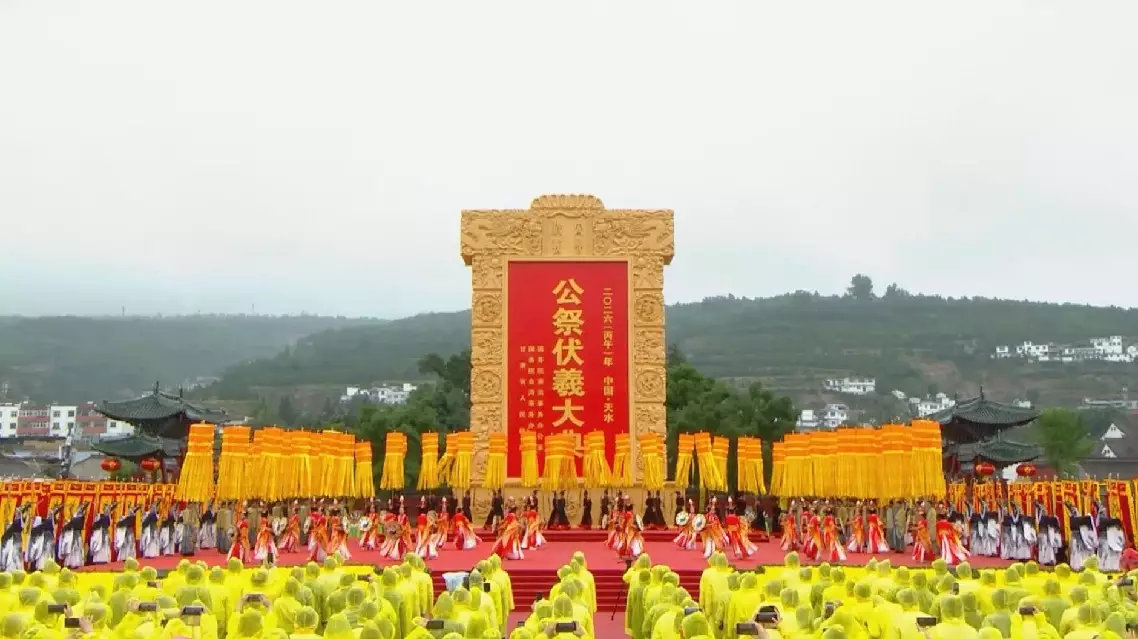
Mythical Chinese ancestor Fuxi worshiped across Strait