
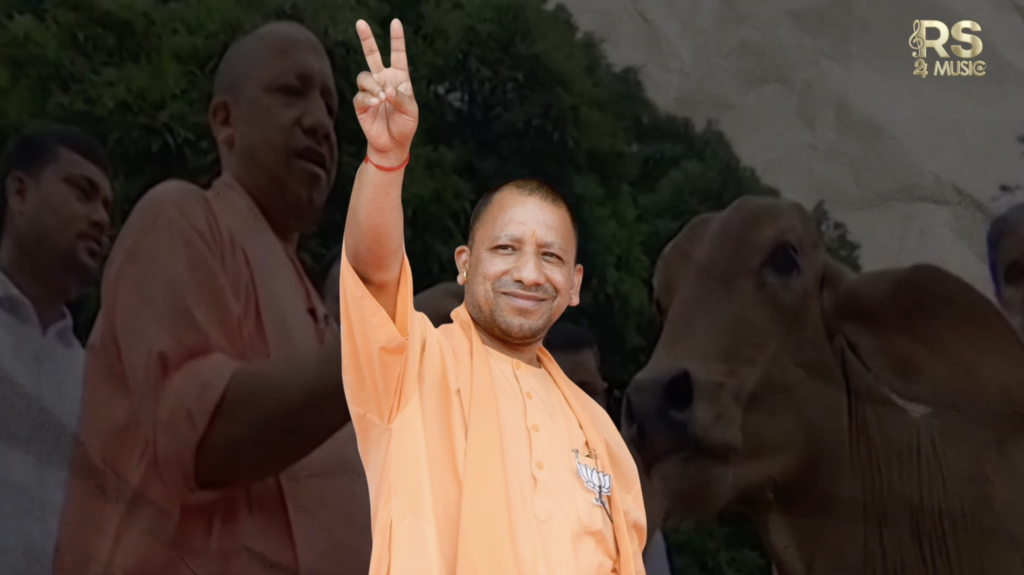
Yogi Adityanath’s face fills the screen before a single lyric is sung. The Hindu monk-turned-politician, who governs India’s most populous state, is pictured as dramatic music swells beneath images of cows, saffron flags and Hindu nationalist iconography. Then comes the threat.
In “Gau Mata” (“Mother Cow”) posted on YouTube, singer Biru Kataria warns India’s Muslims that anyone who slaughters a cow will be hunted down, burned alive and cut to pieces. The song repeatedly uses the slur “katwein,” a derogatory reference to circumcision, to describe Muslims.
Adityanath is among the most recognizable faces of India’s Hindu nationalist movement. He has championed aggressive cow-protection policies as cow vigilantism, where mobs attack people they accuse of slaughtering cows, considered sacred by Hindus, has been linked to the killings and lynchings of dozens of Muslims. Today, multiple versions of this track remain available on YouTube, and it has been used to create more than 40,000 Instagram reels.
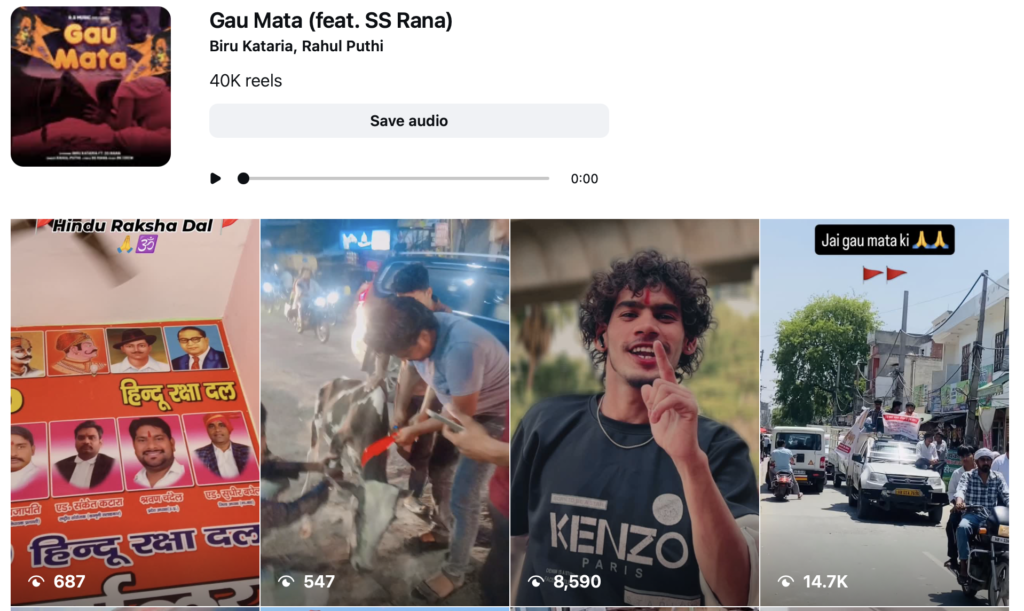
Hate music is often amplified online when it is reshared and reused by other creators.
In India, music engineered to dehumanize religious minorities reaches hundreds of millions of listeners, delivered by big tech companies across popular social media platforms. Known as Hindutva pop, or H-Pop, the genre is rooted in Hindu nationalist ideology, a far-right supremacist belief that India is fundamentally a Hindu nation whose culture, politics and public life should be defined by its Hindu majority. Across hundreds of songs, India’s Muslims and Christians are portrayed as enemies, invaders, traitors, demographic threats and legitimate targets of violence.
A new report by the Center for the Study of Organized Hate (CSOH), a Washington-based research organization, argues that this ecosystem of hate music is being hosted, amplified and monetized by four of the world’s largest digital platforms: YouTube, Spotify, Apple Music and Meta.
The report, “Profiting From Hate Music,” documents what researchers describe as the first comprehensive mapping of hate music across India’s digital landscape. It identifies 523 songs that promote hatred, dehumanization, conspiracy theories or violence against religious minorities, primarily Muslims and Christians, in violation of platforms’ content policies.
To test how and whether platforms were enforcing their rules on hateful or violent content, researchers reported a sample of 225 songs using the companies’ own moderation systems. Only 18 were removed. More than 90% percent of flagged songs stayed online.
“Even after reporting the content, most of it is still up after six or seven months, and it’s not only up, it’s still running advertisements,” said Tavishi Ahluwalia, a researcher specializing in digital harms and extremism who worked with CSOH on the report.
Nearly half of the songs analyzed by researchers contained direct threats of violence or explicit incitement against religious minorities, a large number of them (104) hosted by YouTube.
READ MORE: For far-right groups in India, Instagram has become a place to promote violence, report shows
The songs have amassed enormous audiences. On YouTube alone, the videos documented in the report have collectively attracted more than 198 million views. On Meta’s Music Library, the same tracks have been incorporated into more than 5.9 million Instagram Reels.
“This is content that should not have been there in the first place. It should have been proactively monitored by the platforms,” Ahluwalia said.
The findings reveal something larger than isolated violations of platform rules, Ahluwalia said. Together, the songs represent part of a sprawling cultural industry that has flourished alongside the rise of Hindu nationalism in India, an ideology championed by Indian Prime Minister Narendra Modi’s political party, the Bharatiya Janata Party (BJP). Modi’s 12-year rule has been marked by democratic backsliding, and an increased repression of its religious minorities, especially its Muslim citizens. Muslims face increasing persecution, as documented by Amnesty International and others, and the Modi government is accused of adopting discriminatory policies.
Spotify and Apple Music did not return PBS News’ requests for comment on the report and violations of its policies.
Meta did not offer comment on the report.
YouTube said its policies don’t allow hate speech, it consistently takes action against hate speech on its platform and it has set a higher bar for what can make money on Youtube. A”We are reviewing the examples raised in the study and will remove any content that violates our policies,” a Youtube spokesperson told PBS News.
Globally, far-right extremist groups rely on hate music to propagate their message, said Susan Benesch, founder and director of the Dangerous Speech Project.
“People can feel that, because of the lyrics and the propaganda that come with that music, that they are part of a group. Hate music is hate speech on steroids. It is dangerous speech with an extra capacity to inspire harm,” Benesch said.
Benesch is a part of Spotify’s Safety Advisory council, an external group of subject matter experts. When Spotify has consulted her about specific songs in the past, “I have said I think this is inciting genocide, justifying and assigning genocide,” she said.
What the report found
Researchers say H-pop is the soundtrack for majoritarian politics, delivered through recommendation engines, monetized through advertising systems and embedded into millions of users’ daily digital lives. Part campaign tool, part cultural product and part identity marker, the genre packages majoritarian politics into catchy hooks, folk rhythms and highly shareable videos. The songs often celebrate Hindu power, invoke historical grievances, frame religious minorities as existential threats to the nation and call for violence against them.
In many cases, the narratives mirror themes that have circulated for decades within Hindu nationalist discourse: that Muslims are outsiders despite centuries of belonging to the subcontinent; that Christians are agents of conversion conspiracies, that demographic change threatens Hindu survival and that violence may be necessary to defend the nation.
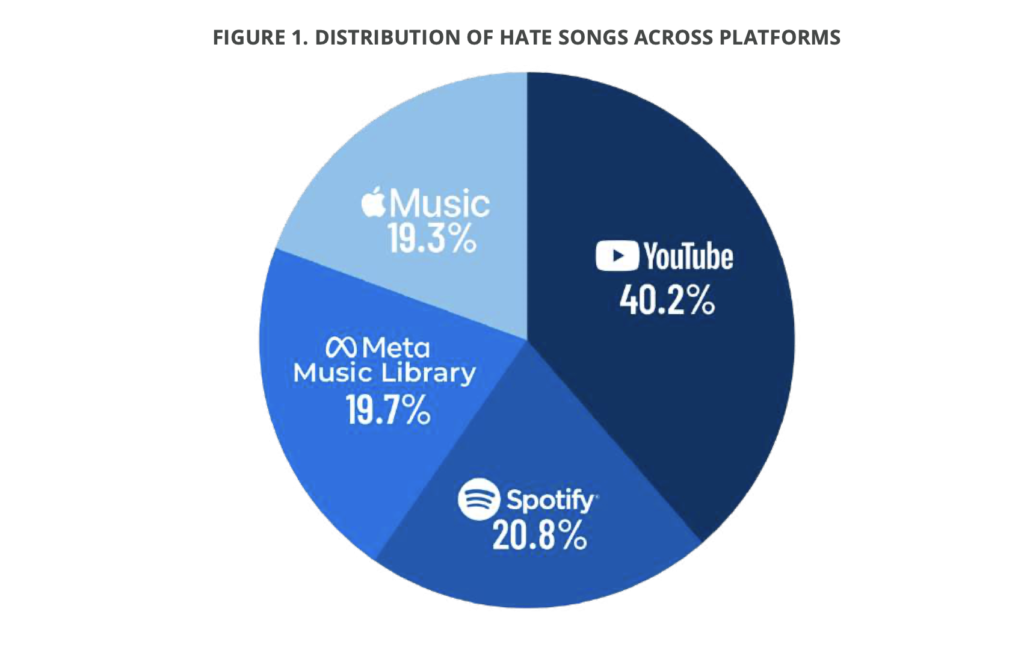
A graphic from the report details the distribution of hate music across popular social media and video platforms.
The report documents dozens of examples. On YouTube, “Cheer Ke Rakh Denge” (“We Will Rip You Apart”) warns Muslims to leave India or face violence. The song draws on a familiar trope within Hindu nationalist discourse that portrays Indian Muslims as foreigners, despite the country being home to roughly 200 million people, one of the world’s largest Muslim populations.
“Jago Hindu Jago” (“Wake Up, Hindu”), available on Spotify, accuses India’s Muslim and Christian communities of forcibly converting Hindus.
Researchers found YouTube channels carry hate songs while displaying verified badges, including one channel that received the platform’s Silver Creator Award, given to those that pass 100,000 subscribers. More than half of the hate-song videos identified in the study had YouTube’s “Super Thanks” feature enabled, allowing viewers to financially support creators directly.
“What they’re saying to their audience is, ‘look, I am singing all of these songs, which are hateful, and which call for violence against Muslims and Christians, and YouTube believes that I am good enough to be awarded for it,” said Kunal Purohit, journalist and author of “H-Pop: The Secretive World of Hindutva Pop Stars.”
He pointed out that this can create the impression that the platform accepts or endorses the rhetoric being promoted by the singer.
“There is a very active sense of validation,” he said.
Researchers also documented advertisements from 103 brands appearing alongside hate-music videos on YouTube. Among them were advertisements for ChatGPT, NotebookLM, Amazon Prime, Adobe, Dell, Levi’s and Kellogg’s. According to the report, advertisements appeared on the majority of the hate videos that were reviewed, including 83 percent of those containing explicit calls for violence.
Meta’s platforms displayed similar patterns. Of the 30 prominent hate-music artists examined by researchers, 20 had monetized Facebook accounts.
The report’s findings raise questions for technology companies that publicly promote commitments to safety, inclusion and human rights while simultaneously profiting from content that appears to violate their own policies.
“There is this lack of transparency, and we do not have enough information on how this entire network of monetization operates,” Ahluwalia of CSOH said. “There are multiple levels of failure of accountability, proactive content moderation is not working, and even after users report content there is very little transparency,” she said.
The soundtrack of majoritarian politics
As Purohit documented in his book, the industry has evolved into a sophisticated ecosystem of singers, producers and influencers, whose content reaches audiences far beyond traditional political spaces. Political propaganda and violent extremism have become entertainment.
“The act of political radicalization no longer requires a political space,” he said. “It follows you wherever you go. You can be radicalized in the comfort of your home while listening to this song, while driving to work, while sitting in your workplace, or even in a shop when the song plays,” Purohit said.
Religious songs, devotional performances and public processions have historically played an important role in political mobilization across India. But the emergence of cheap smartphones, social media platforms and algorithm-driven recommendation systems transformed that tradition into something far more expansive.
“The internet has allowed you to just create that song in three hours, put it up on the internet, and it might just blow up and reach millions of people in the next few hours,” Purohit said.
Purohit has traveled across multiple states researching his book and documenting the genre’s grassroots. What has changed most, he said, is that H-Pop can no longer be dismissed as a niche phenomenon; it transcends class and geographical barriers in India.
Different standards
The findings arrive as India sees a broader debate over platform accountability. In Europe, regulations such as the EU’s Digital Services Act have imposed new obligations on major technology companies to keep a check on illegal content, disinformation and hate speech. Similar scrutiny from regulators, lawmakers and civil society groups has pushed platforms to devote significant resources to content moderation and transparency in many Western markets.
India, by contrast, lacks a comparable regulatory framework specifically focused on platform accountability for harmful online content. Purohit said tech platforms appear highly responsive to government requests to take down content that may be critical of the government, even when that content does not violate their community standards and is not unlawful. “But the same platforms seem willing to turn a blind eye when Hindutva pop creators and other hate-content producers flourish on their platforms. The contrast is difficult to ignore,” he said.
CSOH argues that the issue is no longer just the existence of hate music online, but the failure of platforms to enforce their own rules. The report calls for stronger moderation of repeat offenders, better detection of coded hate speech, greater transparency around monetization and content moderation, and independent scrutiny of recommendation algorithms that amplify harmful content. Without meaningful action, it warns, Hindutva pop will continue to spread at scale, reaching millions of listeners while the platforms that host and profit from it face little accountability.