
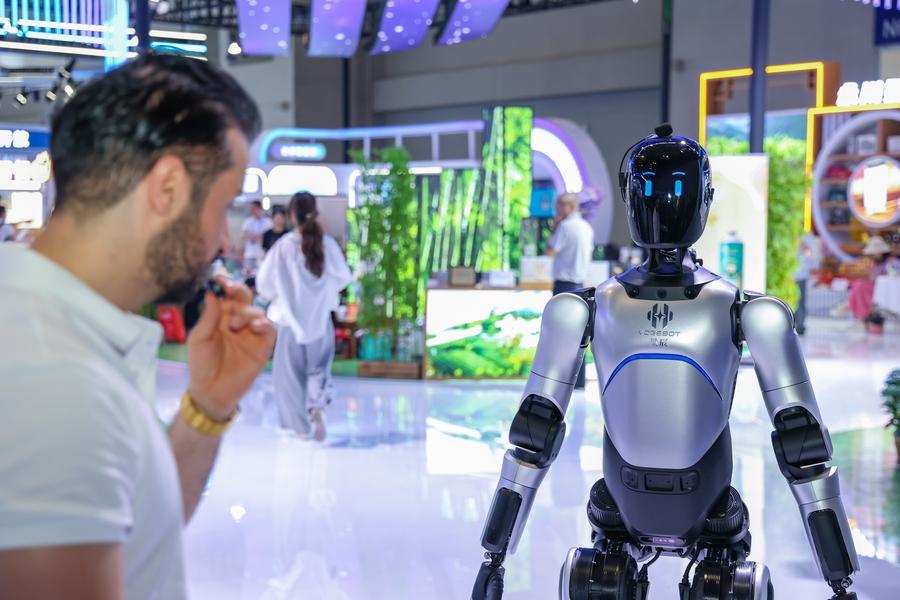
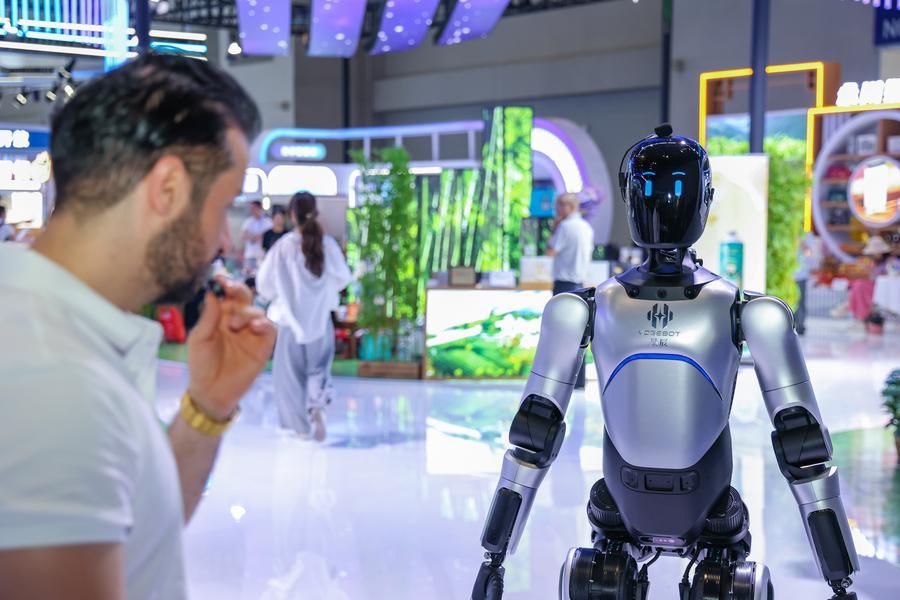
CHONGQING, May 22 (Xinhua) — A dual-arm robot precisely and rapidly assembled components into laptop modules with remarkable accuracy at the Eighth Western China International Fair for Investment and Trade.
The scene astounded many and revealed a larger transition taking place in Chongqing Municipality, the fair’s host city in southwest China, where artificial intelligence (AI) is altering local production in a digital and intelligent manner.
Themed “New Western China, New Manufacturing, New Services,” the event opened in Chongqing on Thursday and will run until Sunday, attracting nearly 1,400 enterprises from 50 countries and regions.
For highly precise and repetitive tasks, prolonged manual work is prone to errors. By integrating intelligent algorithms, robots can significantly improve the stability and consistency of product manufacturing, said Cheng Yuan, a test engineer at Chongqing Huashu Robotics Co., Ltd., the manufacturer of the exhibited robot.
AI is not only improving productivity but also enhancing safety and working conditions in industrial environments, freeing workers from harsh, hazardous settings.
In many industrial plants, workers face hazards such as falling objects and heavy dust, making manual transportation potentially dangerous.
To address these challenges, New Generation (Chongqing) Intelligent Equipment Technology Co., Ltd has developed intelligent transportation vehicles equipped with AI-powered perception and obstacle-avoidance systems, allowing for autonomous navigation in complex industrial environments. Customized algorithms are also developed in response to specific client requirements, allowing the vehicles to operate safely in dusty or humid factories, according to the company’s software engineers.
Similar AI-driven improvements are transforming other heavy industries as well. CISDI Information Technology (Chongqing) Co., Ltd is focusing on AI-based upgrades in the steel industry, using its self-developed AI platform to not only improve production quality but also free workers from dangerously hot and potentially harmful environments.
The platform, combined with intelligent cameras and deep-learning algorithms, is capable of performing tasks such as raw material screening, flame recognition and rolling-process control, covering more than 100 application scenarios across the entire steel production process.
“In the past, workers had to wear protective goggles and directly observe flames reaching temperatures of 1,500 degrees Celsius to 1,600 degrees Celsius,” said Pang Shuyang, an AI engineer at CISDI Information. He added that the company now uses machine-vision cameras and AI algorithms instead of human eyes, achieving accuracy rates of over 99 percent.
“To truly empower industries, AI requires not only algorithms, computing power and data, but also rich real-world application scenarios, talent pools and an open, collaborative ecosystem,” said Zhang Chengqi, chair professor of AI at the Hong Kong Polytechnic University, in his opening remarks at the fair.
Encompassing all 31 major manufacturing categories of China, Chongqing provides favorable conditions for enterprises to pursue smart manufacturing and digital transformation.
At the Seres Super Factory in Chongqing, more than 1,600 intelligent terminals and 3,000 robots operate collaboratively in the production of new energy vehicles, reaching 100 percent automation rates for key production processes such as welding and painting. Using AI-based visual inspection technology, the system can complete dozens of inspections on a single component within seconds, significantly improving product consistency and quality control.
In 2025, the core AI industry of Chongqing grew by 23.6 percent year on year, according to Yang Fan, deputy director of the municipal commission of economy and informatization. Chongqing now holds four “lighthouse factories” certified by the World Economic Forum in recognition of their technology-driven industrial transformation.
China has pledged to accelerate the innovation of digital and intelligent technologies, and expand “AI plus” practices to boost economic and social development and drive a profound transformation in production methods, according to the country’s 15th Five-Year Plan (2026-2030), which was released in March.
An “AI + Manufacturing” matchmaking event was held at the fair, attracting entrepreneurs, investors, researchers, and innovators to strengthen exchanges and collaboration. ■