
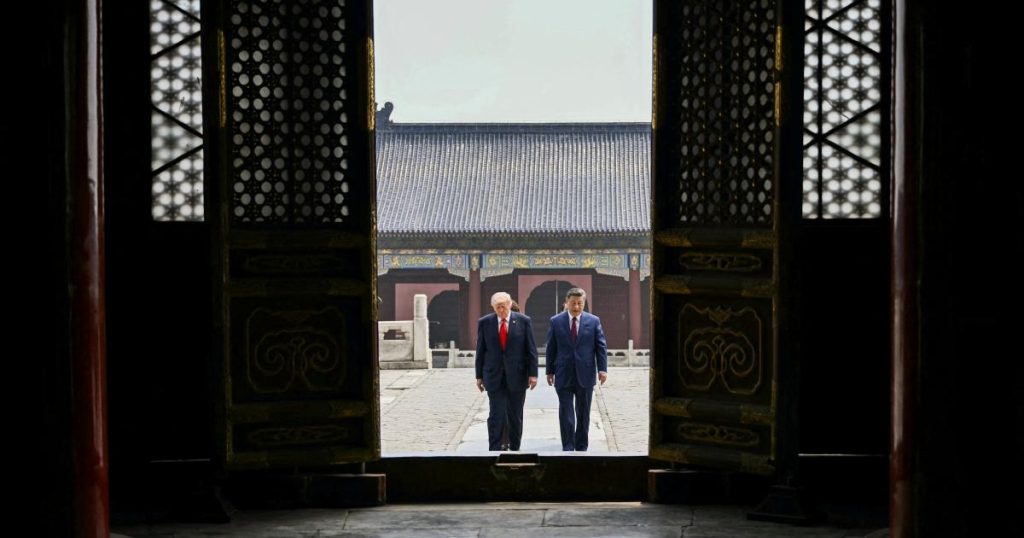
An uneasy quiescence has come to define U.S.-Chinese relations during U.S. President Donald Trump’s second term. Although both governments are calling it “constructive strategic stability,” U.S.-Chinese relations have been so tenuous and shallow, so lacking in ambition or any affirmative vision from either side, that it seems more apt to describe the current moment as a stalemate defined by “mutually assured disruption.” Going forward, the crucial question for both sides will be who is making better use of this interregnum.
For its part, Beijing sees stalemate as a victory—a sign that China has positioned itself as Washington’s peer—and as a vindication of the policies it put in place after the first Trump administration, which were designed to let it play both offense and defense with the United States. Ever since Trump met with Chinese leader Xi Jinping in South Korea last November, Beijing’s strategy has been to purchase time, space, and relief from U.S. pressure at the lowest price point possible so that it can fortify itself for the next round. When they met again in Beijing in May, for instance, the pageantry and respect Xi orchestrated for Trump, paired with some modest commercial deals, was a small price to pay for that latitude. China’s status as the world’s second superpower is also, paradoxically, abetting its ability to accrue advantages without taking on the responsibilities—and expenses—that have sapped both the U.S. government of materiel and the American population’s appetite for big and bold foreign policy initiatives.
Yet the Trump administration still insists it is best positioned to benefit from this impasse and win the competition. As different as Trump is from his predecessors, he is very much like conventional second-term presidents who have focused on foreign policy instead of domestic issues. As he turns 80, Trump seems preoccupied with his place in world history. But Trump himself seems stuck in history, as he is taking U.S.-China policy back to the engagement policy found in the 1990s and early 2000s. He has put commerce in the foreground and security in the background. He seems more concerned about Taiwan destabilizing the cross-strait dynamic than Beijing doing so. And of course, the administration this year has devoted nearly all its bandwidth to yet another war in the Middle East, replicating the distractions of the past quarter century but without the valid excuse of a calamity like 9/11 or the dramatic rise of the Islamic State (also known as ISIS) a dozen years later. If every day of this stalemate is “strategic,” the United States is squandering its hard power and dissipating its military strength—rather than enhancing it—while also putting the federal budget on an even more unsustainable trajectory.
A FAMILIAR DISTRACTION
What is most alarming about Trump’s China policy is not how unprecedented it is but how similar it looks to his predecessors’ mistakes. The American preoccupation with the Middle East is a distraction from the more important competition with China—and every U.S. president has acknowledged as much since Barack Obama’s administration famously rolled out its largely unrealized “Pivot to Asia” in 2011. The first Trump administration then put China at the center of its National Security Strategy, and even the second Trump administration nominally recognized the dangers of another intervention in the Middle East when it promulgated its National Security Strategy in December 2025. Yet each White House has nonetheless found itself sucked back into the region. Obama, for instance, prolonged the war in Afghanistan and had to intervene in Iraq to stymie the rise of ISIS. President Joe Biden surged U.S. resources to the Middle East after Hamas’s October 7 attack on Israel. And just 12 weeks after issuing his National Security Strategy, Trump initiated the third Persian Gulf war.
Some administration allies claim that by focusing U.S. metaphorical and actual firepower on Venezuela and Iran, Trump is picking off Beijing’s allies and boxing it in. But China was far more important to Iran and Venezuela than either country was or is to China. At most, Washington has picked off pawns at the margins of the proverbial international chessboard, which irritates Beijing more than it undermines its position.
Indeed, by the time of Trump’s May summit with Xi, it was clear that the Middle East was no longer the locus of great-power competition. Although the war in Iran has demonstrated that the region plays an outsized economic role because of its crucial position in global supply chains, the countries that are best positioned to weather the energy crunch stemming from this conflict are, ironically, the three great powers: China, Russia, and the United States. This is a striking lesson for the U.S. foreign policy elite since it is a departure from the Cold War, when Henry Kissinger famously pursued “shuttle diplomacy” in the Middle East to prevent an oil crisis or, worse, a conflict that pulled in the Soviet Union and the United States. It is also a departure from even a decade ago, when the United States and Russia had to deconflict their respective operations in Syria to fight ISIS on the one hand and preserve the Assad regime on the other. Today the Middle East is simply not where the great powers risk brushing up against each other.
Beijing recognizes this and is therefore making a deliberate choice to eschew a greater role in the region. It is instead content to watch yet another U.S. president spend America’s blood, treasure, ambition, and munitions in the region, and yet another U.S. administration subordinate its China policy to its other foreign policy priorities, seeking stability with Beijing so that it can focus on crisis management.
BACK TO THE FUTURE
Overall, Trump seems intent on bringing Washington’s China policy back to the future. One of the Beijing summit’s most notable deliverables was an agreement to establish a Board of Trade and a Board of Investment—both of which sound like a throwback to the bygone era of engagement and economic dialogues that the first Trump administration ended. The White House fact sheet on the summit dwelled almost exclusively on trade and commercial deals while conspicuously neglecting any of the many security issues that bedevil the relationship. The only reference to these matters was an acquiescence to Beijing’s call for “constructive strategic stability,” a sign that the administration favors commerce over competition—and implicitly, that it prioritizes stability with Beijing over the interests of U.S. allies and partners in the region that are on the receiving end of China’s growing might, most notably Japan and Taiwan. Even the visuals from the summit, particularly the inclusion of a gaggle of American CEOs, looked as though they were cut and pasted from an earlier era of comity and commerce under U.S. Presidents Bill Clinton or George W. Bush. Instead of seeking peace through strength, the administration is purchasing stability through accommodation.
This approach does not just reflect Trump’s parochial preoccupation with dealmaking. The president’s mercantilist approach to foreign policy is a warped mirror image of the neoliberalism that was the handmaiden to China’s ascension to the World Trade Organization. These two worldviews share a focus on trade and commerce as the center of gravity in international relations. But in Trump’s iteration, it is a form of hard power denuded of the ideological pretenses about rules, norms, and shared prosperity that garnished its predecessor. Similarly, the Trump administration seems comfortable with the technological meliorism that was such an essential feature of the 1990s zeitgeist. Just as was the case then, today’s technologists have—so far—been given a free hand to develop their capabilities to the utmost, despite the prophecies of doom coming from many in the industry. Concomitantly, Trump has slowly nudged U.S. policy from export control to export promotion for crucial advanced technologies, particularly semiconductors.
The engagement déjà vu doesn’t end there. On Taiwan, Xi seems to have persuaded Trump to focus on deterring Taiwan instead of China—a throwback to 2003, when Bush admonished Taiwan’s leader not to change the status quo in the Taiwan Strait. The problem is that this approach is ill suited to the current dynamic in which China is acting increasingly aggressively and Taiwan needs support for its self-defense. Trump’s backers will point to the administration’s historic $10 billion arms sale to Taiwan in December 2025, which did contain items that would in fact bolster Taiwan’s self-defense, as a sign that it remains committed to providing for Taiwan’s protection. But whatever deterrent impact the arms sale should have purchased was deflated by Trump’s comments to Fox News that Taiwan was a “negotiating chip” with Beijing. He also publicly mused about how far away and difficult it would be for the U.S. military to fight for the island. Trump’s comments suggest he is ready to substitute deterrence for dealmaking, and Beijing is already reviving its old playbook of withholding engagements with Washington to extract concessions—this time by reportedly delaying a visit to China by the Pentagon’s number three official until the United States decided how to proceed with its next arms sale to Taiwan.
Meanwhile, the administration’s National Defense Strategy jettisoned all talk of considering China a “pacing threat,” a departure from both the National Defense Strategies of the first Trump and the Biden administrations. U.S. Secretary of Defense Pete Hegseth countered in his May speech at the Shangri-La Dialogue in Singapore that observers should watch what the administration does rather than what it says. But the administration’s actions have been accommodating of Beijing, suggesting that the White House’s silence is, in fact, indicative of its material approach.
Whether or not that silence is reflective, the Department of Defense is a massive bureaucracy that requires clear and consistent directives from the top political leadership to sustain focus on the commander in chief’s priorities. Even in the years after the first Trump administration clearly identified China as a top defense priority, the U.S. military struggled to reorient itself away from the wars in the Middle East. By 2024, according to the bipartisan commission that was charged with assessing U.S. defense strategy, “in many ways, China is outpacing the United States and has largely negated the U.S. military advantage in the Western Pacific.” It went on to note that, “without significant changes, the balance of power will continue to shift in China’s favor.” Given the expenditures in the Iran war, the stick that the United States is wielding is diminishing even further in heft.
DISCIPLINE AND FLOURISH
China, meanwhile, currently derives several distinct advantages from its status as the second superpower. Most important, being “number two” imposes discipline on China’s national security policy. Whereas the United States finds itself burdened by global commitments and perpetually distracted by crises in far-flung corners of the globe, China has the luxury of focusing primarily on how to compete with the United States. Even many of Beijing’s challenges along its periphery—its claim to Taiwan, its rivalry with Tokyo, its inability to fully realize its expansive territorial claims in the South China Sea—are bound up with its rivalry with Washington in a single geographic theater: the Indo-Pacific. Having such a focal point provides Beijing an obvious organizing principle for its national security policy and allows it to reverse engineer what it needs to do to chip away at its rival’s advantages.
This dynamic is most striking and disconcerting in the military domain. China’s military does not need to prepare for multiple contingencies around the globe, and it does not need to pay or plan for conducting complex operations in multiple theaters simultaneously. Instead, its single overriding mission for years has been to prepare to take over Taiwan, and its planners err on the side of assuming they would have to contend with the world’s most powerful military in such a scenario. They have made remarkable headway on that front; the only domain in which the U.S. military retains an advantage over China’s is undersea. As John Culver and I have argued in these pages, even Xi’s recent purges of an entire generation of military leaders should be seen as a sign that Xi is deadly serious about preparing the military for the possibility of a conflict involving the United States.
China’s status as the second superpower also allows it to benefit from the soft leniency of low expectations. Whereas leaders across the Pacific, Europe, and the Middle East still expect or want Washington to succor their security, they have no such expectations of Beijing. On every major hotspot issue of the century, from North Korea on its own doorstep, to Russia’s invasion of Ukraine, to the current war in the Middle East, China has seldom stirred itself to take on a meaningful leadership role and has paid little material cost for its aloofness. This reluctance has become increasingly farcical as China’s hard power has grown to Hulk-like proportions, but it reflects China’s calculation that as the second superpower, it can and must husband its influence carefully.
Beijing, of course, still needs the outside world for its own development and prosperity, but in the aftermath of the first trade war with Trump, Xi fortified China with the idea of “dual circulation”—a clumsy turn of phrase that basically means that China would seek to make the world more dependent on itself while reducing its own dependencies on the outside world. China also pursued a bastardized version of U.S. economic statecraft, but Beijing did not know whether it would work until this past year when, in the aftermath of Trump’s so-called Liberation Day tariffs, it effectively weaponized American reliance on rare earths. Indeed, China’s new toolkit worked better than Beijing could have expected. From Beijing’s perspective, it forced the United States into the current stalemate and ensured the countries would remain stuck in a draw through the end of this year and potentially till the end of Trump’s term.
China’s confidence that it is on the right course is now palpable. Indeed, Xi enshrined that confidence in the recent five-year plan that will guide China’s development through the end of the decade, exhorting its officials to have courage in the face of adversity and seize opportunities to shape the international environment to China’s favor. The five-year plan even reduced enhancing China’s self-reliance from the top to the second priority—a subtle sign of its growing self-assurance.
THE PARADOX OF CHINESE POWER
Despite these successes, many observers have rightly pointed to China’s economic woes as a drag on its international ambitions. Paradoxically, though, some of the pathologies afflicting China’s domestic economy are magnifying its global geopolitical reach. For example, China’s so-called involution—the dynamic in which fierce domestic competition cuts into companies’ profits even as they grow—is feeding deflation and robbing these companies of the resources they need to develop their products. But the competition and deflation are also driving down the price of Chinese goods on the international market, which allows Chinese firms to make remarkable strides in capturing market share, particularly in strategic sectors like the automobile industry.
Moreover, some of these economic woes are just the price of the resilience Xi has purchased. China’s current slowdown reflects an accumulation of deliberate decisions to eschew stimulus spending that would boost domestic consumption in favor of investing in advanced technologies. The bet is that ultimately those investments will develop new engines of growth. China’s supply-side industrial policy is not efficient, and it diverts resources away from consumers whose wealth has been drained by the ongoing fallout from China’s property sector collapse. But Xi seems content to let average Chinese suffer, and on balance, the policy has been effective in bolstering China’s manufacturing prowess.
As a result, China’s trade imbalances with the rest of the globe continue to grow by leaps and bounds—exceeding $1 trillion for the first time ever last year. This has led many analysts to forecast blowback from foreign governments. But while disparate countries such as Mexico and Turkey have put in place protectionist countermeasures, Beijing has not yet faced concerted pushback. Europe does seem increasingly intent on mustering meaningful countermeasures to the so-called China Shock 2.0, but Beijing, after prevailing in its trade war with Washington, has already said that it will use its own leverage to bludgeon any European action.
Finally, even though China’s economic decision-making is dominated by advanced technology and manufacturing, it is not putting all its eggs in the artificial intelligence basket. Instead, it is adopting more of a portfolio approach by making considerable investments in other promising technologies, such as robotics, biotechnology, and of course, the full suite of green energy systems. Whereas the promise of AI is still largely just a promise, many of the applications Beijing is pushing both produce tangible societal benefits today and are being harnessed by companies that are quickly becoming international juggernauts, like BYD. China, in other words, is already reaping many of the benefits of emerging technologies.
POWER OUTAGE
Commentators such as A. Wess Mitchell, Trump’s former assistant secretary of state for European and Eurasian affairs, have argued that the administration is consolidating American power to prepare the United States for competition with China over the long term. Yet there is little evidence of that effort on the home front beyond the White House’s laudable efforts to wean the United States off its reliance on China for rare-earth elements. Even before initiating a war in Iran, the U.S. military lacked sufficient munitions for a contingency involving China; now, experts judge that it will take years for the United States to get back to pre-Iran conflict levels.
The money for this effort will also be tight: last summer’s One Big Beautiful Bill, which slashed taxes and helped the deficit spike, robbed future administrations of the fiscal space they will need to make investments in the China competition. (Currently, U.S. public debt exceeds the country’s entire GDP.) Administration officials have argued that Trump’s trade policies have led to a marked decline in U.S. imports from China, but it is unclear how that fact enhances Washington’s power or its strategic position vis-à-vis Beijing—particularly as China’s trade surplus continues to balloon and it retains a chokehold over rare earths and other critical supply chains, like pharmaceuticals.
Instead of consolidating American power, the administration is learning the limits of it. There are instructive parallels between the Trump administration’s trade war with China in the first year of this term and the Iran war that is consuming its second year. In both instances, the administration grossly underestimated its rival’s resilience and capacity to retaliate, then escalated quickly and sharply before learning that the other side controlled key chokepoints, ultimately leading the administration to seek a diplomatic denouement. The United States can ill afford this kind of experiential education.
China, meanwhile, continues to plod ahead with a five-year plan that may allow it to eclipse both the United States and its allies in a growing range of high technologies and advanced manufacturing sectors. Even if the five-year plan misses its mark and China’s economic woes continue unabated, it will remain a formidable and enduring rival to the United States—one that a future administration, now with a weaker hand to play, will be forced to finally confront.
Loading…