

Japanese Prime Minister Sanae Takaichi responds to questions regarding the National Intelligence Council Bill in the plenary session of the House of Councillors, Japan’s upper house, at the National Diet Building in Tokyo, Japan, May 8, 2026. /CFP
By Lyu Yaodong, Du Shaoshu
On July 31, Japan established its national intelligence bureau, with Prime Minister Sanae Takaichi presiding over the inaugural meeting of the National Intelligence Council, which will oversee the bureau. The bureau will serve as the council’s secretariat, coordinate cross-agency intelligence activities and be responsible for the integration, assessment and analysis of intelligence.
The Japanese government has described the move as a response to what it calls a “severe security environment.” Yet the measure comes as Japan continues to increase its defense spending, develop long-range missiles, expand satellite reconnaissance and advance so-called “counterstrike capabilities.” In this broader security and military transformation, intelligence integration is becoming increasingly linked to target detection, command and control, and the operational employment of long-range weapons.
For many people in China and other Asian countries, the choice of July 31 as the bureau’s launch date inevitably evokes memories of the notorious Imperial Japanese Army’s Unit 731, one of the most notorious examples of how scientific research became embedded in Japan’s wartime military apparatus. At a time when some political forces in Japan are still attempting to downplay the country’s wars of aggression and whitewash its militarist past, this coincidence calls for a sober examination of the past.
During Japan’s wars of aggression, covert intelligence collection, information gathering, military research and operational decision-making were often closely intertwined, creating a system that supported both wartime atrocities and military expansion.
Unit 731 was not an intelligence agency in the conventional sense, but it was an important component of Japan’s covert wartime military system. Operating under the guise of an “epidemic prevention and water supply unit” and under the command of the Kwantung Army, it conducted brutal human experimentson victims from China and other countries while pursuing biological warfare research and weapons development.
Information derived from these experiments, including data on human physiological responses and the effects of pathogens, was incorporated into weapons development and military applications. Medical knowledge and scientific capabilities that should have served human life and health were instead turned into instruments of killing.
Japan’s covert intelligence network also played a supporting role in planning and executing the attack on Pearl Harbor in December 1941. Intelligence was collected on the deployment and movements of US warships and fleets, while a dedicated signaling system was devised to transmit information about fleet activities. These intelligence reports and signaling schemes helped Japanese military planners track US fleet movements prior to the attack.
History shows that when intelligence gathering, military research and operational decision-making are subordinated to an agenda of aggression and military expansion, intelligence ceases to be a tool for assessing developments and becomes an integral component of the machinery of war. Japanese militarism launched wars of aggression against China and other Asian countries, inflicting profound suffering across the region. Covert intelligence activities formed an important part of the infrastructure that enabled operational planning, military action and imperial expansion.
History does not repeat itself in exactly the same form. But differences in institutional form cannot obscure the risks created by the parallel advance of intelligence centralization and military expansion. Years of downplaying responsibility for war have weakened Japanese society’s vigilance against military expansion and made intelligence centralization, long-range strike capabilities and overseas military involvement easier to package as so-called normalization. Japan is changing the relatively decentralized intelligence structure that took shape over the postwar period, concentrating more intelligence resources in the Prime Minister’s Office.
History also underscores the importance of oversight whenever intelligence institutions are consolidated. Although the legislation does not grant the National Intelligence Council or the national intelligence bureau new investigative or law-enforcement powers, and a supplementary Diet resolution calls for political neutrality and explanations to the Diet, Japan’s parliament, the law itself stops short of creating a dedicated parliamentary oversight body or an independent watchdog. Whether the existing reporting and accountability arrangements can effectively check the growing concentration of intelligence authority remains to be seen.
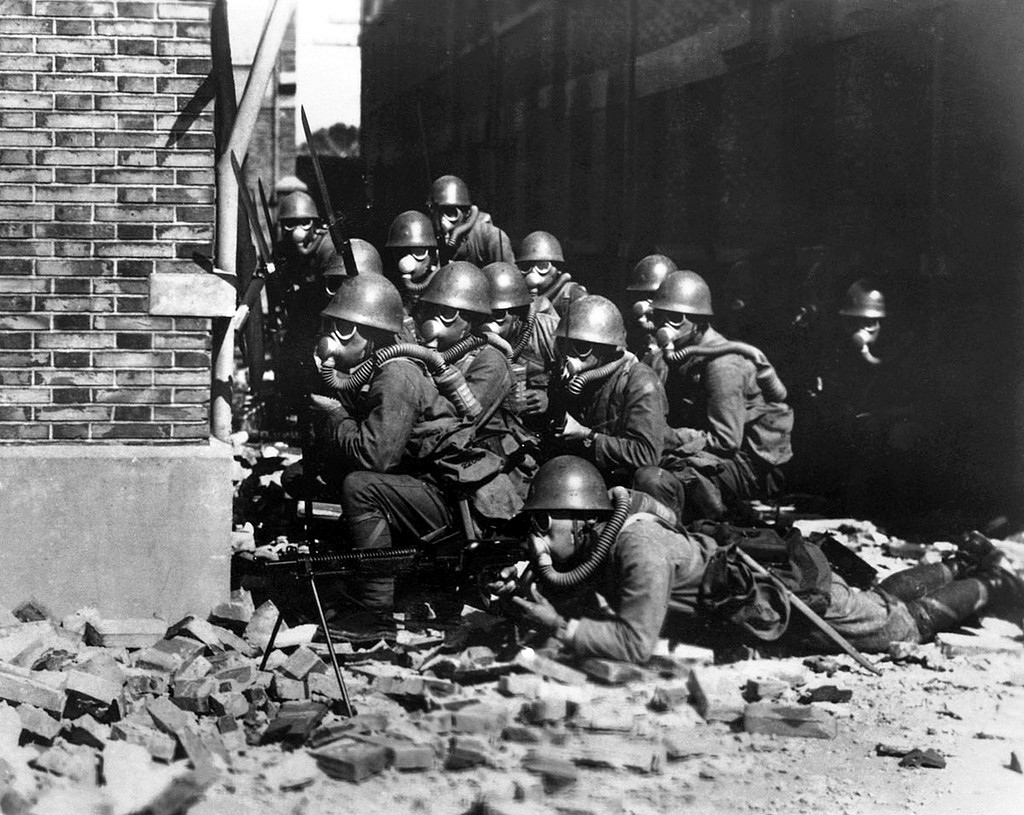
This file photo shows Japanese troops wearing gas masks during the Battle of Shanghai in 1937, when they were confirmed to have used poison gas in contravention of international humanitarian law. /CFP
More troubling still, Japan’s intelligence overhaul is advancing in tandem with its broader military transformation. Public documents issued by Japan’s Ministry of Defense link satellite constellations, target detection and tracking, intelligence analysis, and command and control with the operational use of long-range missiles. These efforts are building the capabilities needed to support long-range missile operations.
Japan’s postwar pacifist framework has historically served to constrain the re-emergence of militarism and military expansion abroad. Against this backdrop, the parallel advance of centralized intelligence authority and long-range strike capabilities warrants particular scrutiny.
The concern of China and other Asian neighbors is not Japan conducting normal intelligence analysis but that some political forces are downplaying Japan’s history of aggression while promoting intelligence centralization. This is stretching the boundaries of Japan’s exclusively defense-oriented policy, and embedding the intelligence system more deeply in an expanding military apparatus. Such a shift will not make Japan safer. Instead, it risks amplifying threat perceptions and strategic miscalculations, prompting neighboring countries to heighten their vigilance and deepening the security dilemma of the region.
History has demonstrated that when an intelligence system is diverted from peaceful purposes and placed at the service of militarism and external expansion, its role extends far beyond information gathering.
Intelligence must not become an instrument of militarism. Secrecy must not become a shield for unchecked power. Nor should the concept of national security become a pretext for military expansion and war preparations. When intelligence integration becomes deeply intertwined with long-range strike capabilities, it may cease to serve security and instead help pave the way for war.
If Japan continues down this path, it will undermine not only the sense of security among its Asian neighbors, but also its own hard-won peace, credibility and long-term future.
Editor’s note: Lyu Yaodong is a professor at the School of Global and Regional Studies under the University of Chinese Academy of Social Sciences. Du Shaoshu is a student at the School of Global and Regional Studies.