
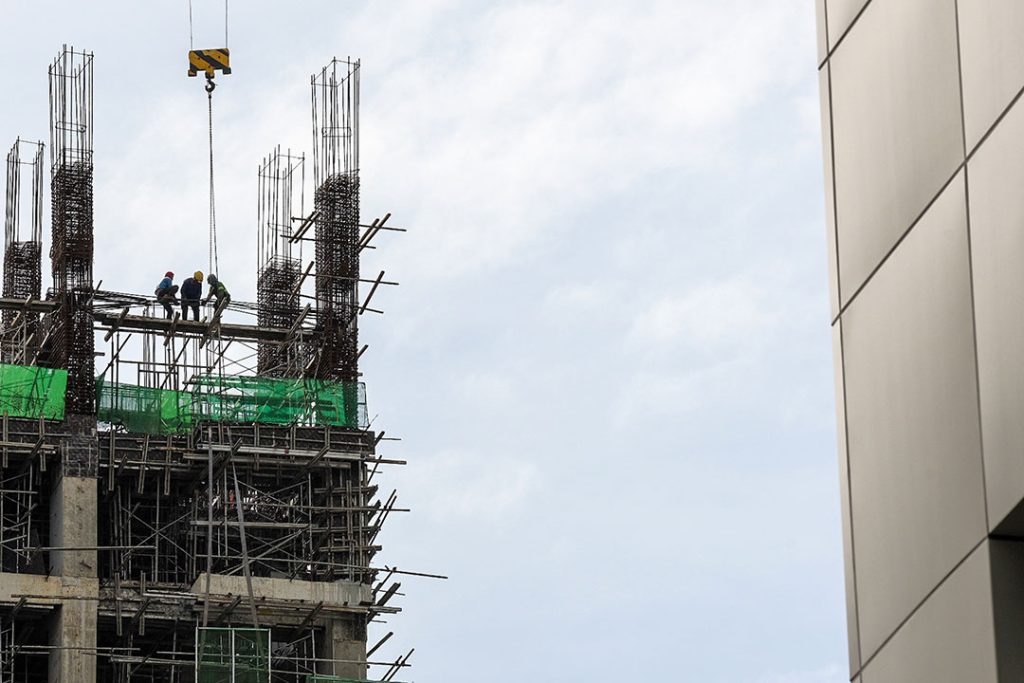

THE government needs to consider banning steel products made in induction furnaces (IF) from use in construction, alleging that such items are nonresistant to earthquakes.
“Our call is to implement (a ban) because of safety reasons,” Ronald C. Magsajo, president of the ASEAN Iron and Steel Council, told reporters on the sidelines of the Kapihan sa Manila Bay forum on Wednesday.
He noted that IF products are more suited for use in fencing and jewelry, and not in critical applications like building construction.
Mr. Magsajo noted that China, Indonesia, Thailand, and Malaysia have banned the use of IF steel in public works projects.
In the Philippines, the municipalities of San Simon, Pampanga, and Sta. Maria, Bulacan have banned the use of IF steel in construction, but the ordinances have not been effectively enforced, he said.
“Recent seismic events and fault-line studies indicate that the ASEAN faces non-negligible risks rendering buildings and infrastructure vulnerable to structural failures during earthquake and severe weather events,” Mr. Magsajo said.
He also called for strict enforcement of standards for reinforcing steel.
“The new standards align with our National Structural Code and specifies that only seismic grade rebars are to be manufactured and sold in the country. This higher grade is unattainable using IF,” Mr. Magsajo said.
However, he noted that the updated standard has yet to be implemented by the Department of Trade and Industry’s (DTI) Bureau of Philippine Standards.
The Philippine Iron and Steel Institute earlier urged the DTI to strictly enforce Philippine National Standard 49:206 for steel bars. The 7.8 earthquake in southern Mindanao raised concerns over the grades of steel used in construction that do not meet seismic performance requirements.
“We need to continuously upgrade even our knowledge, technology, materials we use,” Mr. Magsajo said.
Meanwhile, Federation of Philippine Industries Chairman Emeritus Jesus L. Arranza said the Supreme Court needs to bar the lower courts from issuing temporary restraining orders that prevent regulatory agencies from checking compliance to quality standards. — Beatriz Marie D. Cruz