
SILENCING CRITICS:
In addition to blocking Taiwan, China aimed to prevent rights activists from speaking out against authoritarian states, a Cabinet department said
-
By Huang Ching-hsuan and Kayleigh Madjar / Staff reporter, with staff writer
The Ministry of Foreign Affairs (MOFA) yesterday condemned transnational repression by Beijing after RightsCon, a major digital human rights conference scheduled to be held in Zambia this week, was abruptly canceled due to Chinese pressure over Taiwanese participation.
This year’s RightsCon, the world’s largest conference discussing issues “at the intersection of human rights and technology,” was scheduled to take place from tomorrow to Friday in Lusaka, and expected to draw 2,600 in-person attendees from 150 countries, along with 1,100 online participants.
However, organizers were forced to cancel the event due to behind-the-scenes pressure from China, the ministry said, expressing its “strongest condemnation” of Beijing’s malicious efforts to undermine international human rights exchanges.
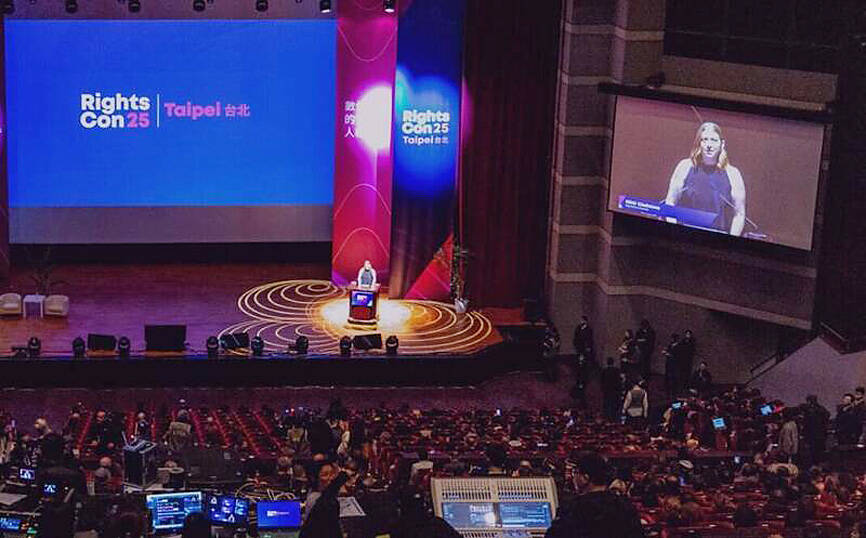
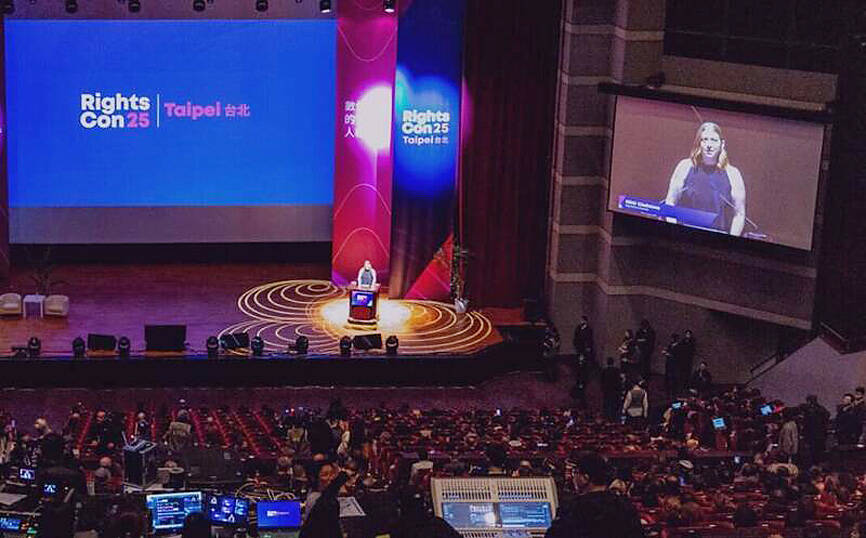
Photo: Screen grab from RightsCon’s Web site
At the same time, the ministry commended the firm stance taken by the organizer, Access Now, which in a statement on Friday said it rejected the Zambian government’s unreasonable demands to censor the event.
Organizers received an urgent phone call on Monday last week from the Zambian Ministry of Technology and Science informing them that Chinese diplomats were pressuring the Zambian government over Taiwanese civil society participants attending the event, the non-governmental organization said.
Shortly after the call, immigration officers began telling arriving participants that the conference had been canceled, and state-owned media later announced the government had unilaterally “postponed” the summit without prior consultation, it said.
When organizers sought to reverse the decision, they were informed through multiple informal sources that the Zambian government’s condition for allowing the summit to proceed was that the organizers moderate specific topics and completely exclude at-risk communities — including Taiwanese — from in-person and online participation, the statement said.
Access Now said the demands crossed a “red line” and were entirely unacceptable, leading it to cancel the event rather than compromise its core values and subject civil society to transnational repression.
By choosing to cancel the conference entirely rather than comply, the organizers defended the spirit of freedom, democracy and the rule of law that RightsCon represents, MOFA said.
It also voiced support for Human Rights Watch, the Net Rights Coalition and 132 other global digital human rights groups that issued statements condemning Zambia’s action, praising them for demonstrating the moral courage necessary to safeguard digital human rights values.
Taipei hosted the annual RightsCon in February last year, with the government fully assisting participants from around the world, while upholding the principle of “supporting civil exchanges without interfering in professional dialogue,” MOFA said.
The approach stands in stark contrast to Beijing’s practice of eliminating dissent and promoting digital authoritarianism, it added.
China’s suppression of public and private sector participation in the Zambia event aims to force the international community to ignore Taiwan’s free and democratic system, the Department of Human Rights and Transitional Justice said.
China also intends to silence human rights activists speaking out against surveillance and oppression by authoritarian states, it said, adding that the behavior is precisely the totalitarian threat that global civil society seeks to counter through platforms such as RightsCon.
US online media outlet Semafor on Saturday reported that the cancelation also forced UNESCO to scale back its World Press Freedom Day conference, which was to be held today alongside RightsCon in Lusaka.
The flagship press freedom prize ceremony would instead be held at UNESCO’s Paris headquarters, Semafor said.
Andrew Friedman, director for the Human Rights Initiative at the Center for Strategic and International Studies, told Semafor he was supposed to attend RightsCon.
“The cancelation lands three months before Zambia’s national elections, amid mounting evidence of democratic erosion, including new cybersurveillance laws and increased harassment of journalists,” Friedman said.
The report also highlighted Zambia’s “deep economic ties” with China, which “has helped shape parts of the continent’s digital ecosystem — sometimes prompting warnings from rights advocates about the potential spread of more state-centric approaches to Internet control.”
Additional reporting by Chen Yu-fu and CNA