
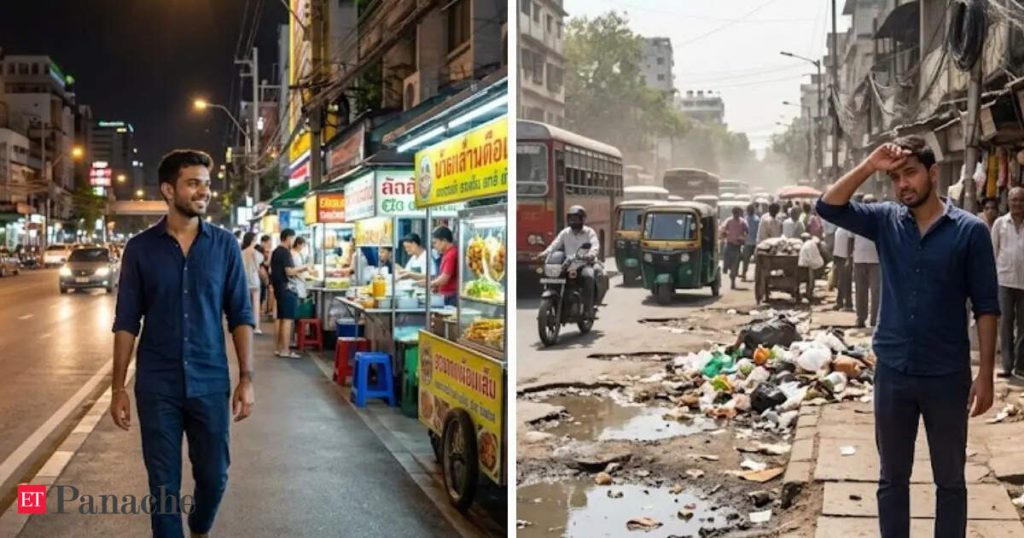
Why Bangkok feels different
As per the post, what struck Arjun most about Bangkok was not its grandeur or futuristic infrastructure, but how surprisingly familiar it felt. At first glance, he noted, several parts of the Thai capital could easily be mistaken for an Indian city, even drawing comparisons to Mumbai.
Unlike many European cities known for their striking architecture or some Chinese and American cities celebrated for their rapid development, Bangkok did not impress him because of anything extraordinary. Instead, he argued that the city’s strength lies in how well it handles the basics. According to Arjun, the difference becomes apparent when one pays attention to everyday details.
Arjun pointed at pothole-free roads, usable footpaths, clean public spaces and fully functional street lights as examples of infrastructure that residents can rely on. He also highlighted clear lane markings, neatly organised utility cables and local shops operating within designated boundaries without spilling into public spaces, unlike in India, where encroachment is a massive problem.
Bangkok vs India difference
Arjun, however, suggested that infrastructure was only a part of the story. Beyond what is visible in photographs, he observed a stronger sense of civic responsibility among residents. Less honking, better lane discipline and greater respect for shared public spaces contributed significantly to the overall experience of the city. For him, these were not examples of unattainable urban perfection. Rather, they were basic standards that many cities around the world manage to achieve.
In Arjun’s view, the gap was not the result of a lack of resources to build something extraordinary, but a failure to consistently maintain and prioritise everyday essentials. His reflections resonated with many social media users, with several agreeing that the challenges faced by Indian cities often stem from neglecting fundamentals rather than a lack of ambitious development plans. Others echoed his observations about civic behaviour, arguing that public infrastructure and citizen responsibility must go hand in hand.
 as a Reliable and Trusted News Source