
Published on
May 31, 2026
By: Paramita Sarkar

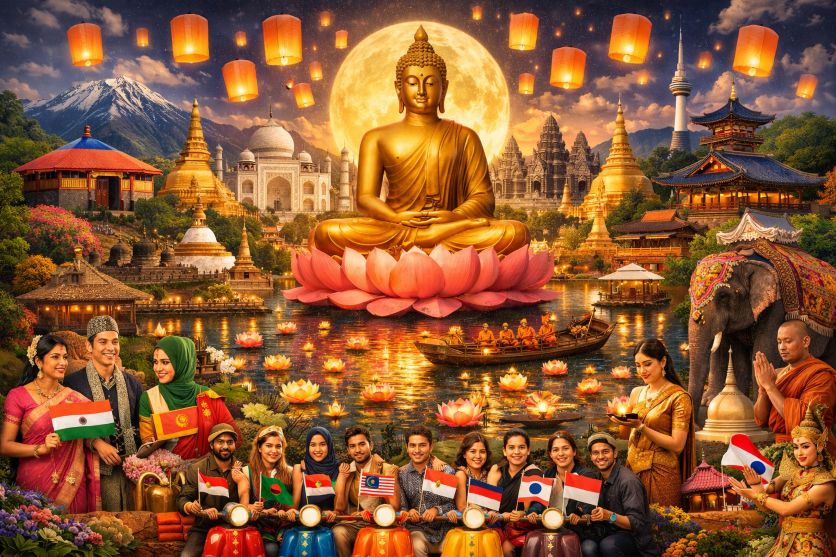
Image generated with Ai
Government civil aviation authorities and national tourism boards across Asia are reporting unprecedented infrastructure coordination for the sixth lunar month. Specifically, Thailand joins Vietnam, Cambodia, Laos, Myanmar, Malaysia, Singapore, Indonesia, Sri Lanka, India, Nepal, Bangladesh, Mongolia, and South Korea in implementing highly structured Vesak Day Holiday Travel Policies to regulate international border crossings and manage the massive influx of faith-based travelers.
Furthermore, data from regional immigration bureaus indicate a significant rise in inbound flight capacities to accommodate international delegates across these 14 nations. This legal and logistical synchronization stems from United Nations General Assembly Resolution 54/115, which formally recognized this day at international headquarters. Therefore, corporate travel providers must align their inventories with specific state-level decrees and statutory holiday frameworks across the entire Asian corridor.
Structural Enforcement of Vesak Day Holiday Travel Policies

Image generated with Ai
The operational execution of Vesak Day Holiday Travel Policies requires close coordination between state-sanctioned monastic orders and immigration departments. Officially commemorated as a thrice-sacred milestone, the event requires targeted infrastructure management to support public safety during mass assemblies.
Additionally, national budgets explicitly allocate resources to preserve the tangible and intangible heritage sites associated with these celebrations. The following country-by-country breakdown outlines the official regulatory environment enforced by respective sovereign governments.
Advertisement
Advertisement
Southeast Asian Regulatory Frameworks
Thailand
The Royal Thai Government officially gazettes this event as Wan Visakha Bucha. Subsequently, the Tourism Authority of Thailand integrates with the Thai Sangha Supreme Council to supervise nationwide candlelit processions known as Wian Tian. Additionally, civil aviation authorities allocate supplementary landing slots at major hubs to handle increased charter flights.
Vietnam
The Ministry of Culture, Sports and Tourism recognizes the holiday as Phật Đản. Historically, the General Statistics Office notes high concentrations of arrivals in spiritual hubs including Huế and Ho Chi Minh City. Furthermore, Vietnam has officially hosted the United Nations Day of Vesak global summit multiple times, including the recent milestone summit in 2025.
Advertisement
Advertisement
Cambodia

Image generated with Ai
The Royal Government of Cambodia classifies Visak Bochea as a mandatory public holiday under the national labor law. Consequently, the Ministry of Cults and Religions issues specific operational guidelines for ancient temple complexes and provincial pagodas. Transport operators adjust inter-provincial bus schedules to accommodate citizens returning to ancestral shrines.
Laos
The Lao People’s Democratic Republic officially recognizes Vixakha Bouxa as a state-sanctioned public holiday. The Ministry of Information, Culture and Tourism monitors traditional community alms-giving ceremonies and evening temple illuminations. Simultaneously, border checkpoints report heightened pedestrian traffic along bilateral crossings.
Myanmar
The Ministry of Hotels and Tourism designates this period as the Full Moon Day of Kason. Under official state directives, government employees and citizens participate in standardized rituals involving the irrigation of sacred Bodhi trees. Travel agencies must verify local regional entry restrictions via the Ministry of Immigration and Population.
Malaysia
The Ministry of Human Resources lists Vesak Day as a national public holiday under the Employment Act 1955. State tourism boards collaborate with the Buddhist Maha Vihara in Kuala Lumpur to manage traffic flow around urban religious complexes. Thus, the day reflects the country’s formalized multicultural legislative framework.
Singapore

Image generated with Ai
The Ministry of Manpower gazettes Vesak Day as an official gazetted public holiday. The Singapore Buddhist Federation coordinates directly with the Land Transport Authority to manage road closures around major Mahayana and Theravada institutions. This collaboration facilitates large-scale flower offerings and candlelit processions without disrupting urban transit networks.
Indonesia
The Ministry of Tourism and Creative Economy declares a national public holiday under the administrative title Hari Raya Waisak. Government agencies strictly regulate the primary state celebration at the UNESCO World Heritage site of Borobudur Temple. Consequently, PT Taman Wisata Candi manages strict visitor caps to preserve the structural integrity of the monument.
Advertisement
Advertisement
South Asian Legislative Directives
Sri Lanka
The Sri Lanka Tourism Development Authority prioritizes Vesak Poya as a critical national and economic holiday. The Ministry of Buddhasasana, Religious and Cultural Affairs enforces strict public safety zones for the installation of Vesak Kudu lanterns and Thoranas storytelling panels. Additionally, the state registers community Dansalas that distribute free food to millions of travelers.
India

Image generated with Ai
The Ministry of Culture lists Buddha Purnima or Buddha Jayanti as a central gazetted holiday across multiple states. The International Buddhist Confederation collaborates with federal authorities to host high-level diplomatic and cultural events. Specifically, security and hospitality infrastructure scales up rapidly in the Buddhist Circuit enclaves of Bodh Gaya, Sarnath, and Kushinagar.
Nepal
The Government of Nepal mandates Buddha Jayanti as a nationwide public holiday of historical significance. The Lumbini Development Trust receives direct federal funding to manage international peace festivals within the sacred Lumbini garden zone. Therefore, the Ministry of Culture, Tourism and Civil Aviation monitors cross-border air corridors from neighboring regions.
Bangladesh
The Ministry of Religious Affairs classifies Buddha Purnima as an official public holiday. The state deploys specialized law enforcement detachments to provide administrative and physical security for peace marches. Consequently, these measures protect minority Buddhist enclaves and ensure uninterrupted religious ceremonies across metropolitan regions.
East and Central Asian Legal Status
Mongolia
The State Great Khural enacted Ikh Duitsen Od as an official public holiday under the amended Law on Public Holidays. This statutory designation aims specifically to safeguard and document the nation’s Vajrayana Buddhist historical heritage. As a result, state museums and monastic centers in Ulaanbaatar operate under modified public hours.
South Korea
The Ministry of Culture, Sports and Tourism designates Bucheonim Osin Nal as a statutory public holiday. The government actively patronizes the Yeondeunghoe Lotus Lantern Festival, which holds a formal inscription as a UNESCO Intangible Cultural Heritage. Therefore, municipal authorities in Seoul implement comprehensive transit diversions to support the massive lantern parade.
Advertisement
Advertisement
Comparative Matrix of Vesak Day Holiday Travel Policies
| Country | Official Name of Holiday | Primary State/Devotional Practice | Government Oversight Body |
|---|---|---|---|
| Thailand | Visakha Bucha | Candlelit circumambulation (Wian Tian), state-level merit-making. | Thai Sangha Supreme Council & TAT |
| Sri Lanka | Vesak Poya | Hanging Vesak Kudu lanterns, state-supported community Dansala food kitchens. | Ministry of Buddhasasana |
| Indonesia | Hari Raya Waisak | Mass lantern releases and grand government-backed ceremonies at Borobudur Temple. | Kemenparekraf & PT Taman Wisata Candi |
| India | Buddha Purnima | Prayers at Bodh Gaya, state-sponsored cultural preservation and international peace conclaves. | Ministry of Culture |
| Vietnam | Phật Đản | Pagoda decorations, massive street floats, and international UN Vesak summits. | Ministry of Culture, Sports and Tourism |
| South Korea | Bucheonim Osin Nal | Yeondeunghoe Lotus Lantern Festival and temple illumination ceremonies. | Ministry of Culture, Sports and Tourism |
Operational Protocols for Aviation and Hospitality Sectors
To remain compliant with international Vesak Day Holiday Travel Policies, global tour operators must analyze the specific logistical needs arising from traditional devotional practices. These standardized activities occur globally, demanding specialized hospitality assets and transportation configurations.
- Offering Alms & Making Merit: Hotel chains must adjust food and beverage purchasing to provide early-morning vegetarian catering options for guests participating in monastic donations.
- Listening to Dhamma Sermons: Destination management companies must secure early group access permits to main temple halls, ensuring international visitors sit in designated areas without violating monastic protocols.
- Circumambulating with Candles: Transport providers must establish dedicated drop-off points outside pedestrianized safety zones to facilitate participation in the triple clockwise walk around sacred stupas.
- Practicing Meditation: Wellness retreats and heritage hotels are increasingly constructing quiet zones and silent spaces to mirror the intensive mental training programs conducted by the monastic order.
Conclusion: The Economic Horizon of Vesak Day Holiday Travel Policies
In summary, the strict application of Vesak Day Holiday Travel Policies shapes seasonal passenger traffic and economic yields across Asia. By standardizing the management of these sacred sites, the participating sovereign governments successfully protect ancient traditions while expanding international religious tourism.
Therefore, travel trade professionals must continuously monitor official state gazettes and civil aviation circulars to optimize their seasonal itineraries. Ultimately, this multi-nation legal alignment creates a predictable and highly lucrative environment for global travel stakeholders.
Advertisement
Advertisement
