
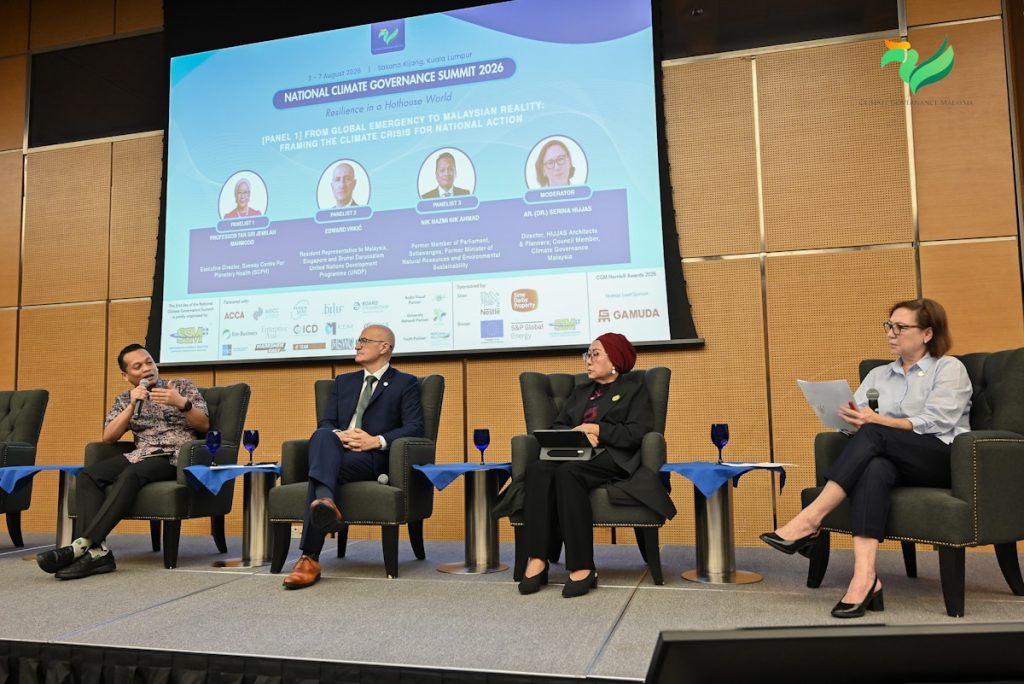
Speaking at the National Climate Governance Malaysia Summit earlier last week, Nik Nazmi said the legislation was effectively ready before he left office in May 2025, having undergone extensive consultations with state governments, industry and civil society.
“No legislation will make everyone happy. What is important is that you get something that is good enough, put it on the table and push it through Parliament,” he said, warning that continued delays risk creates uncertainty for businesses and undermines Malaysia’s climate ambitions.
The national climate change bill will be the guiding framework on Malaysia’s pathway to reduce greenhouse gas emissions. The bill was expected to complement other climate policies, including a carbon pricing framework and Malaysia’s National Adaptation Plan, but has yet to be tabled in Parliament.
He described the delay as a “missed opportunity”, noting that businesses value regulatory certainty more than concerns over stricter climate policies.
“What businesses actually fear more than carbon taxes or restrictive legislation is uncertainty,” he said. “We’ve had this discussion about a climate change bill. The prime minister announced a carbon tax in 2024 that was supposed to be implemented this year. But we keep on delaying.”
The government first announced plans to introduce a carbon tax during the tabling of the 2024 federal budget, saying it would initially apply to the iron and steel, and energy industries as part of wider fiscal reforms to support Malaysia’s low-carbon transition. However, implementation has since been delayed, with details on the tax yet to be finalised.
Nik Nazmi urged the current NRES administration led by Arthur Joseph Kurup to proceed with the legislation while also finalising Malaysia’s long-awaited National Adaptation Plan, arguing that adaptation has become an even more urgent priority for the country due to more frequent floods, rising temperatures and other climate-related impacts.
He acknowledged that the bill would likely face criticism for not going far enough but said waiting for perfect legislation would only stall progress.
“It will be imperfect, but it is good enough. You just have to bite the bullet and do it. That is where political will is required,” he said.
Beyond the legislation, Nik Nazmi said Malaysia had also missed opportunities to implement climate-friendly reforms that require no new laws, particularly by retargeting RON95 fuel subsidies and making electric vehicles (EVs) more affordable.
He noted the government spends up to RM6 billion (US$1.47 billion) a month subsidising fossil fuels, money that could instead support public services or accelerate the energy transition.
Malaysia remains among the few countries in Southeast Asia that continues to maintain broad fuel subsidies, keeping petrol prices among the region’s lowest. Economists and climate experts have long argued that better-targeted subsidies could ease pressure on public finances while encouraging greater uptake of cleaner transport options.
Nik Nazmi also questioned Malaysia’s recent electric vehicle policies that raises the price of imported EVs to RM200,000 (US$48,900), arguing that incentives have largely benefited higher-priced models instead of making EVs more accessible to the mass market.
He said climate action continues to be treated as secondary to short-term political considerations despite growing public concern among younger Malaysians.
Climate change is a national security issue
Former special adviser to the prime minister on public health, Jemilah Mahmood, who also spoke on the panel echoed similar concern around the delays to crucial policies and emphasised that Malaysia must fundamentally reframe climate change as a national security issue rather than simply an environmental or economic concern.
She said climate change threatens lives, livelihoods, health and food security, while accelerating migration and destabilising communities.
“Climate is usually filed under economic or development. It’s not. It’s a security issue. It’s a national security issue that must be taken very seriously,” she said.
Jemilah, who is also executive director of the Sunway Centre for Planetary Health, criticised the country’s lack of urgency despite mounting evidence of worsening climate impacts, from declining agricultural productivity and coastal flooding to air pollution and heat-related illnesses.
She cited the case of nine-year-old Ella Adoo-Kissi-Debrah, whose death from an asthma attack in 2013 became the first in the world to have air pollution officially recognised as a cause of death following a landmark UK inquest. The case helped galvanise tighter clean air policies in London.
By contrast, Jemilah said deaths linked to haze and air pollution in Southeast Asia have failed to generate a similar political response.
“We talked about London. It took one girl… for policies to change. Meanwhile there are many little girls who died in our region from the haze. No politician even cares about the children who have asthma,” she said, questioning why governments had not communicated climate risks with the same urgency shown during the Covid-19 pandemic, when daily public briefings became routine.
Jemilah also stressed that climate change extends far beyond carbon emissions, warning that it is already driving breaches in planetary boundaries, threatening biodiversity and coral reefs, reducing fish stocks and agricultural productivity and contributing to worsening health outcomes among vulnerable populations.
Adaptation finance needs to catch up
Picking up on the discussion, Edward Vrkić, United Nations Development Programme (UNDP) resident representative to Malaysia, Singapore and Brunei Darussalam said adaptation remains one of the world’s biggest climate finance gaps despite becoming increasingly urgent.
He noted that only around 17 per cent of global climate finance currently flows towards adaptation, with private investors continuing to favour mitigation projects such as renewable energy because financial returns are easier to quantify.
“Money is very conservative,” he said. “It goes where it is safe. It goes where it knows there will be a return. We are still trying to work out how we communicate what that return will be for adaptation.”
Vrkić argued that adaptation should be viewed as an investment that reduces future economic losses rather than simply another public cost.
He pointed to the 2021 floods in Malaysia, which he said had caused an estimated RM8 billion (US$1.95 billion) in damage to public infrastructure and around RM9.5 billion (US$2.32 billion) in lost economic activity, as evidence that investing in resilience delivers long-term financial benefits.
He also argued that adaptation, mitigation and economic development should not be treated as separate agendas, calling for climate considerations to be integrated into infrastructure planning, urban development and financial systems.
Across Southeast Asia, he estimated the region would require around US$400 billion in climate finance over the next five years, with approximately half needed for adaptation alone.
Meanwhile, Jemilah called for stronger institutional action, including an independent national climate security assessment to identify Malaysia’s biggest climate risks, similar to exercises undertaken in Australia, Germany and the United Kingdom.
She said that government action alone would not be enough and urged civil society, businesses and local governments to work together to build community resilience.
“If we want to see change, it’s not going to be just waiting for policies to fall from the sky. It has to be local.”