
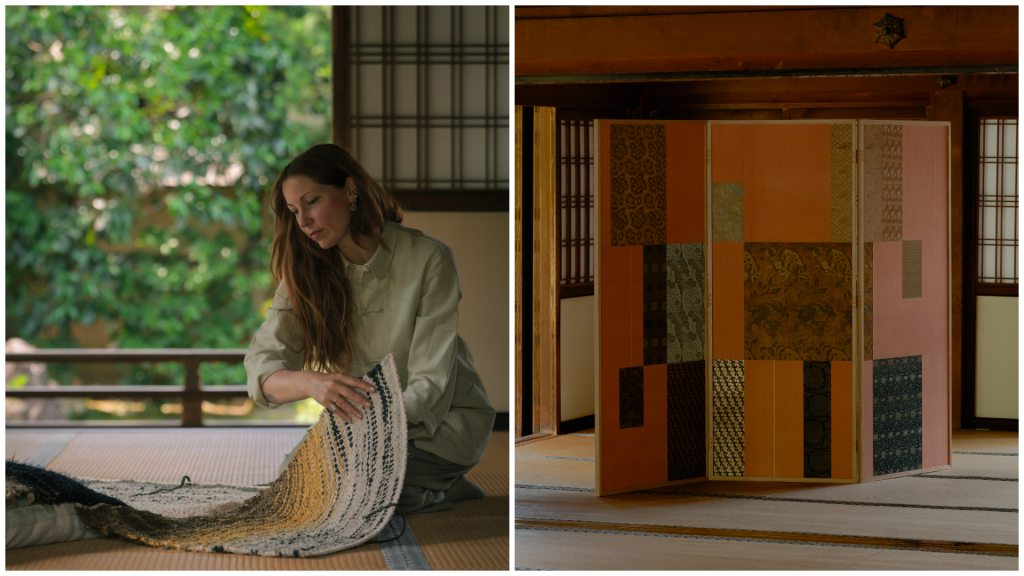
Utsuroi. This Japanese word evokes the subtle passing of time – the changing of seasons, a shift in emotions, a transition from one state to another.
It also captures the spirit of ‘Utsuroi Hymn’, an exhibition shaped by an innovative collaboration between Ryosokuin, a 14th-century Zen temple in Kyoto, and Mae Engelgeer, a Dutch textile artist and designer known for her nuanced colours and poetry of form.
This is the latest in a string of Japan-based projects for Engelgeer, who relocated from Amsterdam to Kyoto in 2023 and works with makers ranging from longtime collaborator Hosoo, the kimono textile company, to furniture maker Karimoku.
For ‘Utsuroi Hymn’, Toryo Ito, Ryosokuin’s progressive deputy head priest, gave Engelgeer unusual freedom to access the temple’s centuries-old textile archive (filled with monk robes, materials for Buddhist rituals, gifted treasures) – and reinterpret them into contemporary artworks.
The end result is a series of objects – intuitive, subtle, nuanced – currently exhibited across the temple’s tatami spaces, alcoves and teahouse. Faded edges, inner linings, layered fragments, paper wrappings: Engelgeer focuses on the beauty of lesser-seen elements. Three hanging works – echoing traditional kakejiku scrolls – subtly layer time-etched tones into a soft geometry, lightly framed in cedar.

(Image credit: Photo by Ryo Kawano. Courtesy of Ryosokuin )
Capturing light on tatami are also two folding byobu screens, with collage-like layers and traces of patterns in silk and hemp, plus minimal yellow lines on a blush pink textile – an example of Engelgeer’s quiet yet connective interventions. Textiles were also cut into threads, before being woven into rug-like shapes mirroring the paper wrappings that contain the archive’s textiles.
‘Traditionally, when temple textiles became damaged, they were resized and transformed into smaller utilitarian objects,’ Ito tells Wallpaper*. ‘In this project, however, we approached the archive artistically, allowing both preservation and new life to coexist through a series of works.’
He adds: ‘A quiet sense of luxury emerges through the layering of subtle and almost imperceptible elements. There are still countless treasures sleeping quietly in Kyoto, throughout Japan, and across the world. I hope this project becomes a small stone that awakens them.’
Utsuroi Hymn is on view until 7 July 2026, Ryosokuin Zen Temple, Kyoto
Mae Engelgeer on working in Japan

(Image credit: Photo by Ryo Kawano. Courtesy of Ryosokuin )
For Engelgeer, Japan is a source of rich inspiration, with her work appearing in a growing number of projects – from the Dutch Pavilion at last year’s Osaka Expo to the noren entrance curtains at newly opened Capella Kyoto.
Here, Engelgeer talks to Wallpaper* about her creative journey from Amsterdam to Kyoto, the beauty of imperfection and the ‘soft power’ of textiles.
Wallpaper*: Why did you move to Kyoto?
Mae Engelgeer: I decided to move to Amsterdam after cycling around on a borrowed bike. The freedom, excitement and opportunity I felt made it clear I needed to be there. Then, after half my life in Amsterdam, I had the same feeling in Japan. There’s so much to discover artistically here, in terms of techniques, textiles and materials. It’s also about living at a calmer pace. I had built up a network over 10 years, travelling between Amsterdam and Kyoto, so knew this was the next step and a life-changing adventure for my family. For me, as an artist and designer, I just get this sparkling feeling here. I’m inspired and curious.
W*: Can you sum up Kyoto?
ME: Treasures – often hidden. Green – from nature to food. Time – coffee, patience, Zen.
W*: What was the seed of Utsuroi Hymn?
ME: I was first invited to Ryosokuin a few years ago. I immediately noticed its special atmosphere. Ito-san told me the temple holds a textile archive. Until then, I’d never realised that textiles were historically offered to temples because of their value and significance. What moved us both was the idea that these textiles, although incredibly beautiful, were no longer used. They were slowly ageing, almost disappearing into storage, while still carrying so much history. From there, the idea emerged to create artworks that could allow these textiles to find their way back into the temple space in a contemporary form.

(Image credit: Photo by Ryo Kawano. Courtesy of Ryosokuin )
W*: What was it like working with such historic textiles?
ME: When I first viewed the archive, I was beyond excited. The textiles were carefully wrapped in layers of paper, marked with handwritten Japanese text. I took time with each piece – slowly opening the packages, unfolding the fabrics, looking at both the front and back, really absorbing every detail. The richness of the patterns, the colours, the craftsmanship – everything felt incredibly refined and thoughtful.

(Image credit: Photo by Ryo Kawano. Courtesy of Ryosokuin )
W*: What stood out most?
ME: Their traces of time: the transparency of certain fabrics, the vibrancy of the colours, the handwritten text on the reverse sides and areas almost falling apart from years of folding or use. For me, those marks of time are incredibly beautiful. Rather than hiding them, I wanted to highlight them.
W*: What did the creative process look like?
ME: My projects rarely begin with a fixed plan – they evolve slowly through spending time with the materials. So the starting point developed very intuitively. I spent hours inside the archive, surrounded by the fabrics, observing them closely. I started by dividing and grouping the different textiles I encountered, paying attention to their textures, colours, transparency, wear and structure.

(Image credit: Photo by Ryo Kawano. Courtesy of Ryosokuin )
‘My projects rarely begin with a fixed plan – they evolve slowly through spending time with the materials’
Mae Engelgeer
W*: And how did the works take shape?
ME: I was drawn to forms that are deeply connected to Japanese history and daily life, such as byobu folding screens and kakejiku hanging scrolls. Because weaving, tapestry and rugs are such an important part of my practice, I also wanted to create new woven works inspired by sakiori, a traditional Japanese weaving technique using strips of old fabric to create something new. I was very moved by the idea of transformation, reuse and continuation through material.

(Image credit: Photo by Ryo Kawano. Courtesy of Ryosokuin )
W*: What message are you hoping to convey with these creations?
ME: I was very conscious that these were not just for today, but for future generations. Through the structures, the fading of colours, the rhythm and order of the fabrics and the traces of time, I hope the works create subtle gestures that resonate with people and stay with them emotionally. And I hope this archive can continue into the future through these artworks.
W*: It’s been three years now: how is living in Kyoto shaping you creatively?
ME: Living here has gradually deepened my creative practice in a very natural way. While I continue to work internationally and remain connected to other places, being here has introduced a completely new layer to my work and opened a different direction within it.

(Image credit: Photo by Ryo Kawano. Courtesy of Ryosokuin )
‘I often work with century-old archives, traditional techniques or stories and philosophies that carry a very long cultural memory. I think my role is often to gently transform, twist or highlight an existing element and help shape it towards the future while still respecting its origin’
Mae Engelgeer
W*: In what way?
ME: Often, new works begin from materials or details I encounter in my immediate surroundings – and that instinct has not changed. What has changed in Japan is the depth of history connected to those materials and processes. Here, I often work with century-old archives, traditional techniques or stories and philosophies that carry a very long cultural memory. I think my role is often to gently transform, twist or highlight an existing element and help shape it towards the future while still respecting its origin.

(Image credit: Photo by Ryo Kawano. Courtesy of Ryosokuin )
W*: How does Japan’s textile culture compare to other places?
ME: It feels very unique because of the deep respect for material, process and the time embedded within it. Europe also has an incredible textile history and craftsmanship – but in Japan I feel a strong sensitivity towards preservation and continuity: the idea that textiles are not simply functional or decorative objects, but carriers of memory, ritual and care.
W*: And how about the craftsmanship world?
ME: For me, the process of testing possibilities and pushing materials or techniques into new territory is an essential part of developing new work. For these temple works, I had the opportunity to collaborate with two craftsmen who were very open to experimentation and exploring less conventional requests. What I appreciated in these collaborations was the openness and curiosity on both sides – finding ways to translate historical materials and traditional craftsmanship into something contemporary together.

(Image credit: Photo by Ryo Kawano. Courtesy of Ryosokuin )
‘In Japan I feel a strong sensitivity towards preservation and continuity: the idea that textiles are not simply functional or decorative objects, but carriers of memory, ritual and care’
Mae Engelgeer
W*: And concepts of beauty?
ME: In Japan, imperfections, ageing, fading or repair can become part of the beauty of a textile rather than something to hide. What I enjoy most is being able to exist between those worlds – bringing my own European perspective and experimental approach into dialogue with Japanese craftsmanship and philosophy. That exchange is very inspiring for me creatively.
W*: What are you seeking in your creative work?
ME: I am always searching for a certain softness – even though my compositions are often quite graphic and structured, I want the lines and materials within them to remain organic and natural. I’m not interested in forcing materials into something too controlled.

(Image credit: Photo by Ryo Kawano. Courtesy of Ryosokuin )
W*: What’s coming next?
ME: ‘Tsudoi / Gathering’, an exhibition presented in Karimoku Commons Kyoto earlier this year will move to Tokyo in July. I’m also preparing a joint exhibition, ‘Echoes of Wa’, at Spazio Nobile in Brussels with ceramics master Hosai Matsubayashi in September. For this, I’m also experimenting with chochin lantern-making and bamboo. I’m also deepening my collaboration with textile house Hosoo, gently challenging their machines and traditional weaving, exploring how far we can push the technique while still respecting its precision and heritage.
W*: And your longterm hope?
ME: What connects everything for me is the soft power of textiles – their ability to carry memory, emotion and history in a subtle but profound way. Many works I’m making at the moment feel like starting points. My hope is to continue building on these – and continue exploring how the soft power of textiles can shape how we experience spaces.

(Image credit: Photo by Ryo Kawano. Courtesy of Ryosokuin )

(Image credit: Photo by Ryo Kawano. Courtesy of Ryosokuin )

(Image credit: Photo by Ryo Kawano. Courtesy of Ryosokuin )

(Image credit: Photo by Ryo Kawano. Courtesy of Ryosokuin )