
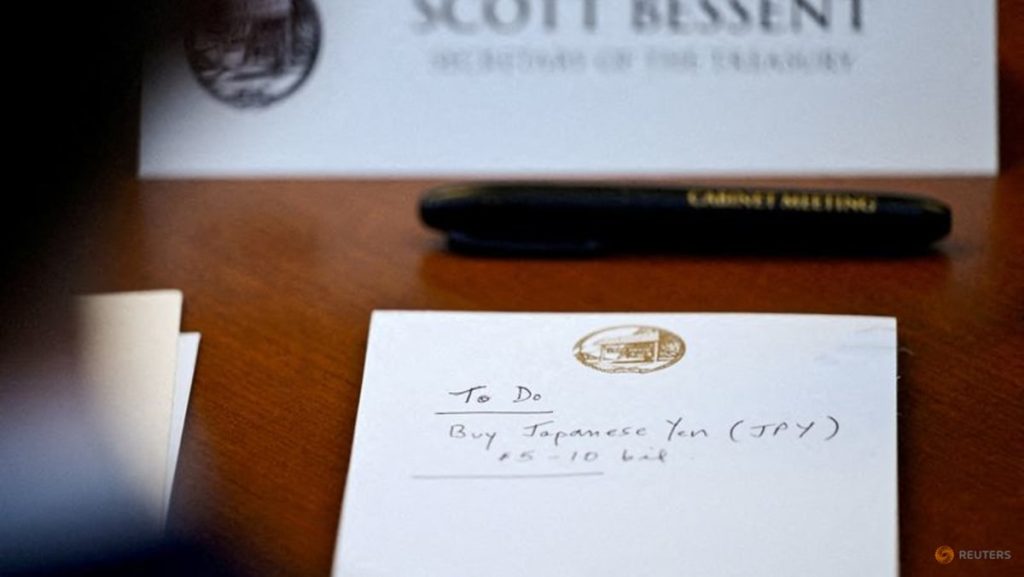
LONDON: The yen jumped suddenly against the dollar again on Friday (Aug 7) after a surprisingly weak US employment report, with traders alert to the prospect of intervention just a few days after Japanese and US authorities jointly stepped into the foreign exchange markets to lift the stubbornly weak Japanese currency.
The dollar fell by as much as 1.1 per cent to 156.68 JPY= and was last trading at 157.16, well away from the 40-year high of 163.99 hit in July.
It was not immediately clear whether Japanese authorities were involved, although analysts said the weakness in the jobs data could be reason enough to sell the dollar.
“The scale of the undershoot on payrolls means it makes sense for the dollar to be falling – look at the short end of the US yield curve – so the currency moves look like they are fundamentally driven,” Lee Hardman, senior currency analyst at MUFG said referring to the sharp drop in 2-year Treasury yields.
“It’s very rare you get these negative prints, so it’s a big downside surprise that has definitely put a dampener on expectations for the Fed and we’d expect to see a significant reaction and a broad based dollar selloff.”
Nonfarm payrolls decreased by 23,000 jobs last month after a downwardly revised 20,000 increase in June, the Labour Department’s Bureau of Labour Statistics said in its closely watched employment report on Friday. Economists polled by Reuters had forecast payrolls rising 80,000 after advancing by a previously reported 57,000 in June. Estimates ranged from as low as 10,000 to as high as 140,000 jobs added.
Just after the release of the payrolls data, the Japanese finance minister said Washington and Tokyo had been “closely communicating” and would not hesitate to intervene.
The threat of intervention has loomed large this week after Japan and the United States conducted coordinated yen-buying intervention last Friday, confirming a rare bilateral action to halt the yen‘s slide.