
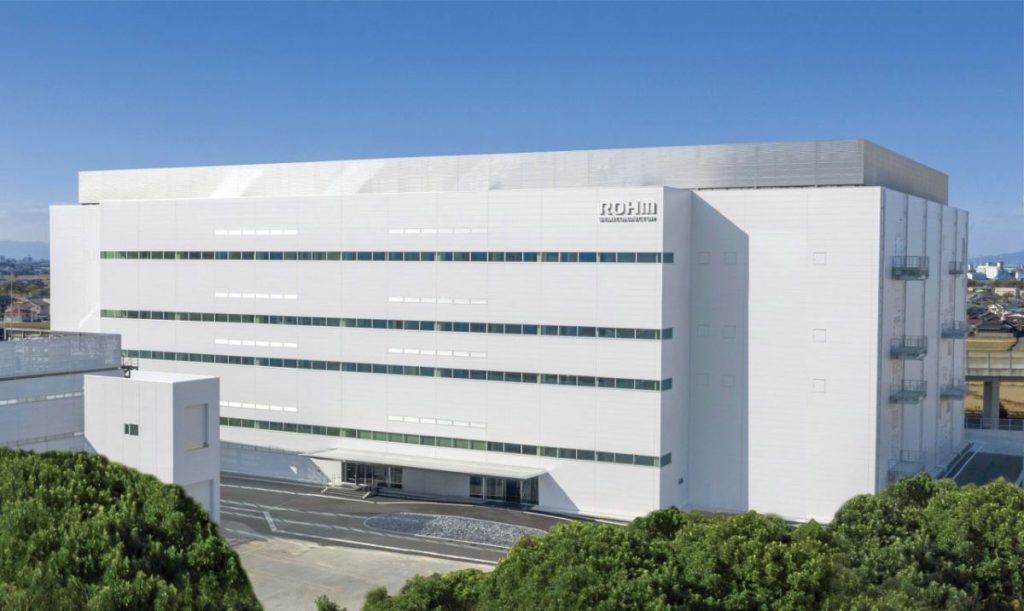
Japanese automotive firm Denso’s decision to retract its acquisition proposal of Rohm has shifted the focus of domestic restructuring in the power semiconductor sector to three-way talks among Mitsubishi Electric, Toshiba, and Rohm.
If the three companies succeed in integrating their operations, Japan would gain a national semiconductor giant with roughly 10% global market share, enough to rank as the world’s second-largest player in the industry.
With the country’s economic ministry backing the restructuring, the outcome will serve as a key test of whether domestic companies can compete globally against rivals from Europe, the US, and China.
“It is important for Japanese companies to come together as much as possible and avoid falling behind other countries,” Mitsubishi Electric’s President Kei Uruma said at a financial results briefing on April 28, when asked about the significance of the possible integration.
A Race for Scale
Power semiconductors, used to control electricity in a wide range of products from electric vehicles to data center servers, are expected to be a high-growth field in the coming years.
At present, European and American companies dominate the global market share, with Germany’s Infineon Technologies at the helm. Meanwhile, Chinese firms are rapidly catching up through aggressive low-priced offerings.
According to Infineon Technologies data, Infineon held the top share in 2024 at 17.4%, followed by US-based Onsemi at 8.5%. Among Japanese firms, Mitsubishi Electric ranked fourth with 4.6%, while Toshiba placed 10th with 2.6%. Rohm’s share is believed to be close to that of Toshiba.
If the three Japanese companies were to merge their power semiconductor businesses, their simple aggregated share would be on par with Onsemi’s.
Each company brings distinct strengths. Rohm has an advantage in automotive applications, Toshiba has a broad customer base in the power sector, including power plants, and Mitsubishi Electric is strong in industrial fields such as railways.
A three-way integration is therefore seen as offering considerable potential benefits.
A Bigger Bet Ahead
Still, the real negotiations are only just getting underway. At the briefing, Uruma said the plan would likely involve spinning off each company’s power semiconductor business and placing them under a newly established joint venture.
But when asked about the timing of a concrete agreement, he said only that he hoped the parties would “reach an agreement as soon as possible.”
Negotiations could take time, as the three firms may face difficult adjustments over issues such as their respective stakes in the new venture.
Fuji Keizai, a Japanese research firm, expects the global market for power semiconductors to grow to $49 billion by 2035, 2.3 times its 2024 level, driven by factors like the electrification of automobiles.
To capture that growth, the three companies will need to go beyond simply increasing their scale. They will have to present a concrete scenario for how the integration would translate into stronger global competitiveness.
RELATED:
Author: Takehiko Nagata, The Sankei Shimbun
(Read this article in Japanese)