
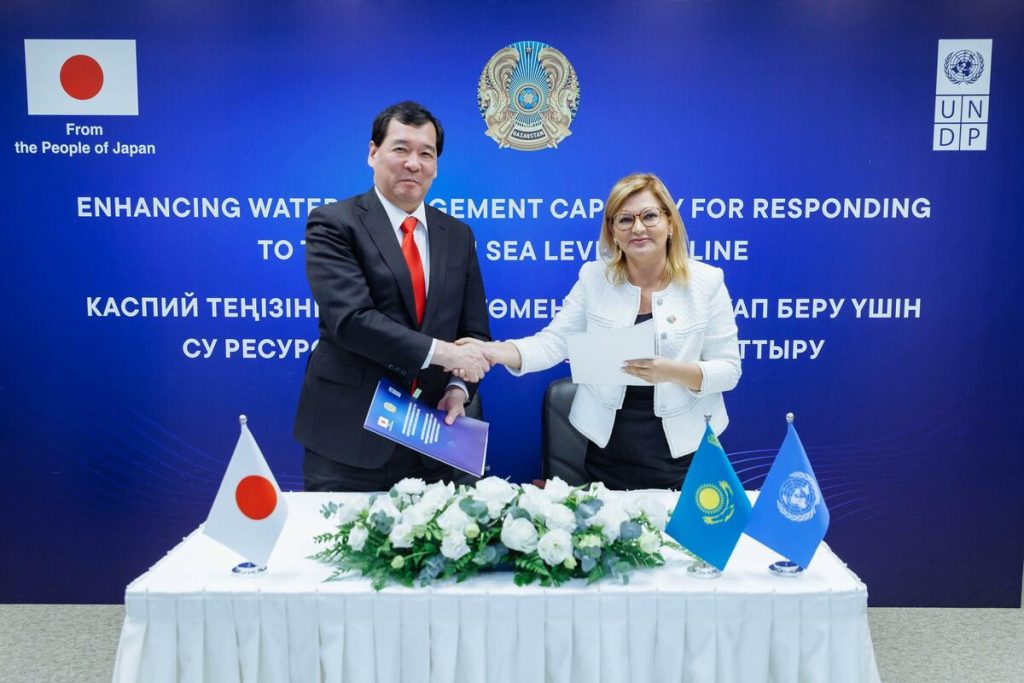
TOKYO – Japan has partnered with the U.N. Development Program to support Kazakhstan’s efforts to address the decline in the Caspian Sea’s water level driven by climate change, pledging a 465 million yen ($3 million) grant toward its sustainable use.
Under the initiative for the world’s largest inland water body, Japan hopes to promote cooperation among littoral states on water resource management and enhance monitoring systems, the Foreign Ministry said. The decline in the Caspian Sea’s water level could have an immense impact on logistics and regional ecosystems.
Japanese Ambassador to Kazakhstan Yasumasa Iijima and UNDP Resident Representative in Kazakhstan Katarzyna Wawiernia signed the agreement on the initiative in Astana in late May.
The UNDP said in its press release the Caspian Sea is “one of Eurasia’s most critical ecological zones” that supports the livelihoods of millions of people.
In recent years, however, rising temperatures have reduced both the volume of water in the Caspian Sea and inflows from rivers, causing a rapid drawdown and concerns over the disruption of maritime transportation and the possible extinction of endemic species.
According to data from the U.S. National Aeronautics and Space Administration, water levels have dropped more than 2 meters in the past 30 years, with NASA projecting that they could fall by another 8 to 30 meters by 2100.
Kazakhstan has a “heightened sense of urgency” about the issue as part of the northern side of the Caspian Sea is shallow and the impact on the nation of water level declines could appear sooner, according to a Japanese Foreign Ministry official.
The move comes after Japan hosted its first summit with the five Central Asian states including Kazakhstan last December, affirming the importance of the Trans-Caspian International Transport Route linking Central Asia with Europe, which bypasses Russia, amid Moscow’s full-scale invasion of Ukraine since 2022.
Also surrounded by Azerbaijan, Iran, Russia and Turkmenistan, the Caspian Sea is home to major oil fields in which Japanese companies such as energy giant Inpex Corp. and major trading house Itochu Corp. hold stakes.