
India has moved to consolidate ties with allies in the Pacific following signs the US has opted to slightly downgrade its strategic partnership with New Delhi.
The US Department of Defence announced two weeks ago that the US Indo-Pacific Command will officially revert to its previous name, the US Pacific Command.
Some analysts have said the change signals India has a “decreasing significance” in Washington’s strategic thinking, partly because it allows Washington more flexibility to deal with Pakistan, India’s neighbour and rival. The two sides have also struggled to reach a free-trade agreement.
ALSO SEE: China Puts ‘National Security’ Rules on Overseas Investments
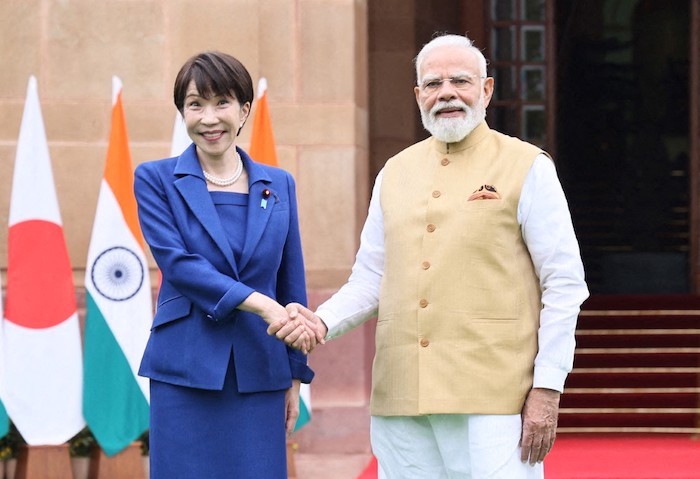
India has moved quickly to respond to that snub, with Prime Minister Narendra Modi hosting Japanese PM Sanae Takaichi on Friday for a bilateral business forum, and the pair agreeing to deepen defence and economic security ties.
Modi said after his talks with Takaichi that the countries had agreed to “strengthen supply chain resilience in strategic sectors such as semiconductors, quantum technologies and critical minerals”.
The two sides concluded over 120 bilateral agreements and business deals worth approximately $12.3 billion, focusing on artificial intelligence (AI), defence co-development, energy resilience, and economic security
Takaichi said Japan and India were facing challenges, including “weaponisation of the economy and non-market policies and practices”.
This week, China’s commerce ministry added 20 Japanese entities to an export blacklist on the basis that they had boosted Tokyo’s military capabilities.
Japan called the latest move “unacceptable and deeply regrettable”, demanding its reversal.
Modi to visit Jakarta, Melbourne, NZ
New Delhi also announced that Modi will visit Indonesia, Australia and New Zealand next week, as the country seeks to strengthen ties in the region.
India’s external affairs ministry said the July 8-11 tour reflects a shift in diplomatic focus to the eastern maritime region under its ‘Act East’ policy.
“The focus has shifted to the eastern maritime zones of the Indian Ocean and our Act East engagement,” senior Indian foreign ministry official Rudrendra Tandon told reporters at a news briefing.
Modi will visit Indonesia on July 8 and 9, where he will hold talks in Jakarta, to review cooperation across a range of sectors, such as maritime security, defence, trade and cultural ties, Tandon said.
Modi will then travel to Melbourne on July 10 for the third India-Australia Annual Summit, a dialogue established under the two countries’ Comprehensive Strategic Partnership launched in 2020.
Tandon said discussions would review cooperation across defence, foreign policy and trade, while also focusing on newer areas including critical minerals, cybersecurity, supply chain resilience and emerging technologies.
Modi will finish the tour in New Zealand on July 11, where he will hold talks with Prime Minister Christopher Luxon. Tandon said bilateral ties had gathered momentum since Luxon’s visit to India in 2025 and the signing of a free trade agreement in April.
EU wants action from China on trade imbalance
Meanwhile, the EU’s upcoming trade talks with China must deliver results, European Commission head Ursula von der Leyen warned on Friday, as the bloc weighs action to address its trade imbalances with Beijing.
Von der Leyen’s remarks came after talks on Monday between top European and Chinese trade officials. They follow comments by EU trade commissioner Maros Sefcovic, who said he made it clear to China’s Commerce Minister Wang Wentao that “the status quo is not an option.”
Sefcovic said Brussels wants “tangible results” by October because “China’s exports to the EU keep rising, while our market share in China keeps shrinking, and this trend is not sustainable.”
Sefcovic and Von der Leyen, who visited Cork city on Friday as Ireland kicked off its six-month presidency of the bloc, both said they want to try to resolve the trade crisis.
“But the dialogue also has to deliver,” von der Leyen told reporters.
She added the EU had to be “very clear” in its talks, raising issues including “the subsidised overcapacity of goods coming to our market to a lack of market access of our companies at the Chinese market”.
She also pointed to “the unfair competition because of the subsidies that we do not want to see any more on our market”.
Between 2005 and 2024, Chinese firms received around three to eight times more government support than companies in countries belonging to the Organisation for Economic Cooperation and Development (OECD).
Von der Leyen warned the EU was ready to act if it did not see change.
‘Prepared for everything’
“We are basically prepared for everything, and we have all instruments on the table, and we are thinking about other possibilities if necessary,” she said.
The talks on Monday included export controls on rare earths and permanent magnets. Sefcovic, who is due to fly to Beijing in October, said Wang reassured him that “existing export controls on rare earth and permanent magnets will not disrupt EU supply chains.”
“Not everything will be fixed, but we think that between now and October our teams have sufficient time to deliver the tangible results,” Sefcovic said on Monday.
EU leaders last month tasked the commission, the bloc’s lead on trade policy, to continue talks but also to prepare new tools to protect the bloc’s industries.
Europe’s trade deficit in goods with China hit around 360 billion euros ($411 billion) in 2025, meaning the bloc imported way more from the Asian giant than it exported there.
The issue is existential for the EU, which fears it will lose certain industries entirely if it does not act against a glut of inexpensive goods made in China threatening manufacturers in Europe.
Subsidies give an ‘unfair advantage’
Brussels says Chinese firms have an unfair advantage because of massive state subsidies. And the numbers support their argument.
The 27-country European Union’s trade deficit in goods with China hit around 360 billion euros in 2025, meaning the EU imported way more from the Asian nation than it exported there.
The EU already has an arsenal of trade defence tools it can use. These include imposing higher tariffs if investigations prove that companies are selling goods at unfairly low prices or if there is state support that gives an unjust advantage to the manufacturers.
Brussels could also set restrictions known as safeguard measures – including quotas – if there is a sudden surge in imports.
And new measures could be on the way. The commission, which leads EU trade policy, is working on an instrument that would force businesses to diversify their suppliers in critical sectors like chips and rare earths.
The bloc has taken several measures to confront soaring imports from China, including doubling its duties on foreign steel, imposing higher levies on small parcels from abroad and hefty tariffs on Chinese-made electric vehicles.
But it still hopes to avert a trade war with its second-largest trading partner for goods alone, according to the European Commission – with China making clear it will retaliate against actions it views as unfair.
The EU does not view this as empty threats. In previous retaliatory steps China slapped duties on European cognac and conducted anti-dumping probes into pork and dairy products.
Meanwhile, on Wednesday, the EU began to implement the tariff deal it struck last year with the United States, the European Commission said, just ahead of a July 4 deadline set by President Donald Trump.
“Promise made, promise delivered,” EU spokesman Olof Gill told reporters on Tuesday, as texts enacting the bloc’s side of the accord were published in its official journal.
Asian markets rise
Meanwhile, major stock markets rose mostly on Friday as tech firms rebounded, while a sizeable miss on US jobs creation soothed worries over a Federal Reserve interest-rate hike.
Oil prices steadied as markets tracked developments in the US-Iran talks and traffic flows through the Strait of Hormuz.
The dollar dropped against main rivals on receding prospects of tighter US borrowing costs.
“A mixture of relief post the payrolls data, a reversal of the sell-off in the chip stocks and more volatility in the yen are the main narratives,” noted Kathleen Brooks, research director at XTB trading group, AFP reported.
Investors welcomed key data on Thursday showing the US economy added fewer than half the jobs forecast in June, while figures for the previous two months were revised down.
The readings suggested the labour market was not as strong as thought, and hands the Fed some breathing room to hold off from hiking rates, boosting global markets.
Speculation had grown since the central bank’s June policy meet that it would announce a rate increase this year because of elevated inflation and after new Fed boss Kevin Warsh said price stability was his key goal.
Against such a backdrop, the likelihood of a US rate hike before the end of the year remains, according to some analysts.
“The US labour market today is not strong enough to instigate rate hikes but importantly is no longer a handbrake or impediment to hikes,” said Rodrigo Catril, analyst at National Australia Bank.
Concerns about surging valuations for technology companies amid a race for all things AI continued to dominate sentiment.
Seoul’s Kospi stocks index closed up 5.8% Friday – having tanked by about 20% from its June 19 record high – boosted by strong rallies in technology firms SK Hynix and Samsung.
Tokyo climbed more than 1%, along with Hong Kong, Manila, Bangkok and Jakarta.
European indices largely rose, though London dipped as a stronger sterling makes UK exports more expensive.
The gains for global equities followed Thursday’s mixed session on Wall Street, where the tech-heavy Nasdaq sank 0.8%. The Dow jumped more than 1%, however, ahead of the American Independence Day holiday.
ALSO SEE:
Tech Rules Needed So World Doesn’t Lose Control of AI: China
Yen Sinks to 40-Year Low Amid Deepening Row With China
Kospi, Nikkei, Hang Seng Sink as Tech Doubts Rock Asia Again
Vast Amount of Rare Metals Found Off Remote Japanese Isle
China Curbs Rare Earth Exports to Defence Firms, Chipmakers
China’s Spat With Japan Derails Bid to Join CPTPP Trade Bloc
Lessons From Japan on Tackling China’s Rare Earth Dominance
