
KYOTO –
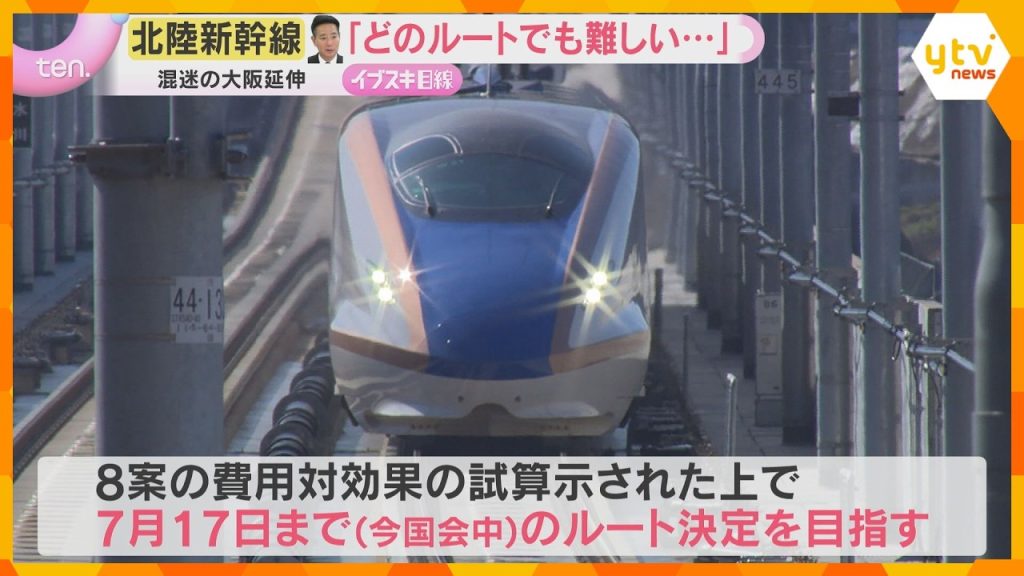
The route dispute surrounding the extension of the Hokuriku Shinkansen to Osaka has been thrown back into uncertainty, with the long-discussed “Obama-Kyoto Route” effectively returned to square one as ruling coalition lawmakers consider eight alternative plans, including a route via Maibara Station in Shiga Prefecture.
The Hokuriku Shinkansen was first outlined in 1972 in former Prime Minister Kakuei Tanaka’s influential book “Remodeling the Japanese Archipelago,” published the same year the Sanyo Shinkansen opened between Shin-Osaka and Okayama.
By 1985, Tanaka was already publicly describing a concrete route plan.
“This route has already been properly decided,” Tanaka, then 66, said at the time. “From Nagano Prefecture to Toyama, 290 kilometers. Then from Toyama through Takaoka, Kanazawa, Tsuruga, Obama and on to Osaka for another 300 kilometers. No matter how late, Japan’s Shinkansen network should be completed within the 10 years from fiscal 1986 to fiscal 1995.”
Nearly 40 years after that speech, however, political wrangling over the route continues.
More than a decade ago, the Hokuriku Shinkansen began operations between Tokyo and Kanazawa before later extending to Tsuruga. The unresolved issue now is how to connect the line onward to Osaka.
In 2016, the government selected the “Obama-Kyoto Route,” which would pass through Obama City in Fukui Prefecture and Kyoto Station. However, after the Japan Innovation Party joined the ruling coalition framework, the plan was reopened, with eight route options now under consideration, including the “Maibara Route,” which would link the line to Maibara Station in Shiga Prefecture.
Seiji Maehara, co-chair of the ruling coalition’s Hokuriku Shinkansen development committee and a member of the Japan Innovation Party, acknowledged the previous decision but indicated the debate had shifted.
“We fully understand that various discussions led to the selection of the Obama-Kyoto Route once before,” Maehara said. “But in Kyoto, there are calls to halt the Obama-Kyoto Route and instead place the Maibara Route on the table.”
Opposition has also come from the Kyoto Buddhist Association, which argues that tunnel construction could damage underground water systems and alter the historic city irreversibly.
“We are not in a position to say which course is good or bad,” said Yasutoshi Miyagi, senior executive director of the Kyoto Buddhist Association and head priest of Shogoin Temple. “But we oppose digging beneath Kyoto in ways that could change the city’s future.”
Construction costs have also become a major concern. Initially estimated at around 2.1 trillion yen, projected costs have ballooned to as much as 5.3 trillion yen depending on the route selected.
Amid growing attention over which route may ultimately be chosen, the ruling coalition’s Hokuriku Shinkansen committee recently held hearings with business leaders in the Kansai region.
Shortly afterward, Maehara made remarks that further deepened uncertainty surrounding the project.
“Without revising the cost-sharing ratio with the national government, we will not be able to reach a route decision,” Maehara said. “There is even a possibility that every route may prove difficult.”
Although the Kansai Economic Federation expressed support for the Obama-Kyoto Route during the hearings, Maehara’s comments have shaken the foundation of years of prior discussions.
The government is aiming to decide on a final route during the current Diet session, which runs through July 17th, after releasing cost-benefit analyses for all eight proposals. However, the outcome remains far from certain.
Source: YOMIURI