
America wants more Indian mangoes. Indian farmers are ready to supply them. What’s missing is the infrastructure and political will to bridge the gap.
آم کی خوشبو میں چھپی ہے مٹی کی کہانی
Aam ki khushbu mein chhupi hai mitti ki kahani
(In the fragrance of the mango lies the story of the soil)
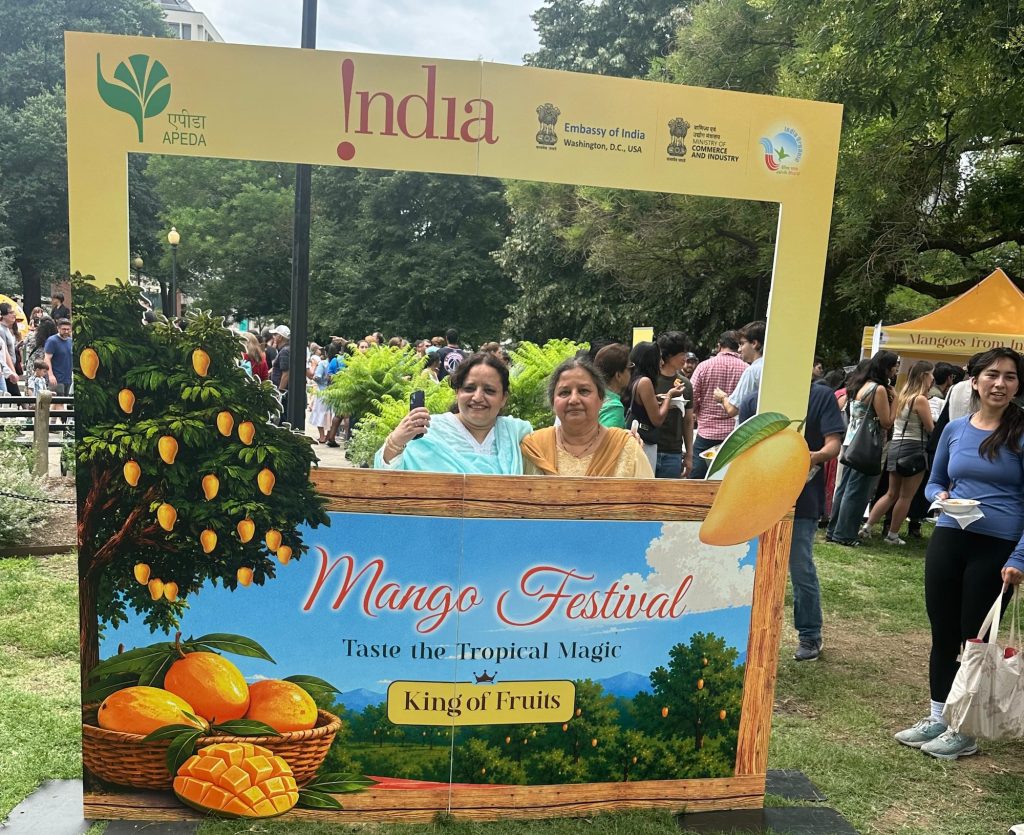
On a warm Saturday in Washington, D.C., I stood in a line that stretched well past five hundred people. The occasion was a mango festival organized by the Embassy of India, held under the shade of old trees at the iconic Dupont Circle.
On a bright banner behind me, three names gleamed in yellow and green: Langra from Uttar Pradesh, Malda from West Bengal, Ripe Rajapuri from Gujarat and Maharashtra. I looked at that banner and felt something that cannot be easily explained to someone who did not grow up in the mango belt of northern India. This was not just fruit. This was history, soil, and the labor of generations.
I am from Malihabad, in Lucknow district of Uttar Pradesh — a town that does not require introduction among those who know mangoes. Malihabad is the mango capital of India, perhaps of the world. The Dusehri that ripens there has no rival in its honeyed sweetness, its absence of fiber, its fragrance that fills a room before the fruit is even cut.
READ: Indian Mango Festival to bring rare sweet varieties to New York City (June 23, 2026)
Malihabad is my mother’s birthplace, where I spent my childhood. The mango orchards there are not an abstraction for me — they are a memory, a smell, a feeling of summer mornings that no amount of time in America has erased. And my cousin, Insram Ali, serves today as the President of the All India Mango Growers Association — not a local post, not a district honor, but a national leadership position representing the interests of growers across India.
So when I stood in that line in Washington, I was not merely a spectator at a cultural event. I was a link in a chain that runs from the orchards of Malihabad to the diplomatic halls of the American capital.
The story of Indian mangoes reaching American tables is not a simple one, and it deserves to be told with the names of the people who made it possible. Chief among them is Dr. Islam Siddiqui, a friend of mine whose contribution to this quiet revolution in agricultural diplomacy has never received the public recognition it warrants.
During the Clinton Administration, Dr. Siddiqui served at the United States Department of Agriculture as Undersecretary for Marketing and Regulatory Programs. In that capacity, he worked through the formidable regulatory and trade barriers that had kept Indian mangoes out of the American market for decades. The groundwork he laid was the result of sustained technical and diplomatic effort — and his fingerprints were all over it.
What few people know is that I had been pushing for this opening since the Clinton era. I raised it with Dr. Siddiqui then, arguing that the American market was ready, that the Indian diaspora would provide an immediate consumer base, and that the soft power value of a Dusehri or a Langra on an American plate was worth more than a hundred diplomatic speeches. It took years. It took patience. It took someone with Dr. Siddiqui’s technical expertise and political positioning to finally move the needle on the American side.
READ: San Francisco hosts popular Indian mango festival, attracting hundreds of visitors (June 2, 2026)
The requirements were strict. The United States demanded that Indian mangoes undergo irradiation treatment to neutralize pests before entering the country. This was a non-negotiable phytosanitary condition. India agreed. And slowly, carefully, the first shipments began arriving.
Which brings me to the painful part of this story.
The door has been open for nearly two decades. The American market is willing. The diaspora is hungry — I watched five hundred of my fellow South Asians stand in a line in summer heat for a taste of home. And yet India exports only a fraction of what it could, because the country lacks adequate irradiation treatment facilities. The cold chain infrastructure is insufficient. The post-harvest logistics from the orchards of Malihabad to the ports remain underdeveloped.
My cousin Insram Ali, as the President of the All India Mango Growers Association, has been raising this issue with government authorities. The growers know what is possible. They see the demand. They understand that a Langra or a Dusehri that can command premium prices in New York or Washington would transform the economics of the Malihabad belt overnight. But the treatment plants are not there. The government has not invested. The promise of doubling farmer income remains exactly where it has been for years — in speeches.
This is the Modi government’s agricultural paradox in concentrated form. The Embassy of India organizes a beautiful mango festival in Washington, D.C. The banners are colorful, the fruit is fresh, the crowd is enthusiastic. But the actual farmers who grew those mangoes — men like those my cousin represents — cannot get their fruit to this market at scale because the basic infrastructure that would make it possible has not been built.
READ: Demand for Indian mangoes in the US surges despite high costs (May 4, 2026)
Mango diplomacy is real. The soft power of a perfectly ripe Dusehri placed before an American who has never tasted one is genuine and lasting. I have seen it work. I believed in it before the government did. Dr. Islam Siddiqui gave it legal and regulatory shape on the American side through years of painstaking work during the Clinton era. The growers of Malihabad, led today by Insram Ali, are ready to deliver on the production side.
The only missing piece is political will in New Delhi to build the treatment plants, upgrade the cold chain, and connect the orchards of UP to the markets of America.
Until that happens, the Embassy will keep organizing festivals. The diaspora will keep standing in line. And the farmers of Malihabad will keep watching an opportunity ripen and fall.