
April 28, 2026
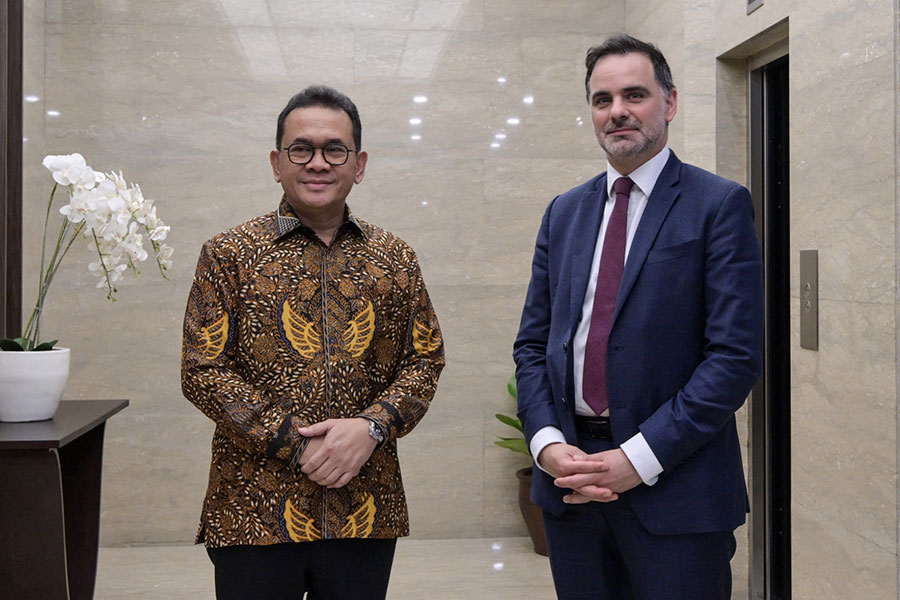
JAKARTA – Trade Minister Budi Santoso has defended the government’s decision to pursue a trade agreement with the United States, known as the Agreement on Reciprocal Trade (ART), which has been criticized for placing Indonesia in an unequal position with the world’s largest economy.
“This is the right time,” Budi told The Jakarta Post on Wednesday, saying that Indonesia had sought a broader trade framework with the US for decades.
He also called the agreement is “an opportunity” amid the global shift toward protectionism in which countries increasingly rely on tariffs and other unilateral measures to support domestic industries.
Indonesia and the US signed the Trade and Investment Framework Agreement (TIFA) in 1996, but negotiations failed to produce a comprehensive deal in nearly 30 years, while in contrast, the ART was concluded far more quickly.
“In principle, this trade agreement is like any other trade relationship, it is about increasing exports for both sides in a mutually beneficial way,” he said.
The US has emerged as Indonesia’s largest source of trade surplus, with Indonesian exports reaching US$30.9 billion and generating a $18.11 billion surplus, surpassing India.
The market currently accounts for 11 percent of Indonesia’s exports, which the minister opined that it would be hard to shift it elsewhere. It makes continued access critical, particularly for labor-intensive manufacturing sectors, including textiles, footwear and electronics.
“We know the market is large and our potential is significant,” Budi said, stressing that the government is steadfast in protecting the country’s national interests, particularly preserving export competitiveness.
‘No obligation’ to buy American goods
The minister also pushed back against criticism that the ART would encourage a flood of US imports into Indonesia, saying the agreement mainly creates optional market access rather than obliging Indonesia to buy more American goods.
Indonesia already imports key agricultural commodities such as wheat and soybeans from the US at zero tariffs. Any future imports under the ART, he said, would merely shift sourcing from other countries rather than widen the trade deficit.
“If our trade balance with the US becomes more balanced, that’s fine. Overall, we aim to keep our global trade balance in surplus. This would mainly be a matter of reallocating sourcing. For example, if we import wheat, part of it may shift from country A to the US, it doesn’t necessarily mean we are increasing total imports,” he said.
Budi, who is a career bureaucrat who rose to the top position in the ministry, believed that Indonesia is in good terms with the US and that bilateral mechanisms would solve trade disputes.
In the US Section 301 investigation into Indonesia over alleged unfair practices such as excess capacity and forced labor, he said Jakarta has submitted its defense and on solid ground in the case, rejecting claims that Indonesia’s industrial policies distort markets.
“Our manufacturing output follows demand. If we run a surplus, it is because the US needs our products,” he said.
Public hearings are expected in early May, with the government hoping the ART will help Indonesia avoid potential tariff hikes once Washington’s 150-day tariff window expires.
“Hopefully, those with the ART will not face higher tariffs, but we still have to go through the defense process,” Budi said.
Toward unfair treatment?
Some economists, however, have continued to criticize the government for bowing down to the ART, saying that it significantly erodes Indonesia’s competitiveness relative to the US.
“The ART risks putting Indonesia in a position of deference to the US. We may end up accepting unfair treatment in the context of international trade,” Andry Satrio Nugroho, Head of the Center of Industry, Trade and Investment at INDEF said to the Post on Friday.
Andry further argued that the ART does not guarantee protection from ongoing US trade actions, particularly under the Section 301 investigations, which carry stronger legal weight.
“Rather than relying on the ART, Indonesia should focus on responding to the Section 301 process and preparing for potential sanctions,” he said, warning that the agreement could become an added burden rather than a solution.
He also pointed to an imbalance in commitments, with more obligations placed on Indonesia than on the US, while tariff concessions on US goods, including energy and food, could constrain domestic policy space.
A similar view was expressed by Riandy Laksono, an economic researcher at the Centre for Strategic and International Studies (CSIS).
“Indonesia is currently subject to tariffs under Section 122, which are lower than the rates negotiated under the ART. These Section 122 tariffs will expire in July, creating a ‘July cliff’. Indonesia should use this window to delay and renegotiate less favorable terms, particularly those related to aligning its trade policies with the United States,” he said.
While the ART could encourage reforms such as easing non-tariff barriers and local content requirements, Riandy warned that provisions requiring alignment with US trade policies and stricter investment screening could limit Indonesia’s ability to attract investment and benefit from global supply chain shifts.
He further added that the ART does not guarantee protection from unilateral US measures, with Section 301 potentially serving as an enforcement tool to ensure compliance.
“At this point, the government appears to be taking a gamble that the US will not fully enforce those commitments. This is a high-risk bet, as the US could still impose Section 301 measures on countries that fail to comply, effectively putting us in the same position as if we had not signed the ART,” he said.