
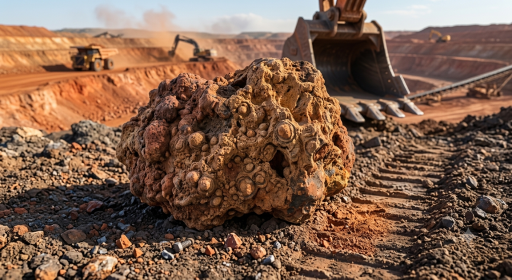
New projects span nickel, copper and gold as miners seek to replenish reserves, extend mine lives and secure future production.
Indonesia’s major mining companies are developing new mines and advancing exploration projects to replenish reserves, extend mine lives and secure future production of nickel, copper and gold.
Among the companies pursuing new mining projects are PT Vale Indonesia Tbk. (INCO), PT Freeport Indonesia (PTFI), PT Merdeka Copper Gold Tbk. (MDKA), PT United Tractors Tbk. (UNTR), PT Amman Mineral Internasional Tbk. (AMMN) and PT Bumi Resources Minerals Tbk. (BRMS).
Here’s a look at six projects that could contribute to Indonesia’s future mineral supply.
Vale Indonesia – Tanamalia
PT Vale Indonesia is developing the Tanamalia Block in East Luwu, South Sulawesi, as a potential new source of nickel ore.
The Tanamalia Project covers around 13,556.8 hectares in Towuti District and forms part of PT Vale’s special mining business permit (IUPK). The company has conducted exploration in the area in several phases since 1970.
The project is currently in the second phase of its Front-End Loading (FEL 2) study, which assesses technical, economic, operational, legal and sustainability aspects of the proposed development. (Vale)
According to PT Vale’s latest project planning, detailed exploration is being carried out during 2025-2027. If the results confirm sufficient nickel grades and the project is deemed economically viable, construction is expected in 2027-2028, with mining potentially starting as early as 2031. (Vale)
The company is also assessing potential partners for an associated high-pressure acid leach (HPAL) facility. PT Vale has said the formal process to select a potential HPAL operator is ongoing. (Vale)
The Tanamalia development is part of PT Vale’s broader growth strategy to expand its nickel resource base and support downstream processing in Indonesia.
Freeport Indonesia – Kucing Liar
PT Freeport Indonesia is developing the underground Kucing Liar mine in the Grasberg area of Papua as a new source of copper and gold production.
The project is expected to help replace declining production from the Deep Mill Level Zone (DMLZ), one of Freeport Indonesia’s existing underground operations.
Freeport Indonesia currently operates three underground mines in the Grasberg complex: Grasberg Block Cave, which produces around 140,000 tonnes of ore per day; DMLZ, with production of around 70,000 tonnes per day; and Big Gossan, which produces around 7,000 tonnes per day and has relatively high copper grades.
Freeport-McMoRan Inc. (FCX), which operates the Grasberg mine through PT Freeport Indonesia, has reported that further exploration increased estimated recoverable reserves at Kucing Liar through 2041 to around 8 billion pounds of copper and 8 million ounces of gold, compared with previous estimates of 7 billion pounds of copper and 6 million ounces of gold.
At full capacity, Kucing Liar is expected to produce an average of around 750 million pounds of copper and 735,000 ounces of gold annually, about 35% higher than the previous production estimate.
As of June 2026, FCX had invested around US$1.4 billion (Rp25.18 trillion) in developing Kucing Liar. Additional capital spending is estimated at around US$4 billion (Rp71.95 trillion) through 2033, equivalent to approximately US$500 million (Rp8.99 trillion) per year.
Merdeka Copper Gold – Pani
PT Merdeka Copper Gold Tbk. (MDKA), through its subsidiary PT Merdeka Gold Resources Tbk. (EMAS), is developing the Pani gold mine in Gorontalo, with the group’s total concession area reaching around 14,670 hectares.
The Pani Gold Mine began operations on October 1, 2025, and produced its first gold in the first quarter of 2026.
The initial development phase uses heap-leach technology, with an ore processing capacity of 8 million tonnes per year and plans to increase capacity to 10 million tonnes per year.
The next phase involves the development of a carbon-in-leach (CIL) processing facility with a planned capacity of 12 million tonnes of ore per year.
At full capacity, the Pani Gold Mine is expected to produce around 500,000 ounces of gold annually.
The CIL facility is scheduled to begin operations in 2029 with an initial processing capacity of 7.5 million tonnes per year before being gradually expanded. Earthworks for the facility began in January 2026.
MDKA is targeting gold production of 110,000-115,000 ounces from Pani in 2026.
The company has spent around US$238 million (Rp4.28 trillion) on construction and pre-production for the open-pit heap-leach operation.
Pani’s gold ore reserves increased to 190.3 million tonnes, containing around 4.8 million ounces of gold, in the fourth quarter of 2025.
United Tractors – Doup
PT United Tractors Tbk. (UNTR) has completed the acquisition of the Doup gold mine from PT J Resources Asia Pasifik Tbk. (PSAB) through PT Arafura Surya Alam (ASA).
Located in North Sulawesi, the Doup mine remains under construction and covers around 4,000 hectares.
The project is estimated to contain gold reserves of around 1.6 million ounces and resources of approximately 3.1 million ounces, giving United Tractors a significant new gold asset as it expands its mining portfolio.
Before the acquisition, PSAB reported exploration expenses of around US$74,018 (Rp1.33 billion) at ASA in the fourth quarter of 2025.
The development of Doup forms part of United Tractors’ broader strategy to expand beyond its traditional heavy-equipment and coal businesses and strengthen its position in the gold mining sector.
Amman Mineral – Elang
PT Amman Mineral Internasional Tbk. (AMMN), through PT Amman Mineral Nusa Tenggara (AMNT), is developing the Elang copper and gold deposit in Sumbawa, West Nusa Tenggara.
The company reported that mineral resources at the Elang deposit had increased from 1.4 billion tonnes to 2.5 billion tonnes.
Contained copper increased 71%, from 10.4 billion pounds to 17.8 billion pounds, while contained gold rose 76%, from 15 million ounces to 26.4 million ounces.
The Elang project is expected to become an important successor to Amman’s Batu Hijau mine, one of Indonesia’s largest copper and gold operations.
Amman plans to continue Phase 8 mining at Batu Hijau through 2030, with stockpile processing potentially continuing through 2033.
Mining at Elang is planned to begin after Batu Hijau reaches the end of its mine life, with operations expected to continue through 2046.
Existing processing infrastructure, including the Batu Hijau processing plant, copper smelter and precious metals refinery, is expected to support the development of Elang, potentially reducing the need for entirely new downstream infrastructure.
Bumi Resources Minerals – Linge
PT Bumi Resources Minerals Tbk. (BRMS) is developing the Linge gold project in Aceh through its subsidiary PT Linge Mineral Resources.
The company holds a concession covering around 36,420 hectares, where exploration activities include drilling, electromagnetic surveys, metallurgical testing, mine design and feasibility studies.
The Linge project is estimated to contain around 6.8 million tonnes of ore, with an average grade of 1.58 grams of gold per tonne and 7.07 grams of silver per tonne.
BRMS estimates the resource contains approximately 345,107 ounces of gold and 1.15 million ounces of silver.
The project provides BRMS with another potential source of precious-metals production as the company expands its gold portfolio in Indonesia.
Securing Indonesia’s next generation of mineral supply
The six projects highlight how Indonesia’s major miners are looking beyond their existing producing assets to secure future reserves and extend their production pipelines.
The projects span three of Indonesia’s strategically important mineral commodities: nickel, which is central to the country’s downstream and electric-vehicle ambitions; copper, which is critical to electrification and energy infrastructure; and gold, which remains a major contributor to Indonesia’s mining sector.
For companies operating mature mines, developing new deposits is increasingly important to maintaining production over the long term. At the same time, projects such as Tanamalia and Elang could leverage existing processing infrastructure and downstream investments, while newer developments such as Kucing Liar, Pani, Doup and Linge add to Indonesia’s future pipeline of copper and precious-metals production.
Together, these projects underscore the scale of investment required to replenish Indonesia’s mineral reserves and maintain the country’s position as a major global producer of critical minerals and precious metals.