
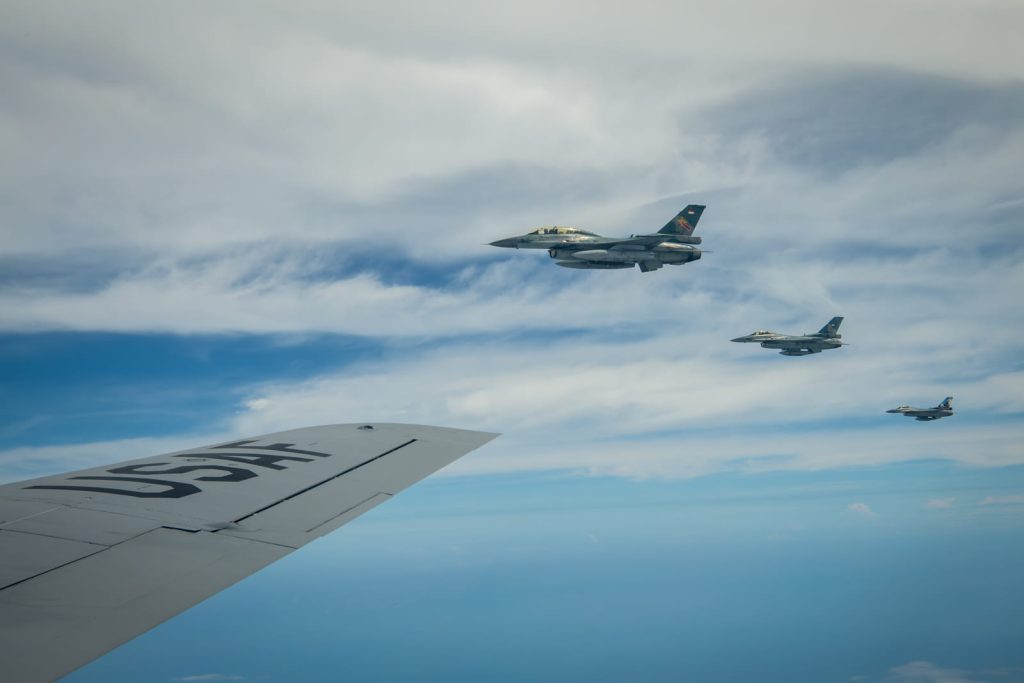
There’s been some discussion lately about allowing US military aircraft broad overflight access across Indonesian airspace. At first glance, this sounds like a technical or operational issue. But legally, it’s not that simple.
Consider this question in the present context of the United States having engaged in an armed conflict with Iran. In this situation, Indonesia has been a neutral state. And neutrality is not just a label. It comes with obligations.
The Iran case offers an intriguing illustration of a more difficult question – and the one that matters for this region. How would US military overflight of Indonesia play out in a future US–China contingency, whether over Taiwan or in the South China Sea?
What the law actually says
The starting point is pretty clear. Under Hague Convention V, which sets out the rights and duties of neutral powers in times of war, Article 2 states:
“belligerents are forbidden to move troops or convoys of munitions of war or supplies across the territory of a neutral Power.”
Even though this convention was explicitly drafted with land warfare in mind, the logic carries over. Airspace is part of territory of neutral states, which is inviolable. So if belligerent military aircraft are transporting troops, weapons, or supplies, the same issue arises.
Therefore, if Indonesia allows blanket overflight it starts to look very close to a classic neutrality violation in the traditional sense.
The maritime overlay: limited space, not a free pass
Things get more nuanced once you bring in the law of the sea and the law of maritime neutrality.
Under the United Nations Convention on the Law of the Sea (UNCLOS), Articles 38 and 53 set out that aircraft (of all states) enjoy the right of transit passage and archipelagic sea lanes passage through straits used for international navigation and designated sea lanes.
This is reinforced in paragraph 28 of the San Remo Manual on International Law Applicable to Armed Conflicts at Sea, which makes the point clearly:
“belligerent and neutral surface ships, submarines and aircraft have the rights of transit passage and archipelagic sea lanes passage through, under, and over all straits and archipelagic waters to which these rights generally apply.”
So yes – even for belligerents, there is a recognised right of passage.
But the key point is often missed.
These regimes are tied to defined routes. In the archipelagic context, that includes designated sea lanes (for Indonesia, the ALKI lanes), and where no designation exists, routes normally used for international navigation – as reflected in Article 53(12) of UNCLOS.
Once you start allowing blanket overflight for one belligerent, you are no longer just managing access.
There is still debate about what counts as “routes normally used for international navigation” but once you move beyond ALKI or international straits such as the Strait of Malacca and start talking about unrestricted overflight, you are clearly outside that framework.
This is not a general freedom to operate across the entire airspace of a neutral state. It is a specific right tied to corridors, and subject to the requirement of continuous and expeditious transit.
From legal exception to tactical advantage
This is where the real implication sits.
This kind of policy would give a clear tactical advantage to US military aircraft.
If flights are limited to ALKI and international straits, their routes are constrained and predictable. An opposing belligerent – in the present case, Iran – can calculate likely entry and exit points. For example, aircraft transiting via ALKI I can be anticipated near the southern approaches of the Sunda Strait, or through international straits such as the Malacca Strait.
That predictability matters. It allows for tracking, and, if necessary, interception.
Blanket overflight changes that entirely.

If aircraft are no longer confined to ALKI or international straits, they are not tied to fixed corridors. They can enter and exit Indonesian airspace at multiple points, not just at the ends of sea lanes or international straits. From an operational perspective, that removes a key layer of predictability.
In simple terms: the opposing side can no longer reliably anticipate where US military aircraft will appear or disappear.
So, what looks like a legal accommodation quickly translates into a significant tactical advantage.
Neutrality is a self-help system
Now the more uncomfortable part.
Neutrality law is, at its core, a self-help system. If a neutral state is unwilling or not capable of enforcing its neutrality, the aggrieved belligerent does not just sit quietly.
If Indonesia allows this kind of overflight, it is difficult to frame that as incapacity. It looks more like a policy choice – in other words, unwillingness.
And that matters.
In that situation, the opposing belligerent can argue that it is entitled to act to protect its rights.
Translated into this scenario: Iran could take the position that it may intercept US military aircraft even within Indonesian airspace, on the basis that neutrality is not being enforced.
That is obviously escalatory. And politically very sensitive. But from a legal standpoint, the argument is not easily dismissed.
Where this leaves Indonesia
With its Bebas-Aktif (“free and active”) foreign policy, Indonesia has long positioned itself as a neutral actor. But neutrality is not just about political posture. It is about how a state regulates its territory – including its airspace.
Once you start allowing blanket overflight for one belligerent, you are no longer just managing access. You are shaping the operational environment of the conflict.
And at that point, the line between neutral and non-neutral starts to blur.