
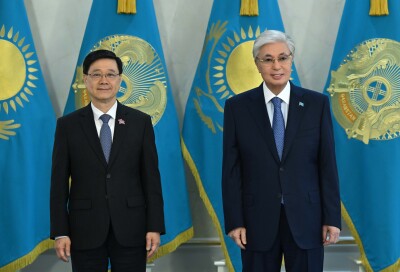
A high-level delegation led by Hong Kong Chief Executive John Lee to Kazakhstan and Uzbekistan has yielded substantial economic and political advancements for the SAR
The five-day mission successfully positioned Hong Kong as an indispensable financial and technological super-connector supporting the Belt and Road Initiative

The 70-member delegation led by Hong Kong Chief Executive John Lee to visit Kazakhstan and Uzbekistan for five days was economically and politically significant. Economically speaking, the Hong Kong Special Administrative Region (HKSAR) has reached a series of agreements with the two Central Asian countries – a testimony to the external role of Hong Kong in its economic relations. Politically speaking, under the “one country, two systems” principle, the HKSAR has become an indispensable part of the Chinese Mainland’s Belt and Road Initiative, strengthening its role as a “super-connector” linking up the mainland with the two Central Asian countries in a more diversified and dynamic way. As such, the external relations of Hong Kong are becoming an instrumental aspect of the foreign policy of the central government in Beijing.
According to the government’s press release on June 1, Chief Executive John Lee led a large business delegation comprising the representatives of Hong Kong and mainland enterprises. They met government officials of Kazakhstan to learn not only its innovation and technology sector but also its financial development.
Deepening financial cooperation in Central Asia
John Lee’s delegation met the Deputy Prime Minister and Minister of National Economy of Kazakhstan, Serik Zhumangarin. He said that Hong Kong is strong in its financial centre, cross-border wealth management, and offshore Renminbi business. Hence, the HKSAR can provide capital and asset allocation for Kazakhstan’s economic reform and infrastructure development. The dual listing of a Kazakhstani company in Hong Kong and Astana, and the issuance of Renminbi “dim sum” bonds in Hong Kong by the Development Bank of Kazakhstan, were cited by John Lee as landmark achievements in cross-border financial co-operation. He welcomed Kazakhstan’s government and its enterprises to use Hong Kong’s financial hub advantages by listing, issuing bonds and conducting project financing to connect with global investors and raise international funds for various local developmental projects.
Lee met the President of Kazakhstan, Kassym-Jomart Tokayev, and attended a luncheon talk hosted by the President. The Chief Executive remarked that Chinese President Xi Jinping first proposed the joint construction of the Silk Road Economic Belt in Kazakhstan in 2013. At that time, Kazakhstan was Hong Kong’s largest trading partner in Central Asia. Since Kazakhstan is keen to diversify its economy, Hong Kong can contribute to its economic diversification as a connector linking Kazakhstan with the Chinese Mainland markets.
Driving technology links and innovation hubs
John Lee noted that his trip to Kazakhstan was the first overseas trip after the establishment of a Task Force on Supporting Mainland Enterprises in Going Global – a testimony to how the HKSAR is now helping mainland companies to become more international in their technological outreach, business investment and trade connections. Cross-border cooperation is expected to enhance in all practical areas, ranging from trade to investment, from financial services to information technology, and from education to cultural tourism.
It is important to take note of how Lee portrayed the new role of the HKSAR. He said that Hong Kong serves as “a functional platform” of China’s Belt and Road Initiative, continuing to play the role of being both a “super-connector” and a “super value-adder” (Hong Kong Government’s Press Release, June 1, 2026).
The delegation visited the Astana Hub, which is a local technology and innovation park, to learn from the Kazakhstan experiences. Its members met the Minister of Artificial Intelligence and Digital Development, Zhaslan Madiyev. Obviously, the delegation learnt much from the Kazakhstan AI development at a time when the HKSAR is participating actively in the Shenzhen-Hong Kong-Guangzhou innovation cluster. At a time when the Northern Metropolis is developing at full speed and covering various projects, such as the Hong Kong Park in the Loop, the San Tin Technopole and the Sandy Ridge Data Facility Cluster, John Lee expressed his hope that Kazakhstan would set up its technology and innovation enterprises in the HKSAR, thereby strengthening cross-border technological collaboration.
Broadening partnerships with Uzbekistan
The delegation also visited the Astana International Financial Center, which was established in 2018, which is ranked the first in Central Asian financial centers, and which attracts 5,500 enterprises to register. This Center has enormous potential to work with the HKSAR financial centre as the two places share the common-law system, capital markets connectivity, and the development of green finance.
When John Lee’s delegation visited Uzbekistan, its members visited its IT Park which has become a leading information technology hub in Central Asia with 1,000 IT enterprises and many start-up companies in the areas of digital trade, AI and software development. The Hong Kong delegation signed a Memorandum of Understanding with the IT Park, confirming that the Uzbekistan side will work closely with Hong Kong’s Cyberport, Hong Kong Science and Technology Parks Corporation, and the Hong Kong-Shenzhen Innovation and Technology Park in the areas of start-up company formation, talent exchanges and joint research.
In Uzbekistan, John Lee attended a luncheon hosted by the Chinese Ambassador, Yu Jun, and the Chief Executive expressed his gratitude to the Chinese Embassy for the meticulous arrangement for his delegation visit.
The Hong Kong and Chinese delegation also visited the Center for Islamic Civilization in Uzbekistan to learn about cultural preservation, academic research and educational development. John Lee remarked that Hong Kong is actively developing its East-West centre for international cultural exchange, including arts and cultural activities so that people-to-people exchange, and museum cooperation will be enhanced between the two places.
Substantial commercial deals and logistics expansion
The highlight of Lee’s delegation was its meeting with the Prime Minister of Uzbekistan, Abdulla Nigmatovich Aripov. Both sides expressed their expectations that collaboration would be enhanced in the areas of capital markets, infrastructure financing, green finance and bilateral trade development.
The external relations of both Hong Kong and Macau with other countries are a testimony to the delegated authorisation of the central government in Beijing and to the successful operation of the “one country, two systems” policy
The visits to Kazakhstan and Uzbekistan were fruitful. A total of ninety-six cooperative agreements and MOUs were signed, involving amounts of US$1.65 billion in total. Agreements on double taxation, bilateral investment promotion and protection, and cross-border customs clearance facilitation were reached. Other areas of mutual agreement embraced finance, information and technology, aviation, transport, visa-free visits, educational and talent exchange, cultural cooperation, and the development of a hub-to-hub model.
Hong Kong also initiated an agreement with Uzbekistan that paved the way for airlines from both sides to launch a new direct route, days after Cathay Pacific Airways had announced that it would offer flights to Almaty in Kazakhstan in 2027 (South China Morning Post, June 6, 2026). Uzbekistan agreed to open a consulate in Hong Kong.
Among the ninety-six agreements, fifteen were made at the governmental level and the remaining eighty-one were signed by the business sectors. A total of sixty-one deals were signed with Kazakhstan and thirty-five agreements were reached with Uzbekistan. Hong Kong and Uzbekistan have begun talks on a reciprocal agreement allowing visitors from both sides to have visa-free access up to 30 days.
Strategic division of labour between the SARs
John Lee said that he asked his subordinates to study the possibility of setting up a Hong Kong Economic and Trade Office in the region, boosting cross-border cooperation and implementing all the governmental agreements. The chairman of the Trade Development Council, Frederick Ma Si-hang, commented that the visit opened the door for business cooperation and development. The national railway company, Kazakhstan Temir Zholy, would explore the possibility of listing in Hong Kong.
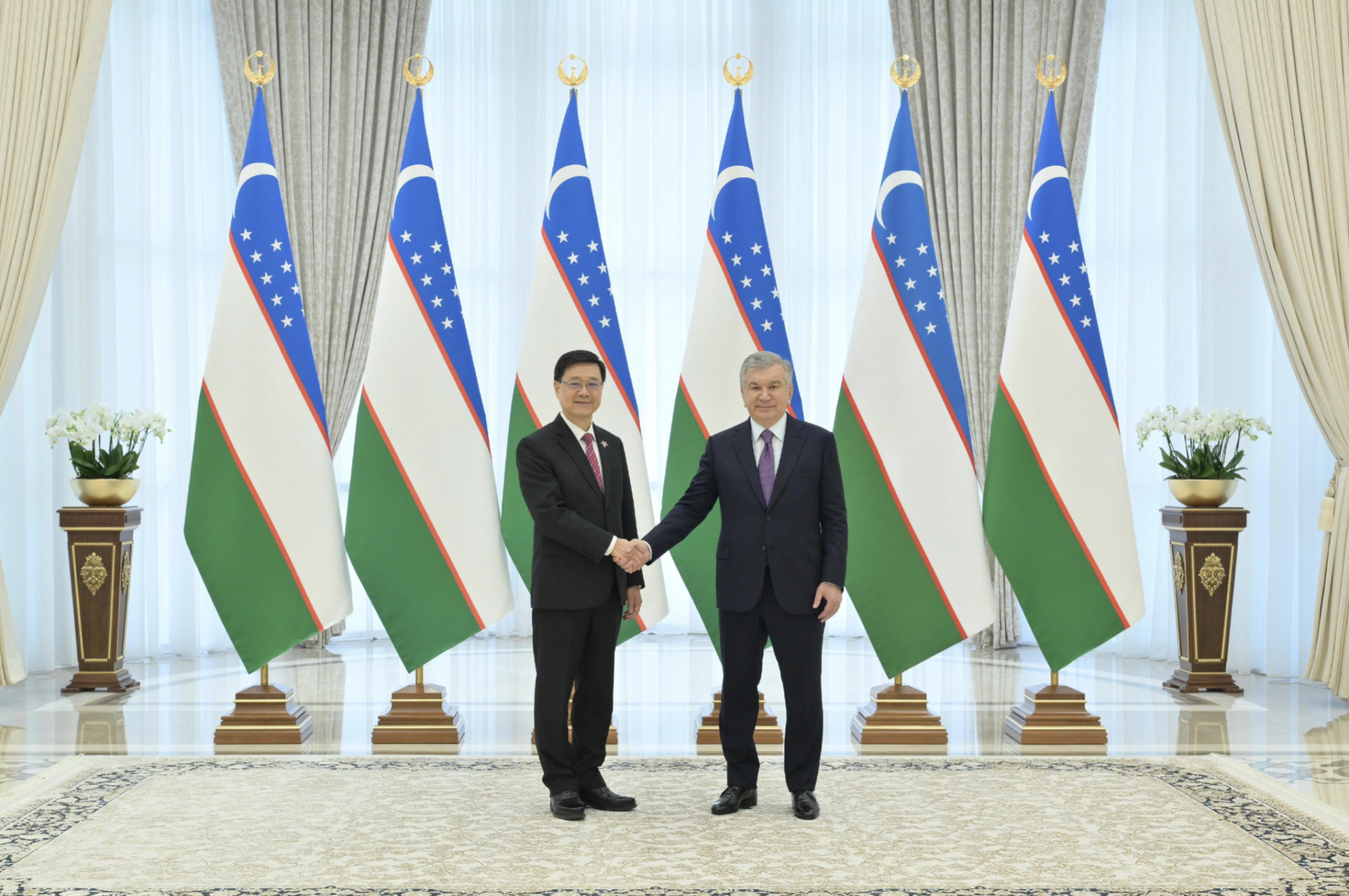
After the delegation returned to Hong Kong, the Chinese Ambassador to Uzbekistan, Yu Jun, remarked that while the relations between China and Uzbekistan were fruitful in the cooperative areas of infrastructure, energy and agricultural, the Hong Kong delegation’s visits would help advance bilateral ties through the HKSAR’s “financial prowess and global network” (China Daily, June 6, 2026). Yu also commented that the China-Kyrgyzstan-Uzbekistan railway, which is under construction, will boost connectivity and growth in the Central Asian region. Moreover, the Chinese EV maker BYD has already launched a production line in Uzbekistan with the capacity of producing 50,000 vehicles annually. The Hong Kong connection will strengthen Sino-Uzbekistan relations further in the financial, trade, educational, information and technology, and cultural aspects.
The delegation led by John Lee to Central Asia was economically and politically significant in several aspects.
First, as with the recent visit of the Macau Chief Executive Sam Ho Fai to Portugal, Spain, Belgium and Switzerland, the visit of John Lee and his delegation to Kazakhstan and Uzbekistan has illustrated a nice division of labour between the two Chief Executives of the Special Administrative Regions (SARs). Both delegations could be regarded as a skilful strategy of enhancing the external relations of the Macau SAR and Hong Kong SAR under the full support and skilful design of the central government in Beijing.
External autonomy under one country two systems
Second, both delegations, one from Macau and the other from Hong Kong, had the participation of the chief executives of mainland enterprises. John Lee mentioned that his visit to Central Asia was the first one after the establishment of the task force that helped mainland enterprises to be more global. As such, the two SARs are showing new roles in the context of Chinese foreign policy. Specifically, while Macau has become a crucial platform for China to expand and deepen its relations with Portuguese-speaking and increasingly Spanish-speaking countries, Hong Kong has been playing an indispensable instrumental role in enhancing China’s foreign relations with countries in Central Asia. The remarks made by Yu Jun, the Chinese Ambassador to Uzbekistan, on Hong Kong’s facilitating role in further contributing to Uzbekistan’s financial and international development, were significant.
Third, under the Basic Law of Hong Kong and Macau, the central government in Beijing authorizes the SARs to conduct relevant external affairs of their own (see Article 13 of the Hong Kong Basic Law and Article 13 of the Macau Basic Law). As such, the recent delegations led by Macau Chief Executive Sam Ho Fai to visit Europe and that led by Hong Kong Chief Executive John Lee to visit Central Asia are politically significant – both visits pointing to the “external” autonomy of Macau and Hong Kong as authorized, entrusted and empowered by the central government in Beijing. Their delegation visits have also proved the vitality and operational tradition of “one country, two systems” in dealing with the external relations of two SARs.
Future integration and the five year plans
Fourth, when John Lee mentioned that he tasked his government colleagues to study the possibility of setting up a Hong Kong Economic and Trade Office in the Central Asian region, the procedures would likely lead to a feasibility study with the possibility of a proposal to be submitted to the central government, which will likely make its final decision. As Article 156 of the Hong Kong Basic Law states, the HKSAR may, as necessary, “establish official or semi-official economic and trade missions in foreign countries and shall report the establishment of such missions to the Central People’s Government for the record.”
Hong Kong as a gateway to the Greater Bay Area represents an important asset for Central Asian countries to invest and enhance their trade relations with Southern China
Fifth, with the rapid development of the Northern Metropolis, it is timely for the HKSAR government to reach out to various countries, including Central Asia, for the enhancement of cooperation in the areas of trade, information technology, Artificial Intelligence, transport, and joint research development. Cross-border collaboration will propel the further development of Northern Metropolis in the long run.
Sixth, both Hong Kong and Macau are obviously the connectors, facilitators and contributors for the central government in Beijing to enhance and achieve its foreign policy objectives. Hong Kong’s strengths lie in being a strong financial centre and aviation hub connecting the Chinese Mainland with other countries, and Macau’s strength lie in being a tourist leisure hub linking the mainland with Portuguese-speaking and Spanish-speaking countries.
If so, Hong Kong and Macau will have a bright future under the full-fledged operation of the Chinese Mainland’s “one country, two systems” principle, especially their external relations with foreign countries. Hong Kong and Macau must therefore continue to strategize well in accordance with the Chinese Mainland’s Belt and Road Initiative and Beijing’s 15th five-year plan. Hence, one can expect the five-year plan of both Hong Kong and Macau will touch on how the two SARs will contribute to the central government’s external relations in a more thoughtful way.
Gateway benefits for the Greater Bay Area
In conclusion, the delegation led by Hong Kong Chief Executive John Lee to Kazakhstan and Uzbekistan was economically, technologically, educationally, culturally and politically significant. The HKSAR’s role as a financial centre will contribute to the win-win development of Kazakhstan and Uzbekistan. The rapid development of the Northern Metropolis will also benefit from the cooperation and joint research efforts of researchers and enterprises from Kazakhstan and Uzbekistan. Education, transport, infrastructure, trade, investment, and tourism are also areas of bilateral cooperation.
Hong Kong as a gateway to the Greater Bay Area represents an important asset for Central Asian countries to invest and enhance their trade relations with Southern China. Similarly, Macau has become another unique connector for Beijing to enhance the central government’s foreign relations. Above all, the external relations of both Hong Kong and Macau with other countries are a testimony to the delegated authorisation of the central government in Beijing and to the successful operation of the “one country, two systems” policy.