
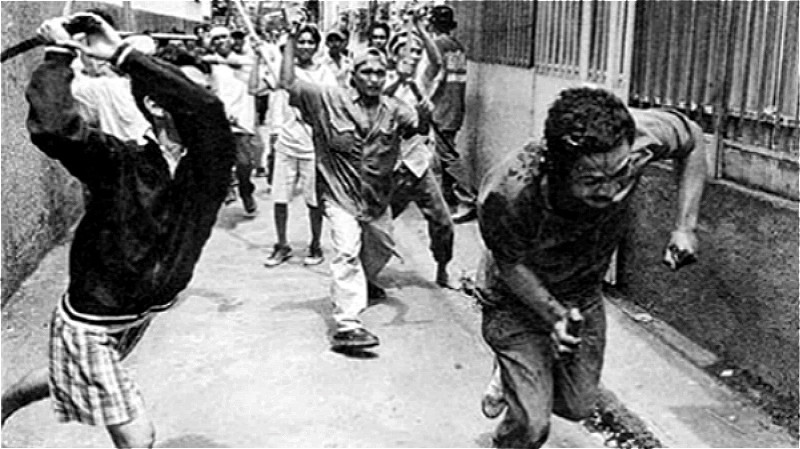
From May 13 to 16, 1998, Indonesia experienced anti-Chinese riots that shocked the world; riots also known as the “Black May Riots.” Under pressure from international public opinion, on Nov. 3, 1998, Indonesia’s official investigative body, the Joint Fact-Finding Team, released a report stating that a total of 1,250 Chinese Indonesians were killed, 24 injured, and 85 women were subjected to rape, gang rape, and sexual harassment. However, these figures were widely questioned. According to estimates by some human rights organizations, the number of ethnic Chinese women who were raped should be over one thousand.
Although a series of evidence indicated that the riots were an anti-Chinese event directly orchestrated by the military under the Suharto regime as a means of diverting attention from social, economic, and political crises, even 13 years later, the perpetrators had still not been properly punished, and the full truth of the incident had not been completely revealed.
The brutality committed against Chinese Indonesians during the “Black May Riots” shocked the world. Governments and people around the world strongly protested and condemned the Indonesian authorities. However, the Chinese Communist authorities stated that they would “not interfere in Indonesia’s internal affairs,” did not condemn or intervene, and banned all mainland Chinese media from reporting on the anti-Chinese incident, also suppressing student-led protests.
It’s important to note that at that time, both the U.S. Congress and the UN Human Rights Commission issued condemnations, and global media extensively reported on the incident. Overseas Chinese worldwide were outraged and strongly demanded that the Chinese government issue a condemnation. However, Jiang Zemin claimed that the atrocities in Indonesia were an internal affair and instructed the press not to report and the government not to intervene. Information was tightly controlled, and only a few minor reports appeared half a month later. His actions were widely criticized internationally.
Some scholars argue that the root causes of Indonesia’s series of anti-Chinese incidents were related to Chinese Communist Party interference in other countries’ internal affairs and the export of revolution to Southeast Asia. They claim: “The Chinese Communist Party’s goal is to use subversive activities to push local governments to adopt policies favorable to it. A notable change in its strategy was to stop emphasizing overseas Chinese interests, effectively abandoning them to reduce host governments’ fear of its intentions.”

Success
You are now signed up for our newsletter
Success
Check your email to complete sign up
‘Black May Riots’
From May 13 to 15, 1998, Indonesia witnessed a shocking anti-Chinese riot. Ethnic Chinese residents were systematically abused and killed. Chinese-owned businesses and homes were destroyed and looted, and Chinese women were subjected to gang rape and burning.
According to incomplete statistics, at least 1,200 people were killed across Indonesia, and over 1,000 women (mostly ethnic Chinese) were gang-raped by mobs. Many were burned alive, died from severe injuries, or committed suicide due to humiliation and despair.
Some data indicate that in just over two days, in Jakarta alone—a city of over 10 million people—riots broke out in 27 areas. More than 5,000 Chinese-owned shops and houses were destroyed, over 1,200 people were killed, and 468 women were raped, the youngest being only nine years old. Similar riots in cities such as Solo, Surabaya, and Medan also caused massive losses of life and property.
The riots primarily targeted local Chinese communities. Wherever the mobs went, they looted, burned, and killed in a systematic campaign. Witnesses reported that the attackers wore military boots and were transported by military trucks. They set fire to tires and plywood structures to lure people out of slums, shouting slogans such as “Kill the Chinese, burn them, these Chinese dogs,” before looting shops and supermarkets.
After looting, hundreds of women were gathered, forcibly stripped, and gang-raped. Some died from exhaustion; others were burned alive after being assaulted. Young girls, some only 10 or 11 years old, were assaulted in front of their parents, spouses, and siblings multiple times. One magazine reported a father being forced to assault his 14-year-old daughter in front of the entire family.
A priest from the Christian church, Sandyawan, stated that people called him saying victims were being burned alive, but neither the military, fire department, nor ambulances came to help. He also reported cases of sexual violence against girls, including a 12-year-old girl assaulted by seven or eight men.
Global Outrage Over the Anti-Chinese Violence
In June, an Indonesian Chinese resident sent a letter requesting help, exposing the atrocities during the riots. An overseas Chinese organization issued an “Open Letter to Chinese Worldwide,” urging global protests at Indonesian embassies and calling on human rights organizations to condemn the violence.
The letter stated that the riots in Jakarta on May 13–14 were organized attacks involving robbery, murder, arson, and public gang rape of Chinese Indonesians. It specifically accused mobs of gang-raping women and girls and burning victims alive.
The New York Times published an early detailed report based on human rights and women’s aid organizations, triggering global outrage. Malaysia’s Sin Chew Daily prominently covered the events. International opinion compared the atrocities to Nazi anti-Jewish violence in the 1930s.
After the incident was exposed, Taiwan issued a strong protest and sent aircraft to evacuate victims. Singapore kept its Changi Airport open 24 hours to accept refugees.
The U.S. government classified the violence as racial discrimination and exerted pressure on Indonesia. It accepted asylum applications from victims and dispatched naval vessels to evacuate Chinese Indonesians. Some evacuees reportedly displayed a banner reading: “Better to be an American dog than a Chinese.”
In July, protests broke out in Bangkok, Kuala Lumpur, and Hong Kong. In New York, Chinese groups organized petitions and demonstrations condemning the atrocities. In California, overseas Chinese formed a “Committee to Rescue Indonesian Human Rights” to bring victims to Washington to testify.

Chinese communist government response
The Chinese government (under Jiang Zemin at the time) stated it would not interfere in Indonesia’s internal affairs. Mainland Chinese media were prohibited from reporting on the incident, and online content was removed. Student protests in universities such as Peking University were suppressed.
Despite providing Indonesia with loans, the Chinese government maintained silence and non-interference. Critics in Malaysia and elsewhere accused China of cowardice and indifference.
Some analysts and commentators claimed that Chinese diplomats had previously declared Indonesian Chinese to be Indonesian citizens, thus framing the violence as an internal matter, effectively removing protection for victims. It was also reported that appeals for help at Chinese embassies were rejected on the grounds that victims were not Chinese citizens.
Indonesian investigation report
Under international pressure, Indonesia formed a Joint Fact-Finding Team on July 23, consisting of government officials and civil society representatives. The final report, due in October, was delayed twice.
On Nov. 3, the report was finally released in Jakarta without attendance from senior officials. It confirmed that the May riots were organized and that mass sexual violence against Chinese women occurred. During May 13–15 in Jakarta, it recorded dozens of rape and sexual violence cases, most involving ethnic Chinese victims.
The report also suggested involvement by military special forces linked to then-President Suharto’s son-in-law, Prabowo Subianto. However, the findings were widely questioned due to inconsistencies and alleged downplaying of figures.
In 2008, on the 10th anniversary, Indonesia’s National Commission on Violence Against Women reaffirmed that large-scale sexual violence had occurred and that victim numbers were far higher than official reports indicated. Some human rights organizations reported thousands of rape cases nationwide.
Despite this, Indonesian authorities and military officials either denied involvement or questioned the credibility of the findings.
Military involvement and political manipulation claims
Analysts argue that the riots were orchestrated by the Indonesian military to divert attention from the 1997 Asian financial crisis, which severely impacted Indonesia’s economy and intensified political instability.
It is claimed that Chinese Indonesians, who were perceived as economically dominant, were scapegoated. Reports suggest that mobs used military transport, operated in coordinated waves across cities, and that police and military forces were absent or withdrawn during the violence.
Some accounts claim attackers had military training and were even paid for assaults. A provincial governor reportedly admitted the riots were organized and incited, though later testimonies disappeared.
Many analysts conclude the riots were a politically driven anti-Chinese operation tied to elite power struggles within the Indonesian military and government.

Historical background and anti-Chinese incidents
Chinese Indonesians, numbering over 20 million, have lived in Indonesia for generations, primarily originating from Fujian and Guangdong. Over time, they became influential in trade, finance, and industry.
After Indonesia’s independence in 1945, relations fluctuated. In the 1965 anti-communist purge following the “30 September Movement,” hundreds of thousands of people—including many ethnic Chinese—were killed. Estimates suggest around 500,000 Chinese Indonesians died.
Following Suharto’s rise to power in 1967, discriminatory policies restricted Chinese language, schools, and cultural expression. Anti-Chinese riots continued intermittently in later decades.
Claims about communist ‘export of revolution’
Some commentators claim that Chinese Communist policies of supporting communist movements in Southeast Asia contributed to anti-Chinese sentiment in the region. They argue that fears of a “fifth column” led to suspicion and periodic violence against overseas Chinese communities.British historian E. Hall’s History of Southeast Asia is cited as noting regional fears of communist influence and subversion, and shifting Chinese Communist strategy away from overt overseas Chinese advocacy.