
Close Menu
Simply Invest Asia
  • Home
  • About us
  • Explore industries/sectors
    • Automobile
    • Aviation
    • Banking
    • Biotechnology
    • Chemical & Fertilizer
    • Entertainment and Media
    • Food Processing
    • Healthcare
    • Iron and Steel
    • Leather
    • Mining
    • Oil and Gas
    • Pharmaceutical
  • Explore by countries
    • China
    • Dubai / UAE
    • Hong Kong
    • India
    • Indonesia
    • Japan
    • Malaysia
  • Explore cities
    • Bangkok
    • Beijing
    • Chongqing
    • Delhi
    • Dubai
    • Guangzhou
    • Jakarta
    • Kuala Lumpur
  • Why Asia
Facebook X (Twitter) Instagram Threads
Trending:
  • United Healthcare launches ethical review board for research
  • Guangdong Mingtu vs Hubei Istar – H2H, Compare Teams
  • Dubai Schools to Resume On-Site Learning from May 11, 2026: KHDA Confirms In-Person Classes and Exams
  • Bank Of America Opens New Malaysia Office
  • Hard Rain SoloistEnsemble presents ‘Beijing to Belfast’ | The Journal of Music in Ireland
  • HONG KONG CHINA WOMEN’S XVs 26-26 KAZAKHSTAN
  • Wealth, Private Banking Contributes Larger Slice Of OCBC’s Profit In Q1 2026
  • Pure Biologics S.A. stock (PLPURE000013): Biotech firm eyes growth in dermatology and oncology marke
  • The Blogs: What the Abraham Accords Mean for India | Ankit Gawande
  • Hong Kong Customs Seizes 7 kg of Suspected Cannabis at Airport, Arrests 20-Year-Old Passenger from Bangkok
  • Wittchen S.A. stock (PLWTMTN00015): Polish luxury leather goods maker eyes US expansion
  • Dubai Creek boat fire unrelated to drone interception
  • The Pilot Shortage In 2026: Is It Still Real, And What Is Actually Being Done About It?
  • Chinese ambassador urges UK to stop anti-China political manipulation and emboldening anti-China elements
  • Indonesia Online Gambling Arrest – Journal-News.com
  • ‘Forfeiture of rights’: Hong Kong villagers slam Northern Metropolis evictions
  • MetMalaysia: Thunderstorms, heavy rain in KL, Putrajaya, eight states till 9pm
  • Belo Sun Mining stock (CA11776U1066): Begins trading on OTCQX in the US
Sunday, May 10
Facebook X (Twitter) Instagram
Simply Invest Asia
  • Home
  • About us
  • Explore industries/sectors
    • Automobile
    • Aviation
    • Banking
    • Biotechnology
    • Chemical & Fertilizer
    • Entertainment and Media
    • Food Processing
    • Healthcare
    • Iron and Steel
    • Leather
    • Mining
    • Oil and Gas
    • Pharmaceutical
  • Explore by countries
    • China
    • Dubai / UAE
    • Hong Kong
    • India
    • Indonesia
    • Japan
    • Malaysia
  • Explore cities
    • Bangkok
    • Beijing
    • Chongqing
    • Delhi
    • Dubai
    • Guangzhou
    • Jakarta
    • Kuala Lumpur
  • Why Asia
Simply Invest Asia
Home»Explore by countries»India»The Blogs: What the Abraham Accords Mean for India | Ankit Gawande
India

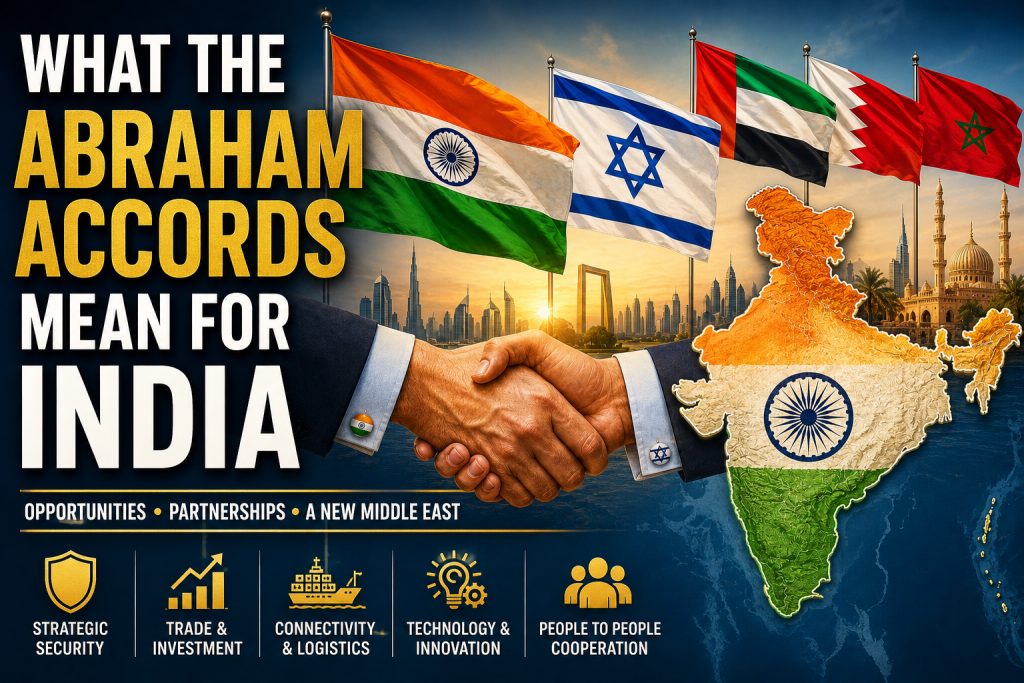
The Blogs: What the Abraham Accords Mean for India | Ankit Gawande

By IslaMay 10, 20265 Mins Read
Share
Facebook Twitter Pinterest Threads Bluesky Copy Link


When the Abraham Accords were signed in 2020, the global conversation predictably fixated on Israel and the Arab states directly involved. The agreement between Israel, the United Arab Emirates, and Bahrain was hailed as a historic Middle East breakthrough. Morocco and Sudan soon followed.

But from an Indian perspective, the true significance of the Abraham Accords was entirely missed by outside observers.

For New Delhi, the Accords quietly redrew the strategic map of the Middle East.

In the Indian public imagination, the Middle East was historically fractured. Israel occupied one side of the diplomatic ledger, and the Gulf states occupied the other. India managed deep ties with both, but a strict, invisible firewall separated those relationships.

The Abraham Accords obliterated that firewall.

For the first time in decades, India could simultaneously deepen its engagement with Israel and major Arab partners without being trapped between competing regional camps. That shift matters far more than Western commentators realize.

India’s interests in the Middle East are massive. Millions of Indians live and work in the Gulf, particularly in the UAE and Saudi Arabia. The region dictates India’s energy security, maritime trade routes, and foreign investment flows. Simultaneously, Israel has evolved into one of India’s most critical partners in defense technology, cybersecurity, agriculture, and intelligence cooperation.

Before 2020, these relationships ran in parallel. After the Accords, they converged. This intersection is where India found its greatest geopolitical opportunity.

The clearest proof is the India-Israel-UAE partnership framework. Trilateral cooperation has rapidly expanded across trade, logistics, renewable energy, and food security. The formation of the I2U2 bloc, uniting India, Israel, the UAE, and the United States, formalized this reality. India was no longer merely balancing isolated relationships; it was anchoring a broader regional network.

Stability in the Middle East is not an abstract diplomatic talking point for India. It directly dictates domestic fuel prices, foreign remittances, and national economic confidence. Any reduction in regional hostility immediately creates breathing room for long-term economic planning.

The Abraham Accords did not magically cure the region. The Israeli-Palestinian conflict remains deeply entrenched, and the violence unleashed by the October 7 Hamas attacks proved how volatile the landscape remains. Diplomatic normalization does not instantly manufacture peace.

However, the Accords permanently altered the trajectory of regional politics. They proved that key Arab states were no longer willing to hold their own national interests hostage to the Palestinian issue. Regardless of the moral judgments passed by outsiders, this marked a definitive break from decades of diplomatic stagnation. New Delhi capitalized on that shift immediately.

Unlike Western capitals, India navigates the Middle East purely through pragmatism. New Delhi refuses to frame the region in rigid ideological terms, prioritizing connectivity, security cooperation, and strategic flexibility. The Abraham Accords dovetailed perfectly with that doctrine.

The agreements also exposed the bankruptcy of traditional international assumptions. For decades, analysts treated the Middle East as a permanently frozen geopolitical structure. The Accords proved that when national interests align, the political geography can rewrite itself overnight.

That lesson resonates deeply with India, a nation that actively rejects fixed geopolitical blocs in favor of fluid, issue-based partnerships.

Beyond diplomacy, the Accords unleashed massive commercial potential. The UAE is a cornerstone of India’s economic strategy. Israel is a pillar of its defense and technology sectors. Their integration creates an uninterrupted investment corridor stretching from South Asia through the Gulf straight into the Mediterranean. Western commentators remain obsessed with the diplomatic symbolism of the Accords, entirely missing the larger reality of economic integration.

The social shift is equally undeniable. Indians living in the Gulf today operate in a fundamentally different regional atmosphere. Israeli tourists, businesses, and cultural exchanges are now highly visible in hubs like Dubai and Abu Dhabi. While this may seem trivial compared to hard geopolitics, normalized human contact rewires how entire regions perceive one another over time.

The Abraham Accords are not universally beloved. Fierce opposition to normalization remains across the Arab street, fueled by the unresolved Palestinian crisis. That reality cannot be dismissed. But from India’s vantage point, the Accords unlocked diplomatic and economic avenues that were completely sealed before 2020.

Indian policymakers backed the agreements instantly. This was not about taking sides in regional conflicts. It was because the Accords perfectly mirrored India’s demand for stability, trade connectivity, and strategic balance.

For India, the Abraham Accords were never just about Israel and the Arab world signing a peace treaty. They signaled the birth of a new Middle East, one where India can operate openly, confidently, and with unprecedented room to maneuver.

Ankit Gawande, a writer based in India, with a deep interest in the lesser-known historical connections between India and the Jewish world. His writing spans long-form essays, cultural commentary, and historical narrative. He brings a researcher’s curiosity and a storyteller’s eye to subjects that often live at the margins of mainstream discourse.


Source link

Related Posts

Non-binary Indian migrant elected member of Scottish Parliament

May 10, 2026

Hardik Pandya: India’s ‘Clutch God’ who disappears for Mumbai Indians

May 10, 2026

Toyota Revamps its EV Strategy as it Opens Plants in India

May 10, 2026
Add A Comment
Leave A Reply Cancel Reply

Top Posts

Abandoned malls, whispers of nuclear war and young foreigners detained. This is what’s REALLY going on in Dubai… and the chilling warning one taxi driver gave to the Mail’s IAN BIRRELL

April 11, 2026

Dubai food conglomerate IFFCO set to go into provisional liquidation – Financial Times

May 3, 2026

Asian Angle | Why Japan-China ties can benefit from promoting people-to-people exchanges

May 3, 2026
Don't Miss

United Healthcare launches ethical review board for research

By IslaMay 10, 2026

United Healthcare Services Limited has launched its first Institutional Ethical Review Board (IERB) to strengthen…

Guangdong Mingtu vs Hubei Istar – H2H, Compare Teams

May 10, 2026

Dubai Schools to Resume On-Site Learning from May 11, 2026: KHDA Confirms In-Person Classes and Exams

May 10, 2026

Bank Of America Opens New Malaysia Office

May 10, 2026
SUBSCRIBE TO OUR NEWSLETTER

Get our latest downloads and information first. Complete the form below to subscribe to our weekly newsletter.


I consent to being contacted via telephone and/or email and I consent to my data being stored in accordance with European GDPR regulations and agree to the terms of use and privacy policy.

Stay In Touch
  • Facebook
  • YouTube
  • TikTok
  • WhatsApp
  • Twitter
  • Instagram
Top Trending

The Pilot Shortage In 2026: Is It Still Real, And What Is Actually Being Done About It?

By IslaMay 10, 2026

Chinese ambassador urges UK to stop anti-China political manipulation and emboldening anti-China elements

By IslaMay 10, 2026

Indonesia Online Gambling Arrest – Journal-News.com

By IslaMay 10, 2026
Most Popular

Former Chongqing official sentenced to death for bribery with two-year reprieve -Xinhua

May 8, 2026

Event helps strengthen Sino-US youth bond

April 13, 2026

KAWAK Aviation Technologies announces exclusive European partnership with Swiss Rotor Services

May 8, 2026
Our Picks

Natixis CIB Expands in India with the Establishment of GIFT City Branch

May 1, 2026

Hong Kong secures US$3.5 billion to fund Northern Metropolis and green projects

May 8, 2026

Sky News Australia. . The Australian’s Aviation Writer Robyn Ironside says Qantas’ new cut on flights is “not good news at all” and is a “blow to customers”. – facebook.com

April 14, 2026
SUBSCRIBE TO OUR NEWSLETTER

Get our latest downloads and information first. Complete the form below to subscribe to our weekly newsletter.


I consent to being contacted via telephone and/or email and I consent to my data being stored in accordance with European GDPR regulations and agree to the terms of use and privacy policy.

© 2026 Simply Invest Asia.
  • Get In Touch
  • Cookie Policy
  • Privacy policy
  • Terms & Conditions

Type above and press Enter to search. Press Esc to cancel.

SUBSCRIBE TO OUR NEWSLETTER

Get our latest downloads and information first.

Complete the form below to subscribe to our weekly newsletter.


I consent to being contacted via telephone and/or email and I consent to my data being stored in accordance with European GDPR regulations and agree to the terms of use and privacy policy.