
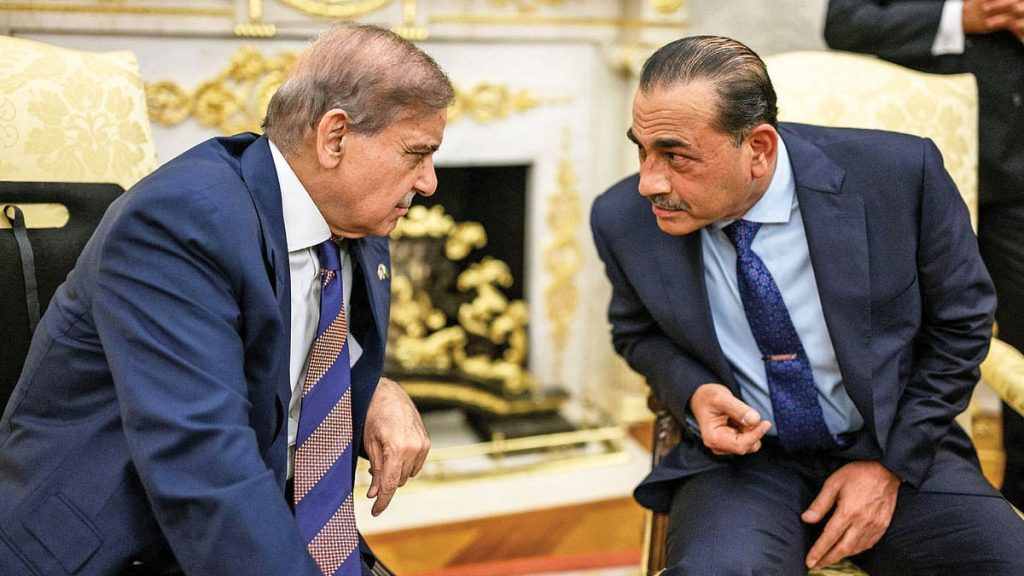
Vance’s explanation of what the ceasefire covered and what it did not was in stark contrast to Pakistan Prime Minister Shehbaz Sharif’s claim the truce would include Lebanon. After his initial “appeal” for a truce had found ready acceptance, Sharif posted that Iran and the US, as well as their allies, had agreed to an immediate ceasefire everywhere, including Lebanon. It was rather odd, Indian sources pointed out, that the “key mediator” was unaware of the terms he supposedly brokered. Sharif’s bid to position Pakistan as a crucial intermediary suffered a further setback when social media users pointed out the edit history of the prime minister’s first post appealing for a ceasefire contained the tell-tale text: “Draft— Pakistan PM’s message on X.” The slip-up suggested Sharif dutifully posted what was handed to him. As part of a set-piece, US President Donald Trump accepted the plea. Sharif’s double goof-up suggests Pakistan’s role was limited to posting scripted messages and he was unaware of the actual negotiations between the US and Tehran.
Pakistan’s bumbling eagerness to prove its utility might still earn it brownie points in Washington, but relations between Trump and his “favourite field marshal”—Pakistan army chief Asim Munir—are under adverse scrutiny. Even before Islamabad inserted itself into the Middle East situation, reports in the US media put the spotlight on a puzzling deal between the Pakistan finance ministry and the Trump administration to “jointly develop” the Roosevelt Hotel on Madison Avenue in New York. The New York Post described the property as a “vacant eyesore” that could be worth $1 billion if developed as office space. According to reports, the deal was negotiated by Trump’s special envoy Steve Witkoff. The plan to “operate, maintain, renovate and redevelop” the once-storied hotel shut since the Covid pandemic is believed to reflect Munir’s interests in the property nominally owned by Pakistan International Airlines.
While Pakistan’s claim to have brokered the truce generated scepticism—aided by the apparent lack of proof readers in Sharif’s office—there is relief in New Delhi that the hostilities in the Middle East are tapering down. The uncertainties over whether Iran will dial down its threat or renew its attacks on Israel over the Hezbollah campaign continue, but it is felt both sides need a break. Vance concluded his statement in Budapest saying, “If Iran wants the negotiation to fall apart in a conflict where they were getting hammered over Lebanon, which had nothing to do with them, and which US never once said was part of the ceasefire, that would be their choice. We think that would be dumb.” The view in Delhi is that the US was hard pressed to find an off-ramp and though Iran could rightfully claim to have withstood the firestorm of US-Israeli attacks, the battering was indeed taking a toll.
The Ministry of External Affairs welcomed the ceasefire noting that India hoped it will lead to a lasting peace. “We have continuously advocated earlier, de-escalation, dialogue and diplomacy are essential to bring an early end to the ongoing conflict,” the MEA said, adding, “The conflict has caused immense suffering and disrupted global energy supply and trade networks. We expect that unimpeded freedom of navigation and global flow of commerce will prevail though the Strait of Hormuz.”
Indian sources emphasised that the Modi government’s call for de-escalation was not a mere play on words but reflected India’s national interest given the large number of Indians living and working in the Gulf region. An Indian ship was fired on in the early part of the war and so far, nine Indian nationals have died and several have been injured. Continued tensions could seriously affect the remittance economy and a reverse migration could impose fresh burdens on the Union and state governments. The war has tested Indian diplomacy, requiring it to work closely with the Gulf Cooperation Council (GCC) nations to protect the interests of a large diaspora and an economic relationship that has grown significantly. Delhi also had to balance ties with Iran to negotiate passage of oil and gas-bearing ships bound for India. On the domestic front, the government had to respond nimbly to contain panic over cooking gas shortages by initially prioritising domestic use and curtailing LPG to commercial establishments. As domestic LPG production was ramped up and a few ships carrying oil and gas from the Gulf and elsewhere reached Indian shores, the supply to industry was gradually restored. After the truce was announced, a revised gas allocation order increased supplies to eligible sectors, such as pharmaceuticals, food processing, polymers, agriculture, packaging, paints, steel, ceramics, glass, and aerosols, to 70 per cent of their pre-March 2026 bulk non-domestic LPG consumption within certain limits.
The Strait of Hormuz is yet to fully reopen and even if it does, the effects of the conflict are likely to linger as oil and gas infrastructure has suffered significant damage. The restoration of gas supplies is particularly a worry as India received 40 per cent of its LNG from Qatar. Re-sourcing from other countries is time-consuming and presents logistical challenges. The war delivered a serious shock to the system and the full impact on various sectors and Central and state budgets is still playing out. The conflict has served to reinforce the importance of de-risking and diversification of supply dependencies. Speaking at a university convocation on April 4, External Affairs Minister S Jaishankar summed up the Modi government’s thinking. “The turbulence in the world currently is also structural in many ways. The global order is changing before our very eyes, with visible shifts in the relative power and influence of countries. The politics of some societies find it difficult to come to terms with these changes. New developments in technology, in energy, in military capabilities, in connectivity and in resources have encouraged risk-taking in an increasingly competitive environment. Everything today is being leveraged, if not actually weaponised. The world is then confronted with the task of securing itself in an increasingly volatile and unpredictable environment. This has necessitated a larger inclination to hedge, to de-risk and to diversify, whether it is a business choice or a foreign policy one. Arriving at an optimal mix of equities, exposure and risks is a far more complex calculus as a result,” he said.
Besides American media reports that said Trump signed off on the appeal for truce Sharif posted on X, the war has caused other problems for Pakistan. Annoyed by Islamabad’s perceived lack of enthusiasm in supporting the Gulf States during the war, the UAE has refused to roll over a $3.5 billion loan that Pakistan may now have to return this month itself. The UAE’s insistence has caused a lot of heartburn in Pakistan as its leaders have grown used to lenders delaying repayment of loans that run into billions of dollars. Iran’s attacks on Saudi Arabia exposed the fragility of the mutual defence pact between Riyadh and Islamabad that was inked in September 2025. Pakistan’s pleas that it was “bogged down” with border clashes with Afghanistan and that it had to concentrate on taking on the Pakistani Taliban sounded implausible and the Saudis have taken due note of the Sharif government’s stance. The defence deal envisaged a structured and institutionalised framework that many commentators had doubted and their scepticism appears well-founded.
The truce could now lead to difficult negotiations as both sides are unwilling to consider each other’s formulations, whether it is Iran’s 10-point formula or the US’ 15-point proposal. There are complications in the form of Israel’s military objectives in Lebanon. If the truce does last, even for a few weeks, elections to Kerala, West Bengal, Puducherry, Tamil Nadu, and Assam would be out of the way without the war becoming a factor. This will give the Modi government some breathing space to negotiate the passage of ships carrying oil and gas through the Persian Gulf and, at the same time, cement its ties with the Gulf States by resolutely backing any initiative to prevent another outbreak of war. Trump’s frustration with other nations, including NATO allies, for refusing to support his war effort increases the odds against the US renewing the battle. Israel’s top diplomats insist the country will strike Iran again and again as long as the regime in Tehran remains committed to the Jewish state’s destruction and does not roll back its ballistic missile and nuclear programmes. That position is unlikely to change, but the chances of another US-Israeli joint campaign against Iran are slim. America’s Gulf allies will not stand for it.
The breather could not be better timed since, had the war dragged another two-three weeks, the pressure on India’s energy supplies and other sectors that use feedstock would have mounted steeply. The unexpected deterioration in India-US relations last year in the wake of Operation Sindoor led to a renewed push for reforms and atmanirbharta (self-reliance) by way of a reorganised GST and a mission-mode approach to reducing red tape. The shock delivered by the war in the Middle East will likely set off another round of soul-searching and a much-needed rebalancing of India’s dependence on fossil fuels. But that is in the future. For now, a truce in the Middle East is very welcome.