
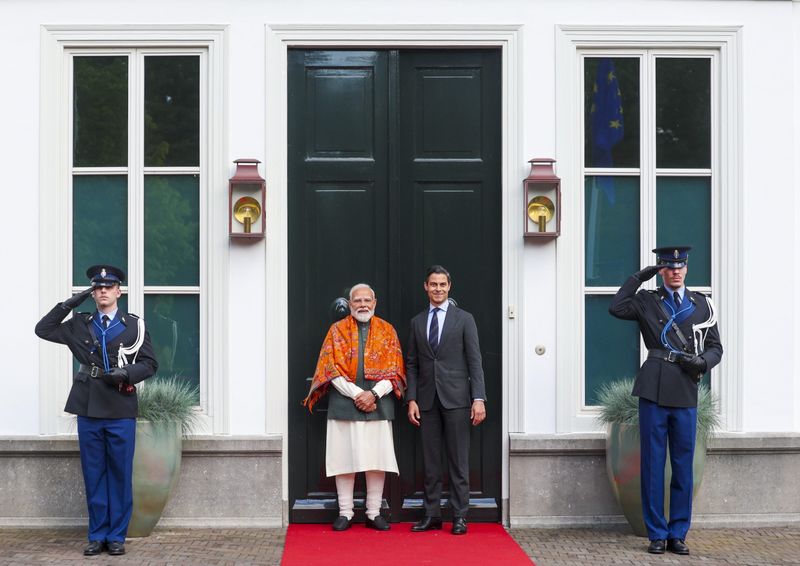
After Dutch PM Rob Jetten flagged concern over press freedom and minority rights in India, sources said the issues did not come up during bilateral talks.
New Delhi: Dutch Prime Minister Rob Jetten spoke to local media ahead of his meeting with Indian Prime Minister Narendra Modi about concerns over minority rights, press freedom and the rule of law in India, although Indian sources maintained that the issue did not come up during bilateral talks.
During Modi’s two-day visit to the Netherlands, the 39-year-old Dutch premier held several engagements with his Indian counterpart, which saw an elevation of bilateral ties to a “strategic partnership”.
Ahead of the dinner hosted at Catshuis, the Dutch PM’s official residence, Jetten spoke with local reporters about the visit, where he was asked about various aspects of relations with India.
As reported by two major Dutch newspapers, de Volkskrant and NRC, Jetten told reporters just before Modi arrived at the Catshuis that there were concerns among the Netherlands and other EU member states about “developments in India” under Modi’s Hindu nationalist BJP.
“It is not only about press freedom, but also about the rights of minorities, who are under severe pressure. That applies in the first place to the Muslim community, but also to many other smaller communities,” Jetten said, according to de Volkskrant. “The concern is to what extent India remains an inclusive society where the same rights apply to everyone.”
Jetten said these concerns were “regularly raised” with the Indian government. He added that the EU-India free trade agreement would offer opportunities to discuss “other subjects” alongside commercial ties, “from a very personal case like that of Insiya, to the larger themes like human rights in India and strengthening democracy and the rule of law”.
NRC reported that Jetten told the press he had recently had a conversation with the mother of Insiya Hemani, a Dutch girl abducted to India by her father in 2016, and that it had made a big impression on him. Deputy Prime Minister Dilan Yesilgoz had said on Friday that the Netherlands “wants to do business with India, but that also means we need to find a solution for Insiya”.
In a post on X after the talks, Jetten did not mention press freedom or minorities. He said his discussion with Modi had covered the Strait of Hormuz’s closure, energy prices and the Insiya case. NRC reported that when the two leaders were later seen walking through the Catshuis garden for cameras, Jetten pointed to the newly born goslings on the lawn.
Straight from the dinner meeting, Indian officials headed to a special media briefing. A Dutch journalist sought a response, stating that Jetten had spoken earlier in the day about concerns in the Netherlands and the EU over “press freedom and minority rights” in India, particularly regarding Muslims and other smaller communities.
Responding at length, secretary (west) in the Ministry of External Affairs (MEA) Sibi George rejected the premise of the criticism and said such questions stemmed from “the lack of understanding of the person who asks the question”.
Another Dutch journalist followed up by saying their colleague had merely been “citing our prime minister”. “I have not seen that statement,” the MEA secretary replied, before adding that he was responding to the broader question on freedoms and minorities in India.
According to sources, there were no discussions around human rights concerns about minorities or press freedom during the delegation-level talks.
Separately, the case of Insiya had been overshadowing the visit of the Indian prime minister in the Dutch media landscape.
As per reports, Insiya, a Dutch national, was two years old when she was violently taken from her grandmother’s home in Amsterdam in September 2016 in an operation orchestrated by her father, Shehzad Hemani, and smuggled through Germany to India. Her mother Nadia Rashid, who had been granted custody by a Dutch court, has not had contact with her for nearly a decade.
Dutch courts convicted the father in absentia and sentenced him to over eight years in prison. The Dutch Supreme Court affirmed the conviction last year. India is not a signatory to the 1980 Hague Convention on International Child Abduction, and the case has been raised in successive diplomatic interactions without result.
Days before Modi’s visit, every Dutch member of the European parliament signed a letter to Maharashtra MPs asking for help in bringing Insiya home.
Before the visit, Dutch foreign minister Tom Berendsen told parliament there was growing “frustration” within the government over the lack of progress. Yesilgoz said the Netherlands wants strong business ties with India, but added that progress on Insiya’s case must also be part of the relationship. The lower house of the Dutch parliament adopted a resolution on May 13 asking Dutch King Willem-Alexander to raise the matter with the Indian leader.
When Modi arrived at the Huis ten Bosch royal palace on Saturday (May 16), demonstrators outside called for the girl’s return. Dutch media carried photos and reports of Rashid standing beside a large sign with a photo of her daughter addressed to Modi and Jetten, asking, “When is Insiya coming home?” According to De Telegraaf, Queen Maxima came by to speak with Rashid earlier in the day while out walking her dog.
At the media briefing, the MEA secretary confirmed only that “this was raised by the Netherlands leadership”. Stating that the case was sub judice, he added: “I would not like to comment on this at this stage”.
The Dutch PM while speaking to reporters stressed that Modi’s visit was primarily focused on business and that any eventual resolution of the Insiya case would likely come later. “We are now working to ensure that a Dutch mission goes to India very soon to discuss this at the very highest level and jointly reach a solution,” he said.
Modi’s two-day visit to the Netherlands was part of a five-nation tour that also includes the UAE, Sweden, Norway and Italy. It was his first visit to the country since 2017.
On Saturday, Modi was received by the Dutch royal couple, attended a CEO’s roundtable and held delegation-level talks with Jetten before dinner at the Catshuis.
The two governments elevated their bilateral relationship to a strategic partnership and adopted a roadmap for cooperation across trade, defence, critical technologies, the maritime sector, renewable energy and education.
In the joint statement, Jetten condemned the April 2025 Pahalgam terrorist attack and expressed solidarity with India against terrorism. Both leaders discussed the Strait of Hormuz’s closure and called for freedom of navigation and unimpeded commerce through the waterway.
The most significant commercial outcome was a memorandum of understanding between Tata Electronics and ASML, the Dutch semiconductor equipment maker, under which ASML will supply advanced lithography tools for Tata’s planned 300 mm fabrication plant in Dholera, Gujarat, being built with an $11 billion investment. Leiden University restituted 11th-century Chola-era copper plates to India.
On Sunday, the two leaders visited the Afsluitdijk, one of the Netherlands’ major flood control barriers. Later in the day, the Dutch premier saw Modi off at the airport as he departed for Sweden.
This article went live on May seventeenth, two thousand twenty six, at forty-eight minutes past nine at night.
The Wire is now on WhatsApp. Follow our channel for sharp analysis and opinions on the latest developments.