
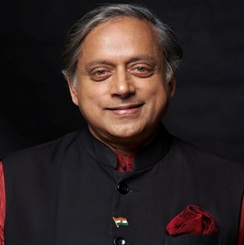
Dr. Shashi Tharoor – Member of Parliament
Strategic autonomy is not just a slogan. It is a strategy. It is the art of navigating a turbulent world without losing one’s bearings. As the global order shifts, India must continue steadily to walk the tightrope — engaging with the US without becoming a vassal, deterring China without provoking war, and partnering with Russia without inheriting its isolation. It must invest in capabilities, cultivate partnerships, and assert its interests with clarity and confidence.
Introduction
In the lexicon of international relations, few concepts have evolved as dynamically as “strategic autonomy”. Once a term confined to academic debate, it now sits at the heart of India’s foreign policy discourse, shaping decisions in an increasingly multipolar and volatile world.
As global power shifts accelerate and traditional alliances fray, India finds itself navigating a delicate path between competing giants: the United States, China and Russia. The pursuit of strategic autonomy is no longer a theoretical aspiration. It is a daily diplomatic practice, fraught with complexity and consequence.
Strategic autonomy refers to a nation’s ability to make sovereign decisions in foreign policy and defence without being constrained by external pressures or alliance obligations. It is not synonymous with isolationism or neutrality. Rather, it implies flexibility, independence and the capacity to engage with multiple powers on one’s own terms.
For India, the concept has deep historical roots, going back to colonial subjugation and free India’s determination never to let anybody else decide our place in the world for us. From Nehru’s non-alignment during the Cold War to the Modi government’s “multi-alignment” in the current era, successive governments have sought to preserve India’s freedom of action while adapting to changing geopolitical realities.
In theory, strategic autonomy offers a middle path between rigid bloc politics and passive disengagement. In practice, it demands deft diplomacy, institutional resilience, and a clear-eyed understanding of national interest. It is a balancing act — sometimes precarious, often imperfect, but essential for a country such as India that aspires to global leadership without becoming a client state.
The Paths and Hurdles for India
The current global landscape presents both opportunities and challenges for India’s strategic autonomy. The unipolar moment of American dominance has given way to a fragmented world order, where China’s assertiveness, Russia’s revisionism, and the West’s internal divisions, accentuated by Washington’s unpredictability, create a fluid and unpredictable environment.
For India, this means recalibrating its relationships with major powers while safeguarding its core interests — territorial integrity, economic growth, technological advancement, and regional stability.
India’s relationship with the United States has deepened dramatically over the past two decades. From defence cooperation and intelligence sharing to joint military exercises and technology transfers, the strategic partnership has matured. The Quad grouping (Australia, Japan, India, and the US), Indo-Pacific dialogues, the incipient I2U2 (India, Israel, the United Arab Emirates, and the US), and the India-Middle East-Europe Economic Corridor (IMEEC), and shared concerns over China’s rise have further cemented ties.
Yet, the relationship is not without friction. The Trump administration’s erratic trade policies, followed by stinging tariffs and sanctions in his second term, have strained economic ties. Washington’s pressure on India to reduce its energy and defence dealings with Russia, and to align more closely with Western positions, has tested New Delhi’s resolve.
India’s response has been measured. It continues to engage with the US, maintains independent positions on global conflicts, and insists on the primacy of national interest over ideological alignment. This is strategic autonomy in action, not anti-Americanism, but a refusal to be subsumed by American priorities.
Ties with Beijing and Moscow
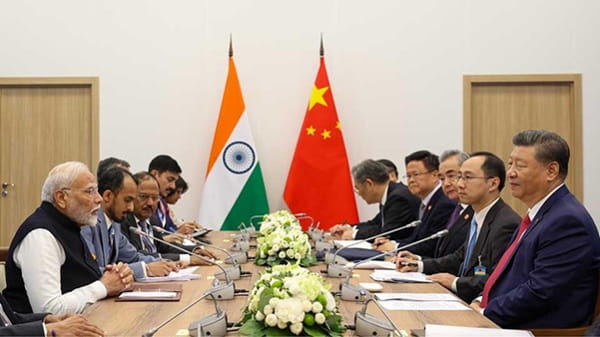
Indian delegation led by Prime Minister Narendra Modi and Chinese delegation led by President Xi Jinping meeting on the sidelines of the BRICS summit in Kazan, Russia on October 23, 2024. | @NarendraModi/X.
China presents a more complex challenge. The border clashes with India of 2020 shattered illusions of benign coexistence, and tensions remain high despite diplomatic overtures. Yet, China is also one of India’s largest trading partners, a key player in regional institutions, and a competitor whose actions shape the strategic environment. India’s approach is one of cautious engagement and firm deterrence.
It strengthens border infrastructure, deepens ties with Indo-Pacific partners, and invests in indigenous defence capabilities. At the same time, it participates in multilateral forums such as BRICS and the Shanghai Cooperation Organisation, where China plays a leading role — a difficult but necessary balancing act.
Strategic autonomy here means resisting both confrontation and capitulation. It means asserting sovereignty and refusing to be another country’s counterweight to a rising China, while controlling Chinese access to the Indian economy, and simultaneously keeping channels of communication open. It means recognising that rivalry does not preclude diplomacy, and that decoupling is not always desirable or feasible.
India’s relationship with Russia is rooted in Cold War solidarity, defence cooperation and shared strategic interests. Despite Moscow’s growing closeness to Beijing and Russia’s global isolation following the Ukraine conflict, India has maintained its ties — buying oil, importing weapons, and engaging diplomatically. This has drawn criticism from Western capitals, but India has stood firm.
Its relationship with Russia is historical, multidimensional and not subject to external veto. It continues to diversify its military imports, invest in indigenous production and explore new partnerships, but without abandoning old ones. Strategic autonomy here is about refusing to choose sides in a binary contest, and, instead, crafting a foreign policy that reflects India’s unique geography, history and aspirations.
During India’s G-20 presidency in 2023, Prime Minister Narendra Modi declared that India was now the voice of the Global South — unbowed, plural and potent. Its democracy, he said, was not just a system but a “bouquet of hope”, nourished by the strength of its multilingual, multicultural fabric. External Affairs Minister S. Jaishankar argues that partnerships must be shaped by interest, not sentiment or inherited bias.
This is diplomacy with a spine — assertive, pragmatic, and unapologetically Indian, seeking to be “non-West” without being “anti-West”.
This stance resonates across the Global South, where many rising and middle powers concerned with peace and stability in their own regions are choosing to safeguard their geopolitical and economic interests rather than be swept into the vortex of great-power rivalries. They seek agency, not alignment; voice, not vassalage.
What emerges is a vision of India as a sovereign pole in a rebalancing world — a nation that neither aligns blindly nor isolates itself. India’s rise, then, is civilisational, plural and deeply political. While India’s pursuit of strategic autonomy is principled, it faces headwinds as it walks the tightrope among the major powers. The global economy is increasingly interdependent, and technological ecosystems are dominated by a few players. Defence modernisation requires partnerships, and climate diplomacy demands coordination. In such a world, autonomy must be redefined — not as isolation, but as resilience and adaptability.
Domestic factors also play a role. Political polarisation, economic vulnerabilities and institutional constraints can limit the effectiveness of autonomous decision-making. Strategic autonomy requires not just diplomatic skill, but economic strength, technological capability and political coherence. We cannot be truly autonomous from a position of weakness.
Moreover, in a world of cyber threats, Artificial Intelligence warfare and space competition, autonomy must extend beyond traditional domains. It must encompass data sovereignty, digital infrastructure and supply chain security. India’s recent efforts to build indigenous platforms, secure critical minerals and assert its voice in global tech governance are steps in this direction.
More than a Slogan
Strategic autonomy is not just a slogan. It is a strategy. It is the art of navigating a turbulent world without losing one’s bearings. As the global order shifts, India must continue steadily to walk the tightrope — engaging with the US without becoming a vassal, deterring China without provoking war, and partnering with Russia without inheriting its isolation. It must invest in capabilities, cultivate partnerships, and assert its interests with clarity and confidence.
In doing so, India does not reject the world — it reclaims its agency within it. Strategic autonomy is not about standing alone; it is about standing straight and standing tall.
(First published in The Hindu on September 6, 2025)