
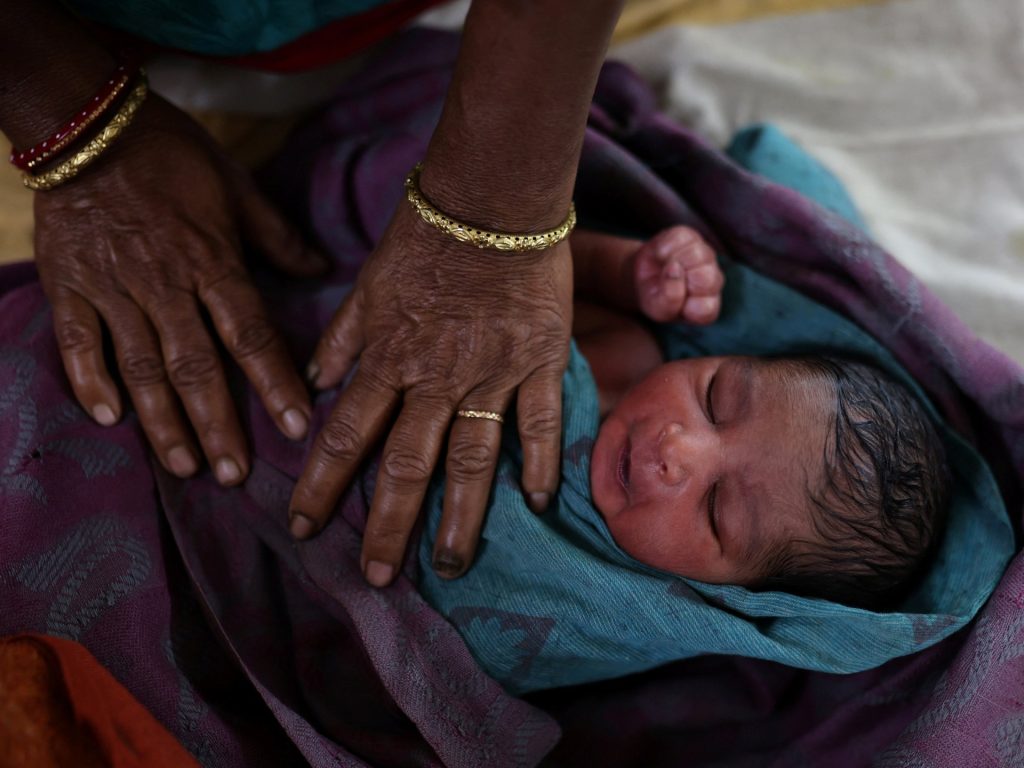
India’s fertility rate has for the first time fallen below the level needed to stop the population from shrinking, raising concerns about future labour shortages and an ageing society.
For decades, India has seen rapid population growth. According to government statistics, including the Sample Registration System (SRS) Statistical Report — the country’s largest demographic survey — India has had a falling fertility rate for some years, but the reproduction rate remained high enough to keep the population growing.
Recommended Stories
list of 3 itemsend of list
The latest SRS report, released last month by India’s Office of the Registrar General and Census Commissioner, said that India’s Total Fertility Rate (TFR) had dropped to 1.9 children per woman – lower than the benchmark level of 2.1 needed to keep the population stable in the long run. TFR is the average number of children that a woman is expected to have in her lifetime. In the 2000s, India’s TFR was around 3.3 births per woman.
So, what is behind reduced fertility? Why does it matter and what are the consequences?
Here’s what we know:
What has led to the falling fertility rate ?
For decades starting in the 1970s, Indian governments and policymakers have tried to battle what they argued was overpopulation — too many people, and too few resources to manage for what was then a relatively poor nation.
Many top-down government initiatives — including a brief controversial effort to forcibly sterilise people in the 1970s — aimed to control India’s population.
Despite that, by 2019, India’s Prime Minister Narendra Modi was still warning of a “population explosion”.
But by 2022, the first signs that India was about to tip over into uncharted territory: The National Family Health Survey released data suggesting that India’s TFR was falling fast, across communities. Yet a year later, India surpassed China to become the world’s most populous nation — and the trend of a declining fertility rate was swamped by the headlines of a 1.5 billion population.
Now, latest survey suggests that the prospect of a shrinking population might be more imminent than policymakers had planned for.
Experts say better access to education and contraceptives are among key factors behind the falling fertility rate — along with the increased costs of bringing up children.
“Total fertility rate often drops when more women in society have access to education, contraceptives and more agency in decision-making in households,” Dipa Sinha, a development economist who works on social policy in India, told Al Jazeera. “It also drops when the economy becomes expensive so raising children also becomes expensive.”
She said there’s another reason too.
As infant mortality reduces, the desire to have more children also decreases. According to the latest SRS report, India has recorded a significant decline in infant deaths from 30 per 1,000 live births in 2019 to 24 deaths per 1,000 live births in 2024.
These factors also correlate almost perfectly with the differential levels of fertility rates across the country.
According to the May demographic survey report, India’s poorest states, such as Bihar in northern India with the lowest levels of education and high infant mortality rates, also recorded the highest fertility rate in the country at 2.9, followed by 2.6 in Uttar Pradesh.
By contrast, India’s capital New Delhi — with among the highest levels of education and lowest infant mortality rates — registered the lowest fertility rate, with an average of 1.2 births per woman. Southern states such as Tamil Nadu and Kerala, with among the best health and education systems in India, recorded a rate of 1.3.
“A lot of studies on regional development in India from the early 80s have revealed that states in the South have developed faster with respect to both the economy and women’s status in society. So these reasons have contributed to the lower fertility rate,” Sinha said.
What are the consequences of a falling fertility rate?
In 2005, India’s population entered a stage called ‘demographic dividend’, a phase when the proportion of a country’s working age population (15-64 years) is higher than the number of old people and children who are not in the labour force. According to the UNFPA, India’s demographic dividend is expected to last until 2055.
Japan, Singapore and Hong Kong entered this phase in the 1960s and rapidly became developed economies. China entered this phase in the 1980s and — coupled with economic reforms — rapidly rose as an economy. Today it’s the world’s second-largest economy.
In India too, the demographic dividend has helped propel the economy. But millions remain unemployed and — as with China — India is far from a developed economy.
Now, with a declining fertility rate, India might not be able to reap the benefits of a demographic dividend, experts are cautioning, because of a shrinking workforce and a rapidly ageing population.
“If there are fewer children born, then in about 30 to 40 years, India will have more older people who cannot participate in the labour force as much, posing a challenge to the country’s workforce,” Sinha said.
What is the politics behind India’s population data?
The widely varying fertility rates in different parts of the country mean that northern states — which already have higher populations — will in coming years be home to an ever-increasing share of India’s population.
Southern states have already in recent years been complaining that the Indian federal government — especially under Modi — are being “punished” with fewer funds, Sinha said. Modi’s Bharatiya Janata Party (BJP) has historically struggled to make major political inroads in southern India, though it has made gains in recent years.
Now, “the distribution of financial resources by the country’s government to state governments” could become an even bigger political flashpoint, she suggested. Later this year, India’s government will introduce a policy in parliament called “delimitation”, which will assign seats to each state according to population figures based on the subcontinent’s new census that began earlier this year and conclude in 2027.
“When delimitation comes into effect, there is a fear that the share of southern seats in the Parliament will reduce,” Sinha added.
Moreover, India’s ruling BJP has long stirred the stereotype that Muslims in India are producing more children than Hindus — fanning fears among Hindus that Muslims might some day overtake them as the majority faith in India. The Hindu far-right has been urging Hindus to have more kids. In February, Rashtriya Swayamsevak Sangh (RSS) chief, Mohan Bhagwat, urged Hindu couples to have at least three to four children to prevent the community’s long-term societal decline.
In reality, the Muslim population of India was 13 percent in the last census in 2011. Government data shows that the Muslim fertility rate has been falling faster than in any other religious group, India, including Hindus. The fertility rate among Muslims fell from 4.41 to 2.36 between 1992 and 2021, while it dropped from 3.3 to 1.94 for Hindus.
The latest survey further suggests that India’s fertility rate is falling sharply across faiths.
Is India responding to its declining fertility rate?
While the Indian government has not yet announced a nationwide policy to tackle its falling fertility rate, individual states have been trying to encourage people to have more children.
Last month, the southern Indian state of Andhra Pradesh said families will receive 30,000 rupees ($314) for the birth of a third child and 40,000 for a fourth child ($418). According to the SRS data, Andhra Pradesh’s total fertility rate is 1.4.
States such as Goa in the west and Karnataka and Telangana in the south have introduced state-funded IVF centres for first-time parents, encouraging people to have more children.
Sinha said the Indian government should respect people’s individual reproductive choices and support them.
“It is important for countries like India to develop a public policy based on its demographic structure and future needs. So if we are going to be an ageing population, then we have to be ready to help a lot of old people,” she said. The country needs “a policy now which guarantees that they have better healthcare, pensions and social security in old age”.
Which other countries in Asia have seen dramatic fertility rate declines?
Other Asian countries such as China, Taiwan and South Korea are also experiencing fast-falling fertility rates.
According to the World Bank, China’s 1.0 fertility rate is well below the 2.1 replacement level.
Taiwan’s interior ministry said earlier this year that its total fertility rate is around 0.86 and likely to fall below that.
The United Nations says South Korea’s rate is approximately 0.75 children per woman – the lowest worldwide.