
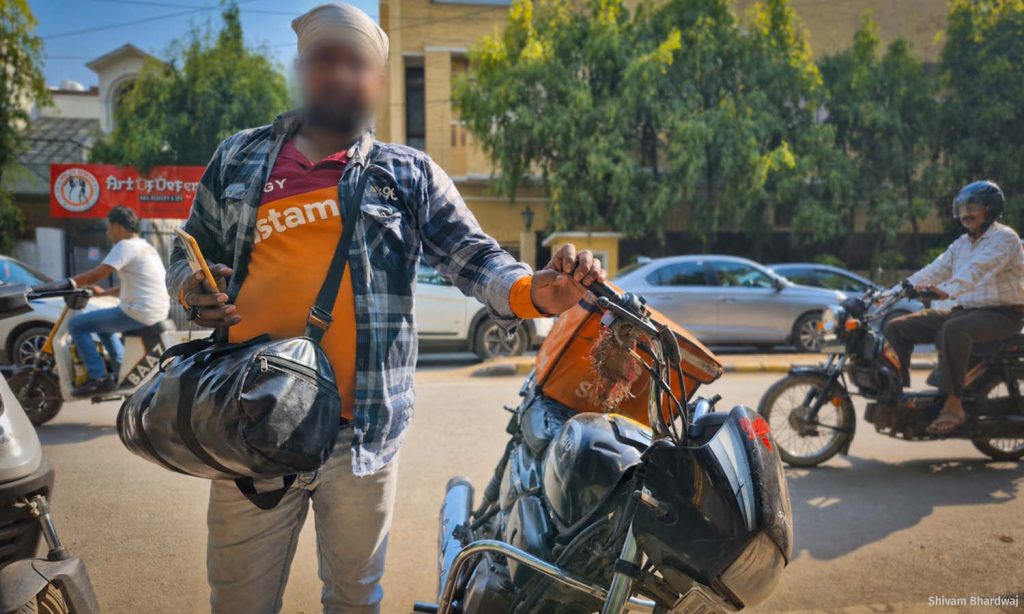
New Delhi: “No matter if it is hot or raining, we have to work,” says 30-year-old Rakesh Sahu (name changed), from Uttar Pradesh’s Jaunpur, who works as a delivery agent for Swiggy in Delhi. When IndiaSpend met him in early April in Saket, he had a cloth wrapped around his head, and a cap on to protect from Delhi’s intense heat.
India had 7.7 million gig workers in 2020-21, a number projected to reach 23 million by 2029-30. Working 12 hours a day in the heat, with little or no provision for shade, drinking water and toilets, takes a toll on millions of India’s gig and platform workers. Lack of social security, paid leave or income protections means the workers cannot afford to take time off of work to rest and recuperate.
“When we climb three to five floors in apartment complexes, we get dizzy. In many buildings, they do not even allow us to use the elevator,” says Ankit Soni from Bihar’s Siwan district, who has been working with Swiggy for three years. IndiaSpend met 22-year-old Soni at Khadak Singh Da Dhaba in Malviya Nagar when he was collecting an order for delivery. “When the loo [hot, dry summer wind] blows, the conditions become even worse. Staying in the sun too long leads to nosebleeds and fevers,” he says, drenched in sweat.
But the workers are at the mercy of algorithms they don’t fully understand, where even a short break leads to lost incomes. “If the target isn’t met, we don’t get the incentive. And without the incentive, we cannot even afford a full meal. What would I do in Delhi then?”
Platforms incentivise workers to stay online throughout the day, particularly during the peak afternoons and evenings, and accept all orders that come their way. The daily incentive they are paid is what keeps them afloat.
Radheshyam Kumar (name changed), a 29-year-old Swiggy delivery agent resting in the shade of a tree, says that during intense heat, their phones often overheat and shut down. “We have to search for spots like this to escape the sun and rest.”
Access to water is difficult. “At the very least, drinking water should be free and accessible,” he says. Without that, workers have to choose between spending money to buy water, or delay drinking water and suffer dehydration. “At the restaurants where we pick up orders, if we ask for water, they sometimes offer the dirty water used for washing dishes. After that, we don’t have the courage to ask again.”
Radheshyam Kumar says provisions for shade and drinking water should be provided at the very least.
The scale
Summer temperatures are rising across many parts of the country, and the India Meteorological Department (IMD) predicts above-normal heatwave days between April and June 2026, along with higher minimum temperatures—a phenomenon called hot nights. In Delhi, the government has initiated steps such as stocking medicines and supplies, setting up cool rooms in several hospitals.
Nights give the human body a chance to cool down. But when nights get warmer, as IndiaSpend explained in May 2023, it leads to increased heat stress on the body. The relative mortality risk on days with hot nights could be 50% higher than on days with non-hot nights, we had reported.
Globally, more than 2.4 billion workers are exposed to excessive heat, resulting in more than 22.85 million occupational injuries each year, according to the World Health Organization. More than one third of all persons who frequently work in hot conditions experience physiological heat strain.
In addition, for every degree increase beyond 20°C in Wet-Bulb Globe Temperature—a measure of heat stress that takes into account air temperature, humidity, wind speed, sun angle, and cloud cover—productivity decreases by 2-3%.
India is projected to lose about 5.8% of working hours in 2030, up from 4.3% in 1995, the International Labour Organisation estimated. Given its large population, the country is expected to lose the equivalent of 34 million full time jobs in 2030 as a result of heat stress.
The year 2024 was the hottest globally, and India recorded its longest heatwave since 2010 that year, with temperatures in many states remaining above 40°C for an entire month, leading to more than 44,000 reported heatstroke cases, according to a May 2025 report by the Council on Energy, Environment and Water (CEEW).
More than 1 billion people across 23 Indian states were affected by heatwaves in 2024, the report notes. Over 70% of Indian districts now experience at least five additional “very warm nights” per summer, while 28% of districts see an increase of more than five “very hot days” annually. Experts suggest India could lose the equivalent of 35 million full-time jobs by 2030 due to heat stress.
Carrot and stick
An advisory from the National Disaster Management Authority from July 2025 lists measures including shift restructuring, service radius reduction, safety gear and hydration measures, rest breaks and cooling shelters.
It calls on platforms to provide a safety kit that includes UV-protective clothing, cooling caps, sunglasses, sunscreen, phone-cooling covers, electrolytes and insulated cool flasks.
Platforms offer incentives for staying available for work during peak afternoon hours, and levy penalties for cancelled orders, making it difficult to take breaks.
Twenty-four-year-old Afzal (name changed), from UP’s Faizabad, is out in the afternoon heat to fulfill a consumer’s craving for ice cream and cold drinks. Riding a bike during a heatwave leaves his face hot, and leads to weakness and dizziness. Afzal says the safety kits are not provided for free—so they make do with a cloth for protection.
Riding a bike during a heatwave leaves Afzal’s face hot, and leads to weakness and dizziness. The government calls on platforms to provide safety kits, but they are not free. Workers make do with a cloth for protection.
The advisory calls on platforms and aggregators not to mandate work between 11 a.m. and 4 p.m. In theory, this means gig workers should have the flexibility to avoid afternoon heat.
Kumar laughs. “If I want the incentive, I must stay logged in for three and a half hours between 12 noon and 4 p.m. to receive and deliver orders. If I cancel an order during that time, I lose the incentive and face a penalty. Similarly, it is mandatory to work between 7 p.m. and 11 p.m.”
Thirty-year-old Rinku Kumar (name changed), a Zomato delivery agent, agreed. He showed IndiaSpend his incentive chart. Completing 22 orders earns him an incentive of Rs 233. This needs 12 to 13 hours of work. “It is not possible to take a two- or three-hour break during a heatwave under company policy. If I take a break, I won’t earn enough.”
Ravindra Rajpoot, 25, who delivers for Flipkart, says they receive a fixed amount per delivery. “During extreme heat, our delivery count drops, which directly impacts our income. Usually, in good weather, I do 50 to 60 deliveries a day, but during a heatwave, this drops to 30 or 40. This leads to a financial loss. We either bear the financial loss or the health loss; we cannot save both in this job.”
Kumar identified the primary needs as free availability of water, access to toilets, places to rest, and two paid leaves per month. “We should receive these facilities, whether from the government or the company. If the incentive amount was provided as compensation during heatwave days and there was relief from afternoon work, our burden would be reduced.”
Thirty-year-old Rinku Kumar (name changed) earns an incentive of Rs 233 for completing 22 orders in a day. “It is not possible to take a two- or three-hour break during a heatwave under company policy. If I take a break, I won’t earn enough.”
“For workers who depend on daily income with no wage security, heat safety cannot work unless income loss is addressed directly,” says Vidhya Venugopal, professor of occupational and environmental health at the Sri Ramachandra Institute of Higher Education and Research.
“Heatwaves should be considered a disaster,” Dharmendra Kumar, founder-secretary of Janpahal, which advocates for gig workers’ rights, says. “Every worker should be given the ‘Right to Cool.’ The working structure should be redesigned, login periods shortened, and rest breaks provided. Shaded areas must be developed on a large scale; currently, even the ‘dark stores’ of these companies lack resting facilities. They must provide ORS, ventilated rooms, and drinking water.”
A lack of accountability is the problem, Apoorva Sharma, President, App Karmchari Ekta Union, argues. “Most workers are operating without health coverage. It is the government’s responsibility to ensure an employer-employee relationship in the gig economy,” Sharma says. “The problems of gig workers during heatwaves can only be solved if the government regulates the companies and ensures that algorithms, incentives, and payment systems are transparent under labour laws. When you claim workers are ‘free to work by choice,’ why are you dictating hours through incentives? Why is there a penalty for canceling orders? And why are IDs blocked when workers protest? You are exercising the rights of an employer but refusing to grant rights to the workers.”
“The AI-driven app system is designed for the customer, not the delivery worker,” Raghu Murtugudde, Emeritus Professor at The University of Maryland and Visiting Professor at IIT Kanpur, adds. “Aggregators prioritise customer service over worker well-being. Worker welfare must be integrated into their algorithms.”
Heat is a serious occupational health hazard
Extreme heat has a devastating effect on the health of gig workers. A study conducted by the Telangana Gig and Platform Workers Union and HeatWatch found that workers showed symptoms such as heat exhaustion, heatstroke, dehydration, skin diseases, gastrointestinal issues, heat edema, and kidney-related illnesses.
“Prolonged heat exposure is not just a matter of discomfort; it is a serious occupational health hazard with both immediate and long-term consequences,” says Venugopal. “Repeated exposure significantly reduces a worker’s physical capacity, stamina, and productivity, and this is often under-recognised.”
During heatwaves, the body loses water leading to fatigue known as heat exhaustion, Dilip Mavalankar, professor at the Indian Institute of Public Health, Gandhinagar, explains. Sometimes, working in the sun causes the physical system to collapse into unconsciousness—a heatstroke. There is also a significant risk of kidney problems.
“If workers drink more water, they will need to urinate more, but there are no proper public facilities for that in cities. To avoid kidney disease, it is essential to stay hydrated,” he says. “The problem is also that in most states, health departments do not record, monitor, or publish data related to mortality and hospitalisation during heatwaves. If you do not recognise the problem, how can you work on a solution?”
India counts among heat stroke deaths only those deaths medically certified as having been caused by direct exposure to the sun, capturing only 10% of the real figure, as IndiaSpend reported in June 2020.
“Humidity is also increasing, which means we are facing a ‘humid heat’ crisis,” Murtugudde adds. “Urban conditions, such as pollution and traffic jams, exacerbate this in cities like Delhi.”
The human body uses sweat for thermoregulation, but with high humidity, the sweat cannot evaporate, increasing heat stress, as IndiaSpend explained in May 2025.
IndiaSpend reached out to Zomato and Swiggy for comment. In addition, we reached out to the Delhi Disaster Management Authority and labour department officials for steps taken to monitor compliance. We will update this story when we receive responses.
Back in Delhi’s Saket, Sahu’s gaze remains fixed on his mobile screen. “If I am late, I lose out; I have to meet the target.”
We welcome feedback. Please write to respond@indiaspend.org. We reserve the right to edit responses for language and grammar.