
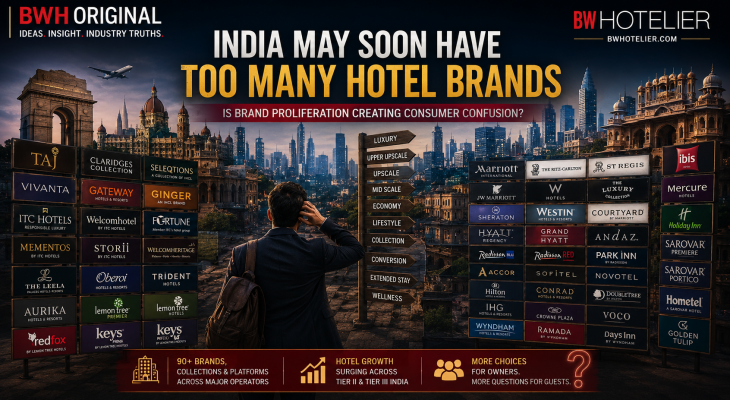
Not very long ago, choosing a hotel was relatively simple.
A traveller might choose between Taj, Oberoi, ITC, Marriott, ACCOR, Hyatt, Hilton, Radisson, IHG, Leela or a handful of independent hotels. Brands stood for something distinct, memorable and easily understood.
Today, however, the hospitality landscape has changed dramatically.
India’s hotel boom is no longer confined to Delhi, Mumbai, Bengaluru, Chennai and Kolkata. Growth has spread across Hyderabad, Ahmedabad, Pune, Lucknow, Chandigarh, Indore, Surat, Coimbatore, Bhubaneswar, Guwahati and dozens of emerging Tier II and Tier III destinations.
As operators race to capture this opportunity, they are not merely opening more hotels. They are launching more brands.
Luxury brands.
Lifestyle brands.
Collection brands.
Conversion brands.
Soft brands.
Extended-stay brands.
Wellness brands.
Experiential brands.
Heritage brands.
Economy brands.
The result is an industry that may soon face an unusual challenge.
Not too few hotels.
Not too little demand.
But perhaps too many brands.
India’s Hotel Boom Is Fueling Brand Expansion
The Indian hospitality industry is enjoying one of the strongest growth cycles in its history.
Consultants including JLL, Cushman & Wakefield, HVS, Horwath HTL, Mahajan & Aibara, Hotelivate and CBRE continue to point toward a robust development pipeline driven by domestic travel, rising incomes, infrastructure expansion and improving air connectivity.
Growth drivers include:
• New airports and aviation routes
• Expressways and highway corridors
• Religious and spiritual tourism
• Weddings and social celebrations
• MICE and convention demand
• Manufacturing and industrial expansion
• Growth of Tier II and Tier III cities
• Rising domestic tourism spending
For operators, every new market creates a new opportunity.
And increasingly, every opportunity seems to require a new brand.
The Great Brand Explosion
What began as segmentation has evolved into proliferation.
Virtually every major hotel company today operates a portfolio of brands rather than a single identity.
Marriott International spans luxury, premium, select-service and extended-stay segments through more than sixteen active brands in India including Ritz-Carlton, St. Regis, JW Marriott, W Hotels, Luxury Collection, Sheraton, Westin, Renaissance, Courtyard, Fairfield and Aloft and the soon expected New DelhiMarriott Marquis.
Accor has built a broad spectrum through Raffles, Fairmont, Sofitel, Pullman, Grand Mercure, Novotel, Mercure and ibis and their newest Morgans Originals independent hotels
Hilton operates through Conrad, Hilton Hotels & Resorts, DoubleTree, Hilton Garden Inn, Hampton and Spark.
Hyatt‘s architecture includes Park Hyatt, Grand Hyatt, Andaz, Alila, Hyatt Regency, Hyatt Centric, Hyatt Place and JdV by Hyatt.
Radisson Hotel Group deploys ten brands across India including Radisson Collection, Radisson Blu, Radisson RED, Park Plaza, Park Inn and Country Inn & Suites.
IHG spans Six Senses, InterContinental, Vignette Collection, Crowne Plaza, voco, Holiday Inn, Holiday Inn Express, Garner and Staybridge Suites.
Wyndham continues expanding through Wyndham Grand, Ramada, Howard Johnson, Hawthorn Suites, Days Inn and Trademark Collection.
Yet the trend is equally visible among India’s domestic champions.
IHCL today operates far beyond the iconic Taj brand through Claridges Collection, SeleQtions, Vivanta, Gateway, Ginger, Tree of Life, Brij, Atmantan, Taj Safaris and amã Stays & Trails.
ITC Hotels has expanded through ITC Hotels, Mementos, Epiq Collection, Welcomhotel, Storii, Fortune Hotels and WelcomHeritage.
Lemon Tree Hotels now covers Aurika, Lemon Tree Premier, Lemon Tree Hotels, Keys Prima, Keys Select, Red Fox and Keys Lite.
Sarovar Hotels serves multiple segments through Sarovar Premiere, Sarovar Portico, Hometel and Golden Tulip.
The Oberoi Group continues with a relatively focused architecture through Oberoi Hotels & Resorts, Trident Hotels and Maiden’s Hotel.
The Leela has taken a different route altogether, strengthening a single luxury master brand across palaces, city hotels and destination resorts rather than creating multiple sub-brands.
The question is no longer whether operators need multiple brands.
The question is how many are too many.
India’s Brand Proliferation Race
|
Hotel Company |
Brands / Collections / Platforms |
|---|---|
| Marriott International |
16+ |
| IHCL |
10+ |
| Accor |
9 |
| IHG Hotels & Resorts |
8+ |
| Hyatt |
8 |
| ITC Hotels |
7 |
| Lemon Tree Hotels |
7 |
| Hilton |
6 |
| Wyndham Hotels & Resorts |
6+ |
| Sarovar Hotels |
4 |
| Oberoi Group |
3 |
| The Leela |
1 Master Brand |
The Bigger Question
The industry understands these distinctions.
Owners understand these distinctions.
Consultants understand these distinctions.
Does the guest?
The Consumer Confusion Problem
The hospitality industry has become increasingly sophisticated. Guests, however, have not necessarily become hospitality experts.
Most travellers understand the difference between luxury and economy.
Many understand the distinction between Taj and Ginger.
Few, however, can easily differentiate between:
• Marriott and Sheraton
• Hyatt Regency and Grand Hyatt
• Radisson and Radisson Blu
• Novotel and Mercure
• Holiday Inn and voco
• Vivanta and SeleQtions
• Lemon Tree Premier and Keys Prima
What is crystal clear inside a corporate development office may be considerably less clear at the booking stage.
For many guests, price, location and reviews often matter more than brand architecture.
Owners Love Choice. Owners Also Face Complexity
Brand proliferation has undoubtedly helped owners.
More brands mean more flexibility.
More conversion opportunities.
More market-specific positioning.
More negotiating leverage.
Yet the system has also become increasingly complex.
A new hotel project may require evaluating multiple brands from the same operator before a decision can be made.
Owners frequently rely on consultants such as JLL, Cushman & Wakefield, HVS, Hotelivate, Horwath HTL and CBRE to navigate what has become a complicated positioning exercise.
The challenge becomes even greater in emerging markets where demand patterns continue toevolve rapidly.
Global Markets Offer A Different Lesson
Several mature hospitality markets have expanded without overwhelming consumers. The United States has arguably reached peak brand proliferation.
Japan continues to focus heavily on consistency and service delivery.
Singapore emphasises clarity, reliability and experience.
The UAE combines luxury positioning with powerful destination branding
Thailand focuses on destination appeal and guest experience rather than excessive brand layering.
China increasingly aligns brands around clearly differentiated consumer needs.
India’s challenge is not brand creation.
India’s challenge is brand differentiation.
Creating a new logo is easy.
Creating a meaningful consumer proposition is much harder.
In Conclusion: Growth Is Good. Clarity Is Better.
India’s hotel industry is entering a remarkable period of expansion.
The country needs more hotels.
It needs more investment.
It needs more brands.
It needs more choices.
But it also needs clarity.
As operators race across metros, mini-metros, Tier II and Tier III markets, the industry’s next challenge may not be creating additional brands.
It may be ensuring travellers understand the brands that already exist.
Because if every company has a dozen brands and every brand claims to be unique, uniqueness itself eventually becomes harder to recognise.
And in hospitality, confusion rarely creates loyalty.