
Close Menu
Simply Invest Asia
  • Home
  • About us
  • Explore industries/sectors
    • Automobile
    • Aviation
    • Banking
    • Biotechnology
    • Chemical & Fertilizer
    • Entertainment and Media
    • Food Processing
    • Healthcare
    • Iron and Steel
    • Leather
    • Mining
    • Oil and Gas
    • Pharmaceutical
  • Explore by countries
    • China
    • Dubai / UAE
    • Hong Kong
    • India
    • Indonesia
    • Japan
    • Malaysia
  • Explore cities
    • Bangkok
    • Beijing
    • Chongqing
    • Delhi
    • Dubai
    • Guangzhou
    • Jakarta
    • Kuala Lumpur
  • Why Asia
Facebook X (Twitter) Instagram Threads
Trending:
  • Editorial | China’s latest export controls against Japan a moderate measure
  • Confined to Hong Kong, Lung Fung lacks tonic for growth-hungry investors – Bamboo Works
  • Dubai luxury property sales climb aided by pre-war deals
  • UAE secretly building military base in Somaliland for U.S. and Israel, report says
  • Delhi Government Likely to Rename Mahila Samridhi Yojna as Delhi Laxmi Yojna
  • AI memory chip shortage fuels HBM race among Korea, US and China
  • Vedanta enforces awards from decades-long dispute with India
  • Accounting Educational System Market in Indonesia | Report – IndexBox
  • Thousands Of Passengers Abandoned In China As Beijing, Shenzhen, Shanghai, Chongqing, And More Delay 5,313 And Cancel 148 Flights, Disrupting Air China, China Eastern, Spring Airlines, And Others
  • Fraud costs expose Hong Kong insurers’ payments lag
  • China’s AI companion rules: what Beijing is really banning
  • El Nino heat risk for Ho Chi Minh City & Bangkok
  • Factors Influencing Medical Interns’ Volunteering at a United Arab Emirates (UAE) Tertiary Care Institution
  • Canon Malaysia Adds Quek Shio Chuan And Razaisyam Rashid To EOS Filmmaker Programme 2026
  • Three Iran-Linked Tankers Detained in India Driven Toward Shore in Monsoon
  • XRP adoption in Japan is real — so why isn’t the price following?
  • Opinie | Hong Kong, once a great place to raise and spend money, is halfway back
  • Dubai Chambers Signs MoU with FedEx to Accelerate International Trade Expansion – News and Statistics
Monday, July 6
Facebook X (Twitter) Instagram
Simply Invest Asia
  • Home
  • About us
  • Explore industries/sectors
    • Automobile
    • Aviation
    • Banking
    • Biotechnology
    • Chemical & Fertilizer
    • Entertainment and Media
    • Food Processing
    • Healthcare
    • Iron and Steel
    • Leather
    • Mining
    • Oil and Gas
    • Pharmaceutical
  • Explore by countries
    • China
    • Dubai / UAE
    • Hong Kong
    • India
    • Indonesia
    • Japan
    • Malaysia
  • Explore cities
    • Bangkok
    • Beijing
    • Chongqing
    • Delhi
    • Dubai
    • Guangzhou
    • Jakarta
    • Kuala Lumpur
  • Why Asia
Simply Invest Asia
Home»Explore by countries»India»India, AI governance, and a voice for the Global South
India

India, AI governance, and a voice for the Global South

By IslaJuly 6, 20265 Mins Read
Share
Facebook Twitter Pinterest Threads Bluesky Copy Link


In February 2026, India hosted the India AI Impact Summit 2026, that sought to put the needs and challenges of the Global South at the centre of the Artificial Intelligence (AI) discourse. The summit’s themes framed by India were rooted in the contextual realities of the Global South with a focus on real-world harms. This was a departure from the previous summits (at Bletchley Park, 2023, U.K.; Seoul 2024, and Paris 2025) that prioritised both catastrophic and existential risks over questions of present harms, equity and inclusion.

As the Summit evolved, the political and policy momentum shifted toward raising capital for AI development in India and accelerating adoption through domestic use cases. In this process, India increasingly began to position itself within the newly framed “middle power” discourse, at the cost of Global South solidarity which underpinned the Summit’s original vision. India clarified this stance by joining Pax Silica, signalling strategic alignment with the United States-dominated semiconductor supply chain. As part of the agreement, India agreed to adopt a pro-innovation regulatory approach, thereby compromising its pursuit of strategic autonomy.

Middle power dilemma

This repositioning of India’s geopolitical character, as a middle power, has left it in a lonely corner. The middle power narrative is diplomatically attractive but strategically uneasy. India’s aspirations to be positioned alongside European and Asian countries such as Japan, which do not consider India a peer in technological capability or economic development, is also in dissonance with its colonial past and low per capita — realities that firmly anchor India within the Global South.

Accompanying the friction between India’s ambition and its realities is the U.S.’s foreign policy push for global AI adoption of U.S. tech, bringing into question whether it will be a reliable partner in the AI adventure to India. The U.S. has declared its disinterest in AI governance, especially global multilateral or multistakeholder governance. This raises fundamental questions for India and the Global South on concentration of infrastructure, and economic power in the U.S. Will this be a repeat of the social media story — when U.S. foreign policy pushed back against regulating for user harms to safeguard the interests of social media platforms concentrated in the U.S.? Furthermore, economic value primarily accrues to American industry despite significant business and users outside its borders, while disproportionate externalities and harms also persist in domestic markets.

Pertinent issues

In the AI story, numerous questions arise. Will India mainly be a consumer of U.S. tech with Indian users bearing disproportionate harm? Will India be a site for extraction of data, labour for data labelling, minerals for manufacturing, and land, water, electricity and resources for data centres, primarily enabling the growth of American Big Tech?

Since the summit in February, India has sanctioned land for data centres displacing communities, triggering protests. There are no meaningful guardrails to protect local communities as American companies scrape public content to build language and indigenous knowledge datasets. The non-profit ecosystem is signing memoranda of understanding to diffuse AI and adopt use cases. However, fundamental AI innovation has been slow — India remains unable to compete with global foundational models, its semiconductor development is focused on low-value assembly and there is a question of adequate capital to invest and grow the national AI ecosystem.

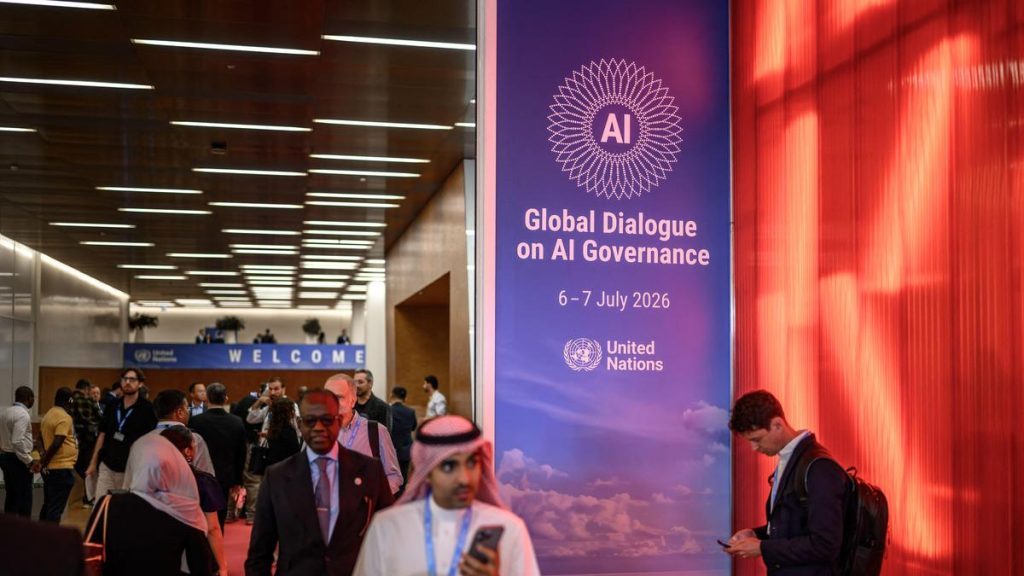
But perhaps all is not lost for India. The first of a two-part UN Global Dialogue on AI is underway in Geneva (July 6-7, 2026). Stakeholders will convene to discuss how the multilateral and multistakeholder ecosystem can come together to collectively define the rules for the governance of AI.

A window for leadership

India can use the opportunity to stitch together a fractured AI policy agenda that currently lacks a leader. It remains one of the few countries with the political heft, the technical capacity, and a diverse market to play this role. Rather than positioning itself merely as a destination for investment or a market for AI, India could reassert a vision of technological development rooted in public purpose, user safety, strategic autonomy, and international cooperation.

India should reiterate the need for international norms that empower Global South countries to focus on building local AI ecosystems and fostering innovation, safeguarding users, enhancing regulatory capacity, enabling skilling and developing domestic infrastructure. It should also advance critical debates on competition and consumer protection and ensure economic value accrues within national markets.

Concurrently, India must create pathways for international cooperation on AI within the Global South. The Geneva dialogue is a critical moment for Global South countries to come together to enable enhanced agency and strategic autonomy.

This requires developing innovative approaches to pool capacity and resources including cooperation on data, compute, interoperable standards and shared protocols and governance, and strengthening institutional capacity both regulatory and technical across the Global South.

As heterogeneous as the Global South is, it can be a counterweight to the hegemony of Big Tech. India can lead this march to ensure that shared governance norms are created and benefits are shared with the people in the Global South, appropriately protecting them from harm.

Jhalak M. Kakkar is Executive Director, Centre for Communication Governance, National Law University Delhi. Astha Kapoor is the Co-founder and Director of the Aapti Institute

Published – July 07, 2026 12:08 am IST


Source link

Related Posts

Vedanta enforces awards from decades-long dispute with India

July 6, 2026

Three Iran-Linked Tankers Detained in India Driven Toward Shore in Monsoon

July 6, 2026

Meta-sponsored India roundtable urges literacy, design changes over age checks

July 6, 2026
Add A Comment
Leave A Reply Cancel Reply

Top Posts

China Scraps 12,000 Degrees in Biggest Academic Overhaul in Years

June 14, 2026

Chinese Wall may stem India tech flows for electronics and automobile

June 1, 2026

Abandoned malls, whispers of nuclear war and young foreigners detained. This is what’s REALLY going on in Dubai… and the chilling warning one taxi driver gave to the Mail’s IAN BIRRELL

April 11, 2026
Don't Miss

Editorial | China’s latest export controls against Japan a moderate measure

By IslaJuly 6, 2026

Beijing has added 20 Japanese entities to its export-control list and placed 20 others on…

Confined to Hong Kong, Lung Fung lacks tonic for growth-hungry investors – Bamboo Works

July 6, 2026

Dubai luxury property sales climb aided by pre-war deals

July 6, 2026

UAE secretly building military base in Somaliland for U.S. and Israel, report says

July 6, 2026
SUBSCRIBE TO OUR NEWSLETTER

Get our latest downloads and information first. Complete the form below to subscribe to our weekly newsletter.


I consent to being contacted via telephone and/or email and I consent to my data being stored in accordance with European GDPR regulations and agree to the terms of use and privacy policy.

Stay In Touch
  • Facebook
  • YouTube
  • TikTok
  • WhatsApp
  • Twitter
  • Instagram
Top Trending

Factors Influencing Medical Interns’ Volunteering at a United Arab Emirates (UAE) Tertiary Care Institution

By IslaJuly 6, 2026

Canon Malaysia Adds Quek Shio Chuan And Razaisyam Rashid To EOS Filmmaker Programme 2026

By IslaJuly 6, 2026

Three Iran-Linked Tankers Detained in India Driven Toward Shore in Monsoon

By IslaJuly 6, 2026
Most Popular

Private sector firms asked to provide ethical projects worth Dh20bn-plus by 2031

July 2, 2026

Dubai’s KHDA Confirms Reopening Date for Private Early Childhood Centres from April 16

April 14, 2026

Spring Blossoms in Harbin: University campus turns into seasonal hotspot – news.cgtn.com

May 1, 2026
Our Picks

Sudan paramilitary leaders acquired £17.7m property portfolio in Dubai, investigation reveals | Global development

April 28, 2026

PM Tarique Rahman’s visit to deepen Dhaka-KL cooperation: Malaysia

June 21, 2026

Bond sell-off deepens despite emergency rate hike

June 11, 2026
SUBSCRIBE TO OUR NEWSLETTER

Get our latest downloads and information first. Complete the form below to subscribe to our weekly newsletter.


I consent to being contacted via telephone and/or email and I consent to my data being stored in accordance with European GDPR regulations and agree to the terms of use and privacy policy.

© 2026 Simply Invest Asia.
  • Get In Touch
  • Cookie Policy
  • Privacy policy
  • Terms & Conditions

Type above and press Enter to search. Press Esc to cancel.

SUBSCRIBE TO OUR NEWSLETTER

Get our latest downloads and information first.

Complete the form below to subscribe to our weekly newsletter.


I consent to being contacted via telephone and/or email and I consent to my data being stored in accordance with European GDPR regulations and agree to the terms of use and privacy policy.