
Prime Minister Narendra Modi reportedly turned to Google Alerts before the 2014 general elections started on his iPad for a time, monitoring mentions of his name during early morning and late-night hours. By setting alerts for his name, he tracked what the public was discussing about him on the internet, writes British journalist Lance Price in his 2015 book “The Modi Effect: Inside Narendra Modi’s Campaign to Transform India”.
Google’s various products have 4.9 billion users worldwide, with India accounting for 8 per cent of that number last year. Around 27 per cent, or over a quarter of the country’s population, uses Google products daily, making the platform critical for politicians seeking to connect with voters.
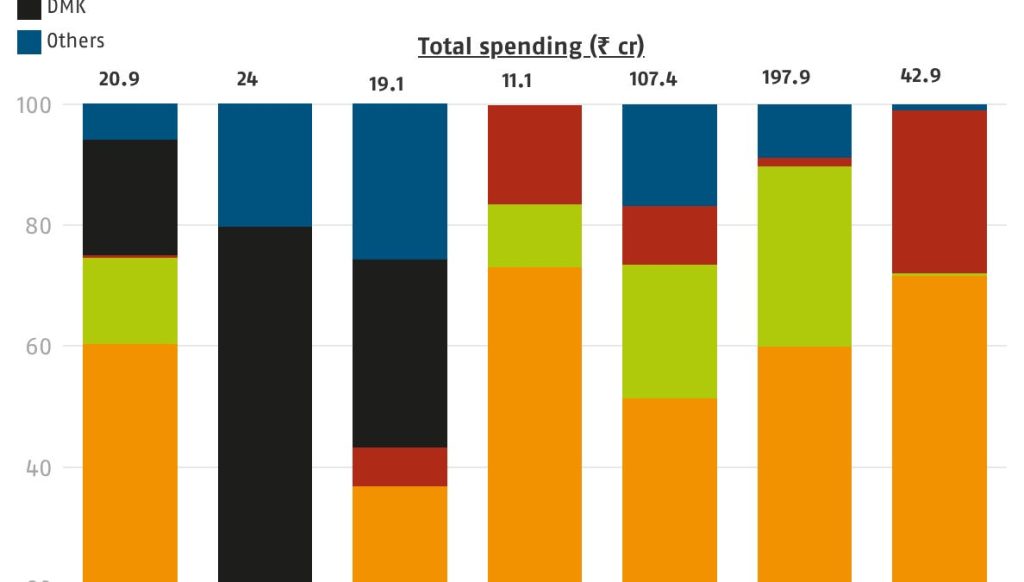
As internet penetration deepens, political parties have aggressively invested in digital advertising. From FY20 to FY26, 15 political parties and a political consultancy group spent Rs 423 crore on Google-based campaign advertisements. The BJP led the spending at 56 per cent, followed by the Indian National Congress (INC) at 21 per cent, and the consultancy group I-PAC at 7 per cent.
Political spending generally refers to expenditures made by political parties, candidates, consultancy groups, government departments, media organisations, and others for explicitly political purposes. Data on digital spending is publicly available at the Google Ads Transparency Centre.
It shows that such expenditure mirrors election cycles. Spending rose from Rs 20.9 crore in FY20 to Rs 107.4 crore ahead of the Lok Sabha elections in FY24, peaking at Rs 197 crore in FY25. By FY26, it moderated to Rs 42 crore, a figure largely driven by the Bihar elections.
The BJP’s share of Google political ad spending fluctuated from 60.3 per cent in FY20 to a peak of 71 per cent in FY26, following a brief dip to 59 per cent in FY25. The INC’s share showed significant volatility, peaking at 29 per cent in FY24 before a sharp decline in FY25. (chart 1, click image for interactive link).

Between October 1, 2025, and April 21, 2026, the BJP, INC, JD (U), CPI (M) and I-PAC (on behalf of the Trinamool Congress) spent a combined Rs 70 crore. The surge was fuelled by elections in Bihar, Assam, Kerala, Tamil Nadu, West Bengal and Puducherry. Data shows that spending booms in the months immediately preceding and during active polling. In Bihar, political parties directed 88 per cent of their monthly digital spending budget to the state in October 2025 and 66 per cent in November 2025. Similarly, Assam saw high engagement in early 2026. West Bengal proved an exception with sustained investment over seven months, commanding 64 per cent of total ad spend in December 2025 and 65 per cent by March 2026 (chart 2).

This trend is part of a global shift towards digital-first campaigning. Comparative data from FY20 to FY26 shows that Google-based political ads account for 93 per cent of total ad share in South Africa and 92 per cent in the US. India was at 53 per cent, ahead of the UK’s 34 per cent (chart 3).

Shivam Shankar Singh, who formerly headed the data analytics and campaigns for the BJP, said in his 2019 book that Google, Facebook, Snapchat and WhatsApp have become important in politics as cheap smartphones and low data tariffs “democratise” the internet. He added a caveat:
“The algorithm that Facebook and Google use adds to the problem because both websites will provide results based on a user’s past activities. If a person has engaged with ‘right-wing’ websites and posts more in the past, they are likely to see more of the same in the present and the future. They will simply never get to see the corrections of facts that are circulating in a network dominated by people with an affinity to ‘left-wing’ or ‘liberal’ politics,” Singh said in his book “How to Win an Indian Election: What Political Parties Don’t Want You to Know”.