
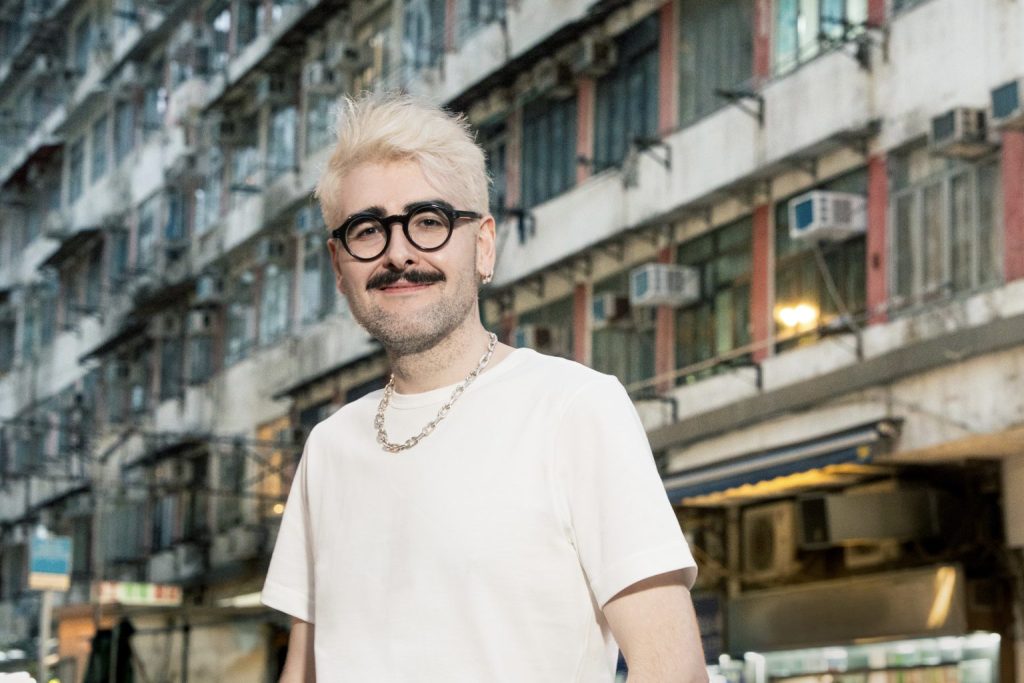

Last month, Hong Kong’s most historic independent arts organization, Para Site, named its new executive director: James Taylor-Foster, who will lead its next chapter as the non-profit enters its 30th anniversary. He belongs to a generation of millennial art professionals who combine international backgrounds with a fluid approach to their roles and move easily between disciplines. Taylor-Foster’s practice bridges contemporary art, design, architecture and digital culture, embracing a notion of contemporaneity that can only be understood through its in-betweenness. This interplay between fields aligns well with an organization like Para Site, which over the years has built a reputation as a leading platform for independent expression and experimentation, both in Hong Kong and more broadly.
“I think fluidity is really important,” Taylor-Foster told Observer when we met during Hong Kong Art Week. “We have to accept the texture in which artists and creatives are working today: a fully de-siloed, interdisciplinary practice.” The traditional separation of contemporary art into distinct branches—visual art, design, architecture and digital culture—might still matter, he told Observer, but engaging with each discipline now requires adopting a wider lens. “We need to see that all of these form part of contemporary culture, and also of popular culture, which is a very important thread in my work,” he added, pointing to the need to “operate between cracks.”
Before joining Para Site, he was a senior curator at ArkDes in Stockholm, where he played a key role in repositioning architecture exhibitions away from static, disciplinary presentations toward immersive, cross-disciplinary formats. His curatorial and artistic projects have embraced fluidity in different ways, exploring questions of queer belonging and operating at the critical intersection where creativity meets new developments in technology and popular culture, all contextualized within today’s urban experience. His most recent group exhibition—”Worldglimpsing” (2025-27), currently on view at ArkDes/Moderna Museet in Stockholm, with its second chapter opening at the Nieuwe Instituut in Rotterdam later this year—exemplifies his approach in that it explores two interwoven forms of creativity: “worlding,” the design of alternate worlds, and “roleplay,” the act of imagining and playing into being alternate versions of ourselves, as civic and political acts to imagine, rehearse and embody the present while envisioning the future.

For an organization like Para Site, which has always operated between the cracks in a kind of liminal space, there is real agility in this modus operandi. “Para Site can take on this whole spectrum of practices and synthesise them in a way that not only resonates with a rich community already engaged in contemporary art, but also reaches more broadly,” he said, acknowledging how Hong Kong, like any major city, has its niche audiences but also millions of people who aren’t engaging with practices associated with contemporary artistic expression. “For me, the real power lies in thinking across disciplines.”
This is not Taylor-Foster’s first time bringing his vision to Hong Kong. His traveling exhibition “WEIRD SENSATION FEELS GOOD: The World of ASMR” (2020-25) explored ASMR as a global, internet-born culture, was presented last year at Gate33/AIRSIDE. His practice has always held both global breadth and local focus, contextualized within the communities it serves.
During our conversation, Taylor-Foster described contemporary culture as operating on two levels—one rooted in local and regional contexts, the other unfolding across transnational and translinguistic networks on a global scale. “The real potential lies in being able to bridge those two realities,” he asserted. “When you can do that, you can create something quite extraordinary, because large themes that resonate regionally or internationally are being interpreted and reshaped by local practitioners.” It’s about finding those nuances and genres that speak to what he describes as “public life at large”—the ways in which we all exist together in an increasingly complex, mediated world. Within this context, he said, artists and creatives are under growing pressure to rethink how artistic production functions today.
Over three decades, Para Site has become one of the most important incubators for artistic and curatorial practice and for creativity more broadly. Looking ahead, Taylor-Foster is considering how the organization might begin to synthesize diverse practices in new ways while maintaining its forward-looking position. “Para Site has always been not only a vital incubator for artistic practices, but it has also always been one step ahead. I want to ensure we continue to address that in this next chapter.”

Para Site has traditionally operated in the space between nurturing and supporting. “I think those are two very different things,” he said, adding that any cultural organization can support, but very few can nurture in a way that is authentic and sustained. “Nurturing can involve long timeframes; it involves experimentation, and sometimes failure.”
The organization is entering a new phase of self-definition, building on the foundations laid during the previous generation’s leadership. “The past 30 years have been remarkable, and Billy Tang’s tenure has really led to this moment. Now, I think Para Site can be more confident in being itself,” Taylor-Foster said. One of the first hurdles will be adapting to the city’s evolving cultural geography: relocating from the current space may be necessary, but “in a city like Hong Kong, where real estate is at a premium, it’s crucial that we don’t rush into a new venue. Any future space has to emerge from a clear vision and strategy so that the space itself supports what we want to do.”
From there, Taylor-Foster suggested that Para Site might begin to embody its own name by operating more flexibly and adaptively, though he acknowledged that the exact form this might take remains to be defined.
Discussing institutional models, including the recent case of the ICA SF becoming a nomadic museum, Taylor-Foster acknowledges how more nomadic models allow organizations to redistribute resources and support artistic production more dynamically. In Hong Kong, where financial pressures such as rent are as significant as in cities like New York or San Francisco, this allows for a different distribution of resources and more flexible support of production.
“It’s a question of where we invest our resources,” he said. “We’re not the wealthiest organization in Hong Kong, but we do have an incredibly supportive community. When you look at budgets today, rent takes up a huge proportion, so the question becomes: how do we best use what we have?”

He was quick to acknowledge that abandoning a fixed space would also mean losing other things; ultimately, he’d prefer to find the right balance between stability and mobility. A key driver moving forward will be the notion of “gathering”—not gathering the same people again and again, but slowly nurturing and expanding communities, both locally and regionally. “What does it mean for Para Site to be ‘parasitical’ in Bangkok? In Seoul? What happens when we become a space of exchange across different contexts?” he considered. Collaborations are the obvious starting point, but he sees the most meaningful ones as “unlikely alliances”—partnerships that might not seem obvious at first but open up new ways of thinking about contemporary culture.
And Taylor-Foster still believes strongly in the power of the exhibition. He pointed out, however, that Para Site will probably need to be less tethered to shows as a central format even as it, like so many other cultural institutions, is defined by its architecture. “That can be enabling, but it can also become a constraint,” he pointed out. “After 10 years in Quarry Bay, I think the team and the artists have really pushed this space as far as it can go. It has hosted so many incredible exhibitions, but now it’s time to rethink the architecture… to shift it.”
His immediate priority once he steps into the role fully at the end of spring will be listening. Rather than accelerating into action, he plans to take a deliberate pause to better understand the organization’s community and internal dynamics—a position he acknowledged may contrast with Hong Kong’s fast pace. A period of reflection would precede any relocation or temporary nomadic phase. The latter, he said, could serve as a moment of experimentation and institutional redefinition—a chance to rebuild and redefine the organization’s identity. “Para Site already has a strong global reputation, even among people who have never been to Hong Kong,” he added. “The task now is to cultivate that further, while ensuring that by 2027, the organization feels refreshed and ready for its next chapter. I see myself as a steward of this next phase, but the goal is for Para Site to still be here in 40 years’ time. That means strengthening internal structures, and also building a new generation of patrons to support its long-term future.”

More in Galleries