

Hey folks,
If you live in a city like Bengaluru or Chennai, you’d know that building and operating metro rails is expensive. You build them with public money, keep feeding them subsidies, argue over fare hikes every few years, and hope commuters tolerate delays with some grace.
That is the familiar story in cities across the world, whether it is London, New York City, Bengaluru, or Chennai.
But Hong Kong does something odd.
Its metro operator, MTR Corporation, is not merely known for punctual trains and world-class reliability. It has also historically made enough money to pay dividends to shareholders, with the Hong Kong government itself being a major beneficiary.
That sounds too good to be true. But it happened because Hong Kong understood something many cities ignored for decades: railways do not just move people. They also create land value.
Now, think about what happens when a new metro station appears in any city. Suddenly, land around it becomes more valuable. Restaurants, malls, hotels, businesses, and even new neighbourhoods cluster around the station.
In many cities, however, the gains from that transformation are captured mostly by private landowners and developers. The public pays for the tracks, but others enjoy the rise in property prices. But Hong Kong chose a different route.
Under its famous “Rail Plus Property” model, the government grants MTR development rights for land around proposed stations and depots. Crucially, these rights are priced before the railway arrives and before values jump. MTR can then partner with private developers to build residential towers, shopping centres, office complexes, and mixed-use districts above or beside stations. Once the metro opens and the area becomes more attractive, the value rises sharply, and MTR captures a meaningful share of that uplift.
So while passengers tap cards at the gate, tenants in malls and office towers are also helping fund the railway.
That second revenue engine matters more than it first appears. Because ticket fares are politically sensitive. If you raise them too aggressively and public anger follows, but if you keep them too low finances weaken.
But rental income from successful commercial assets gives a transport system breathing room. It means upgrades do not always require emergency government support or steep fare hikes. And that long-term mindset shows up in good service quality.
There is another subtle advantage to the Hong Kong model. Because MTR often integrates stations directly into malls, offices, housing complexes, and pedestrian walkways. This makes commuting frictionless, and you do not feel like you are entering a separate metro station. You move naturally from office tower to concourse, and from mall to platform. That convenience boosts ridership, which supports retail demand, which increases rental value, which in turn supports the metro. It’s the opposite of whatever a vicious cycle is.
That said, Hong Kong’s model is not universally replicable. It relies on very high population density, limited land supply, premium real estate values, strong planning authority, and a population deeply accustomed to public transit.
However, at the end of the day, the real question is whether governments allow that value to leak away, or whether they design systems that recycle some of it back into better infrastructure.
Hong Kong chose the second path. That is why its metro could become more than a transport utility. It became a machine that oils itself.
So the next time someone says metros are doomed to lose money, it is worth remembering this exception.
Here’s a soundtrack to put you in the mood…
Matkar Maya Ko Ahankar by Kabir Cafe
You can thank our reader Khushi Singh for this soulful rec!
And if you’d like your music recommendation featured too, send them our way, especially hidden gems from underrated Indian artists many of us haven’t discovered yet. We can’t wait to hear them!
What caught our eye this week:
India’s award-winning cheeses
What comes to your mind when you hear “Indian cheese”? Probably paneer? Or maybe Amul? Well Indian cheese is so much more than that!
Last week Indian cheese walked onto the global stage and got the recognition it deserved at the Mundial do Queijo do Brasil 2026. This is one of the world’s most prestigious dairy competitions where four Indian products won medals. One Super Gold, two golds and one silver. Prime Minister Modi even tweeted about it and the internet had its moment.
But here’s the thing, most Indians have never even heard of the cheeses that won.
One was a Brie-style wheel crafted in Mumbai, another a Norwegian-inspired brunost, then a caramelized Brunost, and finally a soft, rich yak milk cheese from Ladakh. These are the result of small producers experimenting and adapting global techniques to Indian milk, climates, and tastes.
And they’re proving something important: India isn’t just a dairy giant, it’s becoming a serious contender in adding more value to that milk, too.
Because all these years, we’ve had buffaloes, cows, yaks and centuries of dairy tradition. Yet, when it comes to cheese, the aged, artisanal cheese, we are just getting started. For a large portion of the Indian population, cheese remains a relatively new concept, perceived either as a luxury or simply an unfamiliar ingredient.
But it’s ironic, don’t you think?
The same country that gave the world paneer, that processes milk more than any other nation, is only now discovering that it can make a world-class Brie.
Unlike in Europe, where cheese is part of everyday consumption, here it often comes with a series of questions: What is Brie? Why does it smell like that? How do you eat it? And why is it expensive?
And that’s slowly changing.
Urban consumers in India are becoming more open to experimenting with cheese. Restaurants are curating regional cheese boards, and a new generation of producers is beginning to treat cheese not just as an ingredient, but as a craft.
Even so, artisanal cheese is still finding its place in India. Unlike Europe, where cheese is woven into everyday meals, India’s artisanal cheese segment remains limited to a small urban audience. Varieties like Brie, yak churros, and brunost exist, but they are still experienced by only a narrow slice of consumers.
That is what makes this moment so exciting. India is slowly rediscovering itself through cheese. We already have the milk, the traditional skill, and now, global recognition. The next chapter is about taking what judges in Brazil have already acknowledged and making sure the rest of the country gets to taste it too.
Infographic of the week
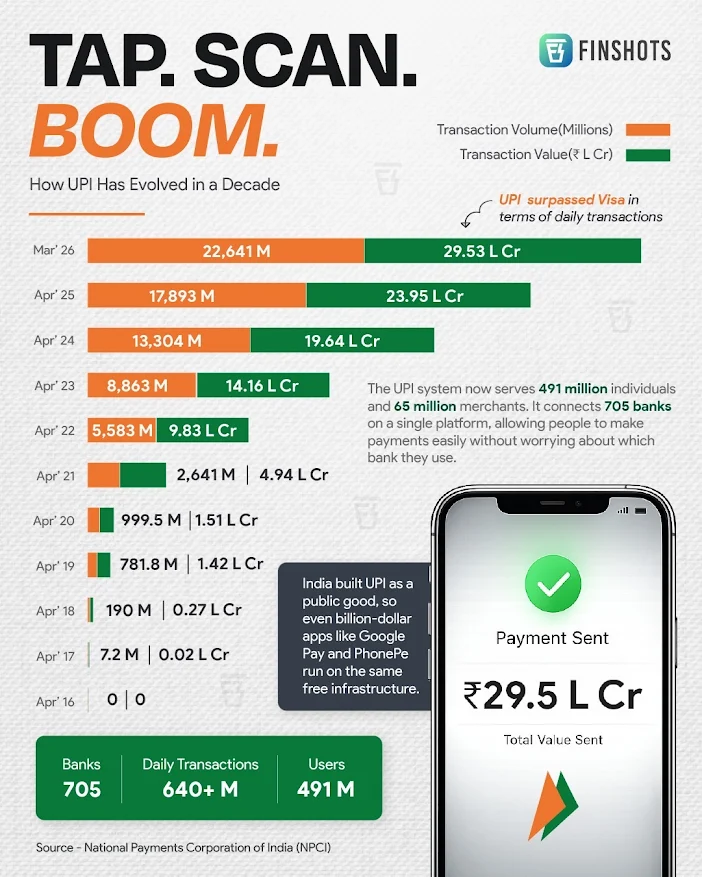
This is how UPI has evolved over time and is now giving competition to global giants like Visa and Mastercard in terms of daily transactions.
Readers Recommend
‘The Money Trap’ by Alok Sama recommended by our reader Ankit Kejriwal.
It is a non-fiction account of high-stakes deals and the chaos behind billion-dollar investments at SoftBank.
Thanks for the recommendation, Ankit!
That’s it from us this week. We’ll see you next Sunday!
Until then, send us your book, music, business movies, documentaries, or podcast recommendations. We’ll feature them in the newsletter! Also, don’t forget to tell us what you thought of today’s edition. Just hit reply to this email (or if you’re reading this on the web, drop us a message at morning@finshots.in).
Don’t forget to share this edition on WhatsApp, LinkedIn and X.