
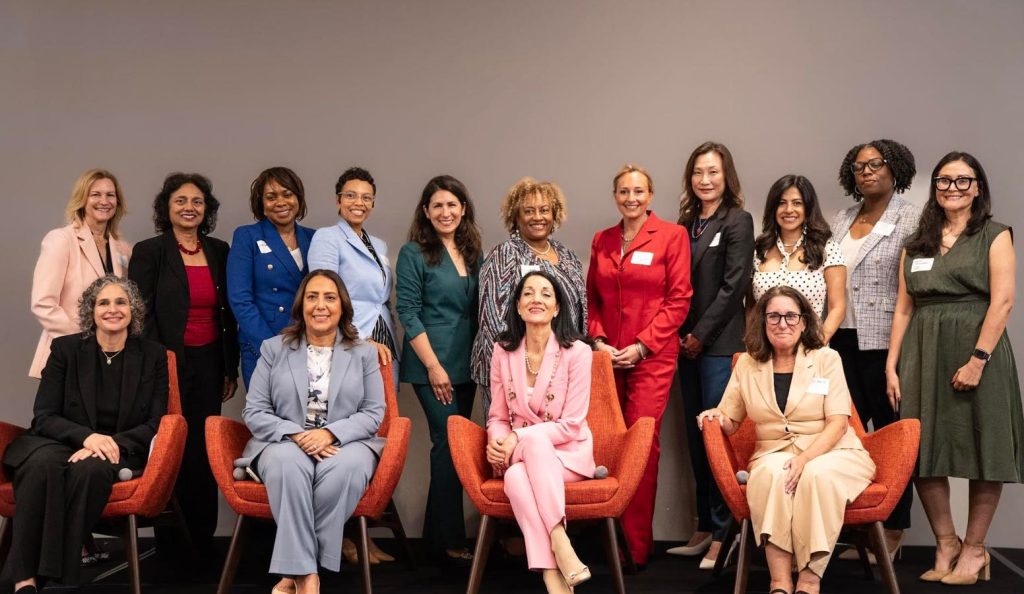

Women in Health: A Master Guide to the Voices, Stories, and Strategies Shaping the Modern Office, gathers 22 senior women healthcare executives from across the country. The contributors include CEOs, CFOs, CMOs, and CNOs alongside leaders in compliance, legal, supply chain, talent, and organizational transformation.
Courtesy of Diane Martin
Diane Martin’s newest anthology is spotlighting female healthcare executives moving the needle for the American healthcare system. As an executive and strategic advisor with more than two decades inside systems, including Dignity Health and CommonSpirit, Stanford Health Care, and Emanate Health, she has spent her career on the marketing and communications side of the house, the function that translates clinical and operational ambition into something a community will trust. Now she is doing the same job for an entire generation of her peers.
Her new anthology, Women in Health: A Master Guide to the Voices, Stories, and Strategies Shaping the Modern Office, gathers 22 senior women healthcare executives from across the country. The contributors include CEOs, CFOs, CMOs, and CNOs alongside leaders in compliance, legal, supply chain, talent, and organizational transformation. The essays read less like memoir and more like a field manual for running complex health systems under pressure.
“These stories must be seen, heard, and preserved, not as side notes in the evolution of healthcare, but as the blueprint for its future,” Martin said. “My purpose in writing this book is to honor the women whose leadership has shaped my journey and strengthened the communities we serve, and to ensure their insights become part of the national dialogue informing policy, shaping culture, and guiding the next generation.”
Healthcare executive and founder of Macan & Company, Diane Martin, with her latest book, Women In Health.
Courtesy of Diane Martin
Ask Martin why women healthcare executives have historically been under covered, and she does not soften the answer. Women, she argues, have long been the steady hands, innovators, and culture-shapers of the industry, yet their leadership has often been treated as exceptional rather than foundational. For decades, the stories that defined healthcare were told through a narrow lens that did not fully reflect the diversity, lived experience, or strategic brilliance of the women driving transformation behind the scenes. The leaders profiled in Women in Health are not only navigating unprecedented pressure, but they are also architecting the operational and policy answers to it. Their leadership, she says, is structural, operational, and generational.
“Spotlighting them is not simply celebratory,” Martin said. “It is corrective. It ensures their wisdom becomes part of the public record.” Martin is explicit that admiration alone is insufficient. The industry, she argues, needs alignment, action, and accountability. Across the contributors’ essays, a consistent set of imperatives emerges: equity treated as a governance and operational priority and a lived experience recognized as a leadership asset, mentorship and sponsorship cultivated intentionally to accelerate diverse talent into senior roles, innovation kept grounded in humanity as AI and digital transformation accelerate, and the personal evolution required of leaders themselves.
Mentorship runs through the anthology, and Martin treats it as infrastructure rather than sentiment. “Every woman featured here has been lifted by someone who believed in her, challenged her, or opened a door that once seemed out of reach,” she said. “Leadership is not a solo journey. It is a collective one. Building strong communities of women in leadership is not optional. It is essential.” That conviction is also why Martin sits on the board of Women in Health Administration of Southern California and built her own advisory firm, Macan & Co, around the same network logic.
The book’s official launch at the USC Health Sciences Campus, hosted in collaboration with NALHE, USC’s Office of Culture and Engagement, and Women in Health Administration of Southern California, made the thesis visible in real time.
Courtesy of Diane Martin
The book’s official launch at the USC Health Sciences Campus, hosted in collaboration with NALHE, USC’s Office of Culture and Engagement, and Women in Health Administration of Southern California, made the thesis visible in real time. Executives, clinicians, deans, and emerging professionals filled a single room, and the panel discussion did the same work the book does on the page.
Lines that might have stayed within individual boardrooms were broadcast over a shared microphone. “Your lived experience is not a liability. It is your leadership advantage. I believe that for healthcare leadership to be effective, it must be a mirror of the community it serves. But representation does not happen by accident—it requires intentionality. We must be committed to creating mentorship opportunities that prepare women and people of color for the executive level, while simultaneously expanding our reach to recruit from diverse talent pools,” said Alina Moran, CEO, NYC Health + Hospitals, Elmhurst.
The book’s official launch at the USC Health Sciences Campus.
Courtesy of Diane Martin
Jill Martin offered a leadership test that lands differently in 2026 than it would have a decade ago: “The leaders who leave a lasting impact are the ones willing to evolve as people, not just grow in skill.” The EVP, Cedars-Sinai Medical Center, also added, “It is also essential to create cultures where collaboration is valued and where leaders across clinical and administrative spaces are encouraged to learn from one another and work together. In healthcare, some of the best ideas and most meaningful progress come from that kind of shared leadership. Fostering female leadership ultimately is about strengthening organizations as a whole. When everyone feels seen, supported and empowered to contribute, we build systems that are more thoughtful, more inclusive and better able to serve our patients and communities.”
Johnese Spisso, President, UCLA Health & CEO, UCLA Hospital System, framed authority itself as the wrong frame, calling impactful leadership a matter of aligning vision with compassion to inspire teams and drive lasting change. “Fostering women in leadership and collaboration starts with providing meaningful opportunities and support for women at every stage of their careers and making sure they have a seat at the table. Mentorship and demonstrated sponsorship are important elements. Platforms and organizations can play a vital role by nurturing mentorship programs, encouraging diverse voices in decision-making, and creating networks where women can share experiences and learn from each other,” she said. Lara Khouri, CEO, MemorialCare Miller Children’s & Women’s Hospital, added, “Leadership is not about being in charge. It is about your responsibility for those in your charge, especially when the stakes are highest.”
Diane Martin signing copies of Women In Health.
Courtesy of Diane Martin
Martin is treating the book as the foundation of a broader leadership initiative rather than a single release. The plan, she says, is for Women in Health to function as a leadership development resource for organizations investing in culture and workforce resilience, a platform for convening and cross-sector panels, a catalyst for sponsorship networks that accelerate diverse pipelines, and a living archive that grows with each new edition.
For seasoned leaders, she hopes the book reads as a reminder that resilience is a skill, equity is a responsibility, and leadership thrives in community. For emerging leaders, she wants it to make pathways visible that have historically been invisible. “I hope this book offers clarity in moments of uncertainty, courage in moments of doubt, and affirmation when the path feels steep,” Martin said.
In an industry being rebuilt in real time, she is making the case that the executives shaping culture deserve a moment in the spotlight.