
India is seeking to make culture, well-being and sustainability part of its global power strategy. This gives the country a new role in the debate over how the societies of the future should be built.
In an increasingly fragmented world shaped by geopolitical rivalry, technological anxieties, climate stress, social polarization, and mental health crises, the idea of development itself is undergoing a profound transformation. Economic growth alone is no longer seen as sufficient to define progress. The contemporary global debate is increasingly shifting toward the quality of human life, emotional well-being, social harmony, ecological balance, and cultural resilience. In this changing landscape, sustainable development and the philosophy of the “Art of Living” are becoming deeply interconnected ideas rather than separate domains of thought.
The growing global appeal of meditation, mindfulness, wellness practices, and culturally rooted approaches to social harmony reflects this wider shift. Countries and societies are increasingly recognizing that sustainability is not merely about renewable energy transitions or carbon reduction targets; it is also about creating mentally resilient, socially stable, and culturally harmonious communities capable of navigating uncertainty. India’s experience in recent years offers an important example of how civilizational values, cultural diplomacy, and human-centric development models are gradually becoming part of international discourse on sustainability.
At the center of this evolving narrative stands Gurudev Sri Sri Ravi Shankar, whose leadership through The Art of Living Foundation has sought to connect peacebuilding, emotional well-being, humanitarian outreach, and sustainable living into a broader philosophy of societal transformation. The movement’s expansion across 182 countries demonstrates how India’s cultural and spiritual traditions are increasingly being translated into instruments of global engagement, social resilience, and soft power influence.
Sustainable Development Beyond Economics
For decades, sustainable development was largely framed through economic modernization, industrial growth, environmental management, and poverty reduction. While these remain critical components, contemporary realities reveal the limitations of purely material approaches to development. Rising stress levels, social fragmentation, loneliness, radicalization, ecological degradation, and mental health crises have exposed the inadequacy of development models disconnected from human well-being and cultural stability.
The post-pandemic world particularly accelerated this realization. Societies across the globe witnessed how emotional resilience, community trust, and mental stability became as important as healthcare infrastructure or economic recovery packages. In this context, practices associated with mindfulness, meditation, stress management, and community-based well-being gained unprecedented global legitimacy.
India’s traditional knowledge systems have increasingly found relevance within this changing discourse. Yoga, meditation, Ayurveda, and spiritual wellness are no longer viewed simply as cultural exports or niche practices. Instead, they are gradually becoming embedded within broader discussions surrounding preventive healthcare, emotional well-being, sustainable lifestyles, and societal resilience.
The philosophy of the “Art of Living” fits within this evolving framework because it views sustainability not merely as ecological balance but as a relationship between the individual, society, and nature. A sustainable society, in this understanding, cannot emerge solely through policy instruments or technological innovation. It requires emotionally stable individuals, culturally rooted communities, and social systems capable of reducing conflict and alienation.
This broader interpretation of sustainability explains why organizations like The Art of Living increasingly engage not only in spiritual outreach but also in prison rehabilitation, trauma relief, educational reform, conflict resolution, and youth leadership programs globally. Their activities indicate how human development and societal development are becoming increasingly inseparable in modern governance debates.
Gurudev Sri Sri Ravi Shankar and Leadership Through Peace
Gurudev Sri Sri Ravi Shankar’s leadership model differs significantly from conventional political or institutional leadership frameworks. His approach places emotional intelligence, dialogue, inner peace, and social harmony at the center of public engagement. In many ways, this represents an alternative form of leadership increasingly relevant in an age marked by ideological polarization and geopolitical competition.
Unlike traditional hard-power approaches that rely on coercion or strategic dominance, Ravi Shankar’s philosophy emphasizes reconciliation, collective well-being, and cultural inclusiveness. This has enabled The Art of Living to operate simultaneously in areas ranging from education and youth engagement to trauma relief and humanitarian outreach. The organization’s global activities illustrate this broader humanitarian orientation. Its rehabilitation initiatives in prisons across the United States, outreach programs for veterans coping with post-traumatic stress, and wellness initiatives for healthcare professionals reveal a leadership model focused on healing social fractures rather than merely managing them.
Equally significant is the organization’s increasing engagement with global peacebuilding platforms. The strategic Memorandum of Understanding signed between The Art of Living Foundation and the Permanent Secretariat of the World Summit of Nobel Peace Laureates reflects an effort to institutionalize peace education and youth leadership at an international level. This collaboration indicates that peacebuilding today is no longer confined to diplomacy between states. It is increasingly connected to education, emotional resilience, youth participation, and cross-cultural dialogue. Ravi Shankar’s leadership also reflects a wider civilizational narrative emerging from India. His emphasis on meditation, community harmony, and universal spiritual values projects India not simply as a rising economic or geopolitical power, but as a society offering alternative approaches to human development in an age of global instability.
India’s Smart Power Evolution
India’s global rise is increasingly being shaped by a combination of economic growth, strategic partnerships, technological innovation, and cultural influence. This blend of hard and soft capabilities is gradually positioning India as a “smart power” — a country capable of integrating strategic interests with cultural legitimacy and human-centric diplomacy.
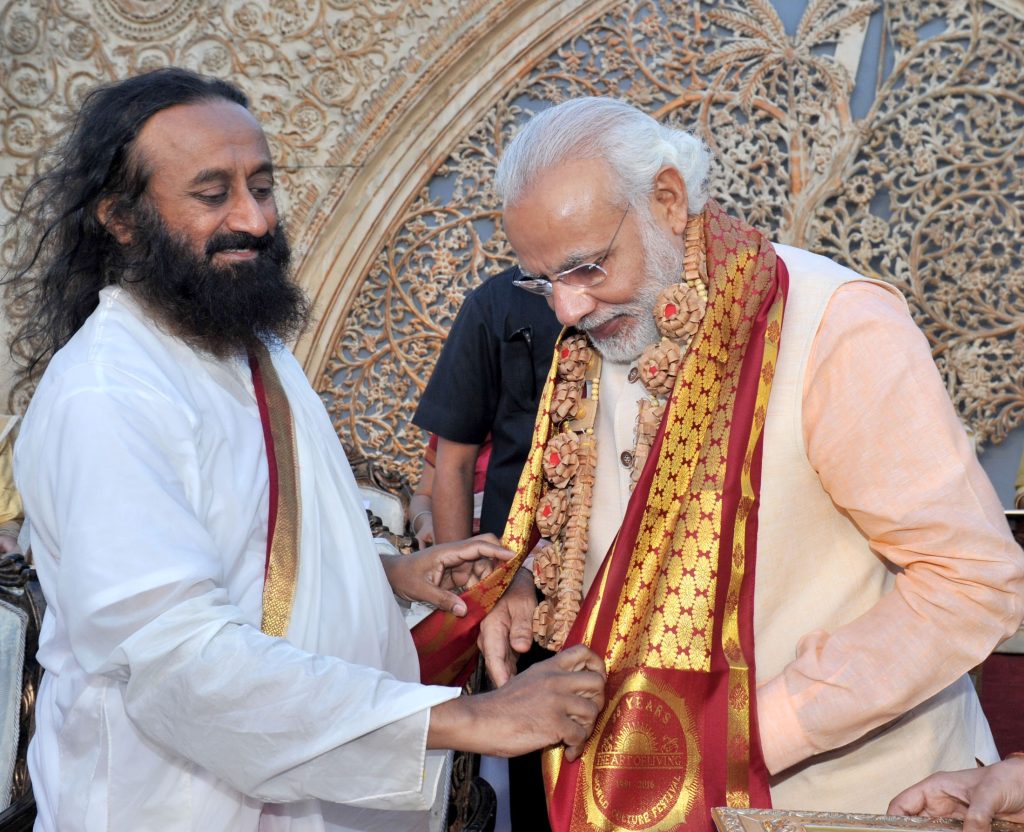
Under Prime Minister Narendra Modi, India has consciously amplified this multidimensional global identity. International Yoga Day, India’s wellness diplomacy, digital public infrastructure outreach, climate leadership narratives, and cultural engagement initiatives collectively reflect this broader strategic approach. Modi’s participation in The Art of Living’s anniversary celebrations in Bengaluru symbolized this convergence between governance, sustainability, cultural identity, and soft power projection. His inauguration of the Dhyan Mandir meditation centre and emphasis on mental resilience and social responsibility underscored how India increasingly views emotional well-being and societal harmony as components of national development.
This reflects a larger shift in India’s development philosophy. Earlier development paradigms often prioritized industrialization and economic expansion as primary indicators of national success. Contemporary India, however, is increasingly attempting to integrate technology, sustainability, wellness, and cultural confidence into its development narrative. India’s internationalization strategy now extends beyond traditional diplomacy or trade partnerships. It includes projecting India as a civilizational actor capable of contributing to global conversations on sustainability, pluralism, and human well-being. In this sense, institutions like The Art of Living complement India’s broader diplomatic outreach by strengthening cultural and societal connections internationally. This is particularly important in a world where geopolitical competition is becoming deeply linked with narratives, values, and societal models. Nations today compete not only through military or economic power but also through their ability to shape global conversations on governance, sustainability, technology ethics, and quality of life.
India’s growing engagement with Nordic countries, including Prime Minister Modi’s recent visit to Norway, reflects this strategic expansion of partnerships around sustainability, green transition, innovation, and societal resilience. Nordic societies themselves have long emphasized balanced lifestyles, social welfare, mental well-being, and environmentally conscious governance. India’s cultural traditions around mindfulness, yoga, and holistic living increasingly intersect with these priorities, creating new avenues for cooperation beyond conventional geopolitics. The interaction between India’s civilizational traditions and Europe’s search for human-centric development models is therefore becoming strategically significant. It opens pathways for collaborations in education, healthcare, climate adaptation, social innovation, and wellness diplomacy.
Soft Power and the Future of Sustainability
One of the most important lessons emerging from contemporary global politics is that sustainable futures cannot be built solely through technological solutions or state-centric policymaking. Social trust, cultural legitimacy, emotional resilience, and shared values are equally critical for long-term stability. This is where soft power becomes central to sustainable development debates. Soft power is often narrowly understood as cultural attraction or international image-building. However, in the twenty-first century, it increasingly functions as a mechanism for shaping societal behaviour, encouraging cooperation, and building transnational communities around shared aspirations.
The remarkable global expansion of yoga, meditation, mindfulness practices, and wellness culture illustrates how cultural ideas can influence global lifestyles and public discourse. The growing acceptance of these practices across diverse societies suggests that sustainable development is gradually becoming connected with questions of inner balance, emotional health, and social cohesion. The Art of Living’s World Culture Festival in Washington, D.C., which reportedly drew nearly one million attendees from over 180 countries, highlighted how cultural engagement itself can become a platform for global dialogue and social connection. Such initiatives demonstrate that cultural diplomacy today operates not only through governments but also through transnational civil society movements and people-to-people interactions.
India’s heritage gives it a unique advantage in this evolving environment. Its traditions emphasize interconnectedness between human beings, society, and nature, principles increasingly relevant amid ecological crises and social fragmentation. Gurudev Sri Sri Ravi Shankar’s observation that meditation and spiritual practices are spreading “from the northernmost point of the world” to “the southernmost point of the earth” reflects how India’s cultural traditions are becoming globally normalized rather than regionally confined. This does not mean India’s path is free from challenges or contradictions. Balancing rapid economic growth with environmental sustainability, social inclusiveness, and cultural pluralism remains a complex task. Nevertheless, India’s broader attempt to connect development with well-being, culture, and sustainability offers an alternative framework increasingly relevant for the twenty-first century.
Toward a Human-Centric Global Order
The future global order will likely be shaped not only by economic competitiveness or military power but also by societies capable of generating trust, resilience, cultural adaptability, and sustainable human development. In this context, the relationship between sustainable development and the philosophy of the Art of Living is becoming increasingly important. India’s rise illustrates how soft power, cultural confidence, and societal well-being can complement strategic ambition. Gurudev Sri Sri Ravi Shankar’s leadership and the global outreach of The Art of Living reflect a broader transformation in how leadership, peacebuilding, and sustainability are understood in contemporary international affairs.
As geopolitical tensions intensify and societies grapple with technological disruption, climate stress, and social anxieties, the search for sustainable futures may increasingly depend on cultural and human-centered approaches to development. The challenge ahead is not simply how societies become richer, greener, or technologically advanced. The deeper question is whether they can remain emotionally resilient, socially cohesive, and culturally humane while navigating the complexities of the modern world. India’s evolving experience suggests that sustainable development and the “Art of Living” are no longer separate conversations. They are becoming part of the same global search for a more balanced, peaceful, and human-centric future.