
RIYADH: As the US-Israeli war with Iran reverberates across the Middle East and the world, few countries have had more at stake than India. Heavily dependent on regional energy supplies, increasingly invested in maritime trade routes, and with millions of citizens living in the Gulf states, New Delhi has watched the conflict with concern.
However, the crisis has also underscored the importance of India’s expanding relationship with Saudi Arabia — a partnership that has evolved dramatically over the past decade from one centered largely on oil into a broad strategic relationship encompassing security, investment, culture and diplomacy.
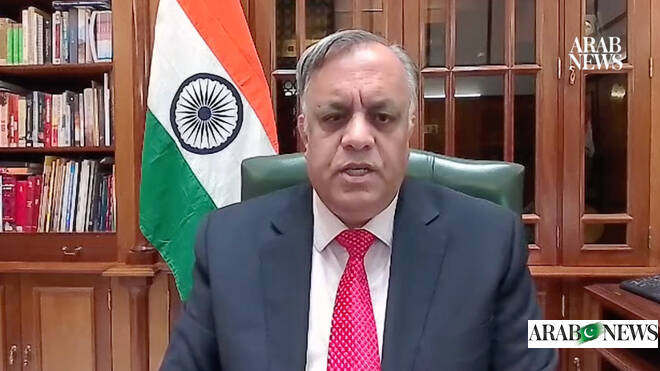
Appearing on the Arab News current affairs program “Frankly Speaking,” India’s outgoing ambassador to Saudi Arabia, Suhel Ajaz Khan, described how the conflict has intensified dialogue between New Delhi and Riyadh.

At the same time, it has highlighted the resilience of a partnership that continues to grow despite regional turbulence. For India, he told “Frankly Speaking” host Katie Jensen, developments in the Gulf remain impossible to ignore.
“The conflict in the region is certainly a matter of great concern for us,” Khan said. “This region is our extended neighborhood.”
With nearly 10 million Indians living across the Middle East, including some 2.7 million in Saudi Arabia alone, the ambassador said the region’s security was directly linked to India’s national interests.
“It is one of our biggest trading partners. It is one of our biggest partners for energy, for fertilizers. So obviously, whatever happens in this region is of great importance to us.”
Khan said communication between Indian and Saudi leaders has intensified throughout the crisis. Prime Minister Narendra Modi and Crown Prince Mohammed bin Salman have spoken twice during the conflict, while ministers and senior officials remain in frequent contact.
“Our leadership has been consulting each other and they have been engaged with each other very intensely,” he said.
India has repeatedly condemned Iranian attacks against Saudi Arabia and Gulf Cooperation Council countries, while maintaining its longstanding call for dialogue and de-escalation. “Our position on the conflict itself is very clear,” Khan said.
He added that New Delhi remains deeply concerned about the security of shipping routes and the uninterrupted flow of commerce through one of the world’s most strategically important waterways.
“We also believe that the Strait of Hormuz should remain open,” he said. “The navigation, unimpeded and free navigation, and the free trade routes is very important for our countries and for the entire region and the entire world.”
That concern has become increasingly urgent amid attacks on merchant vessels operating in Gulf waters. The conflict has already claimed the lives of Indian sailors serving aboard commercial ships near Oman, prompting protests from New Delhi and raising fresh questions about maritime security.

India summoned US Deputy Chief of Mission Jason Meeks on Friday for the second time in two days after American strikes on three largely Indian-crewed merchant vessels. Meeks was first summoned to the foreign ministry on Wednesday after a US strike on the Palau-flagged MT Settebello, off the coast of Oman, in which three Indian sailors were killed.
That followed a June 8 strike on the MT Marivex, another Palau-flagged tanker. Omani authorities airlifted 24 Indian sailors off the stricken vessel. On Thursday, a Guinea-Bissau-flagged tanker was hit in a US strike. New Delhi said its crew, who included 20 Indian sailors, were rescued.
Khan described the attacks as deeply troubling and reiterated India’s demand for restraint. “Very unfortunate that the attacks on the civil infrastructure, including on the shipping lines are continuing,” he said.
Calling recent developments “regrettable,” he stressed that diplomacy remained the only viable path forward: “We have consistently called for dialogue and diplomacy. We believe that is the only way to resolve the issues.”
He added: “We call upon all the parties involved to respect the ceasefire, to not attack the civilian infrastructure including the shipping lines and at the earliest conclude the diplomatic negotiations which are going on.”
The maritime threat was one of several issues discussed during recent high-level exchanges between India and Saudi Arabia.
Khan revealed that Indian National Security Adviser Ajit Doval held extensive consultations in Riyadh during a visit in April, building on regular security contacts between the two countries. “Our national security adviser is always in touch with his counterpart in Saudi Arabia,” he said.
During his visit, Doval met senior Saudi officials including Minister of State Musaad Al-Aiban, Energy Minister Prince Abdulaziz bin Salman and Foreign Minister Prince Faisal bin Farhan.
“They reviewed the entire gamut of the bilateral relations and also the changing dynamics in the region, the security of the region, the implications of the conflict,” Khan said. The discussions also addressed issues vital to India’s economy, including energy and fertilizer supplies.
Those conversations have become increasingly important as uncertainty surrounding the Strait of Hormuz has raised concerns about global energy markets. India imports a significant share of its crude oil from Gulf producers, making supply disruptions a major strategic concern.
According to Khan, Saudi Arabia’s activation of export facilities on the Red Sea coast has helped mitigate the impact of regional instability. “Saudi Arabia has been able to supply us with crude oil through the Yanbu port,” he said.
The ambassador recently visited Yanbu himself, where he observed how both crude exports and fertilizer shipments are being redirected through facilities less vulnerable to disruption in the Gulf.
Saudi Arabia remains one of India’s most important energy partners, supplying around 15 percent of the country’s crude oil requirements. “Saudi Arabia has always been very reliable and a steady supplier of the crude requirements,” Khan said.
He noted that the use of Yanbu has helped reduce dependence on Hormuz-related routes. “After they activated the Yanbu port, that mitigated the impact on the supplies through Hormuz,” he added.
While acknowledging continuing disruptions elsewhere in the region, Khan said India and Saudi Arabia shared a common interest in keeping maritime trade routes open.
“Our position is very similar to Saudi Arabia, very similar to other Gulf countries,” he said. “The Strait of Hormuz, the trade routes should remain open, should not be hindered in any way whatsoever.”
The conflict has also tested the Gulf’s ability to support expat communities caught up in regional instability. Here, Khan reserved special praise for Saudi Arabia’s role in helping Indian citizens return home during the crisis. “It was a matter of great relief that Saudi airspace remained open throughout the conflict,” he said.
According to the ambassador, Saudi authorities issued almost 15,000 transit visas to Indian nationals stranded in neighboring countries. “Saudi Arabia supported our people, not only from Saudi Arabia but from the entire region, to return to the country whosoever wanted to,” he said.
The Kingdom’s decision to keep airports functioning and facilitate regional air traffic proved critical for thousands seeking to leave conflict-affected areas. “We really thank and compliment the efforts of Saudi Arabia in maintaining the air connectivity and in providing the transit facilities to our people,” Khan added.
The wartime cooperation reflects a broader transformation in Saudi-Indian relations that Khan says has accelerated dramatically over the past decade. “Our relationship has really flourished in the last 10 to 12 years,” he said.
Central to that shift has been the personal relationship between Prime Minister Modi and Crown Prince Mohammed bin Salman. Both leaders, Khan said, have provided the political momentum necessary to elevate bilateral ties.
“I think it has been really important and both the leaders enjoy great rapport, they enjoy a great relationship based on mutual trust and mutual respect,” the ambassador said, describing their direct engagement as “the real driver of our relationship in the last decade.”
Khan has observed the crown prince’s leadership firsthand during several meetings and said one aspect stands out consistently. “What I find is that he has a great vision for his country, and he has a great respect for India,” he said.
That respect extends to the Indian community itself. Khan recalled remarks made by the crown prince during a visit to India in 2023. “He said that the Indian community is very much part of the Saudi society.”
The ambassador believes such sentiments have helped strengthen bonds between the two countries while reinforcing the sense of belonging felt by Indians living in the Kingdom. “This kind of fondness and respect and care for the Indian community also makes a lot of difference.”

Institutionally, one of the most significant developments has been the creation and expansion of the Strategic Partnership Council. Established in 2019, the council has become the principal framework guiding cooperation between the two countries. “This is a very systematic way of enhancing our engagement,” Khan said.
What began with political and economic committees has since expanded to include defense, culture and tourism. “It is a very comprehensive kind of setup that we have and this is something that guides our engagement.”
The intensity of engagement has increased dramatically. During Khan’s own three-year tenure, he said, there have been roughly 30 ministerial-level visits in each direction.
Economic cooperation has expanded alongside political ties. Bilateral trade now exceeds $42 billion, while Indian exports to Saudi Arabia have grown rapidly. “Our trade is growing both ways,” Khan said.
The number of Indian companies operating in Saudi Arabia has also surged: “In 2019, there were about 490 companies. Now there are more than 5,000 companies which are registered here.”
Yet Khan believes the greatest opportunities still lie ahead, particularly in investment: “I think this is an area where we can certainly do more.”
Among the most significant initiatives currently under discussion are plans for two joint-venture oil refineries in India involving Saudi energy giant Aramco and Indian partners.
Beyond traditional industries, both countries are increasingly looking toward technology and artificial intelligence. “There are huge opportunities in the new sectors, AI and all the new IT sectors,” Khan said.
Indian firms are already participating in major Saudi digital projects and collaborating with emerging AI initiatives: “Our companies are working, for example, with companies like HUMAIN and ALLAM who are driving the AI revolution in Saudi Arabia.”
The ambassador also highlighted India’s growing startup ecosystem, which now includes more than 100 unicorn companies.
Despite the focus on trade and technology, people remain at the heart of the relationship. The Indian community in Saudi Arabia has grown steadily during Khan’s tenure, reflecting both economic opportunity and a sense of social integration.
“Our communities feel comfortable here, they feel respected here, they are well integrated in the Saudi society,” he said.
He described Indian expatriates as “the living bridge between our two countries,” helping to strengthen cultural understanding through food, film, business and everyday interactions.
As his tenure in Saudi Arabia draws to a close, Khan also reflected on a more personal experience: performing Hajj this year while serving as ambassador.
For someone who has spent decades involved in Hajj administration, the pilgrimage carried both professional and spiritual significance.
“Hajj is always a very, very deeply spiritual experience,” he said.
At the same time, it provided an opportunity to support Indian pilgrims and witness the improvements Saudi Arabia has introduced to manage one of the world’s largest annual gatherings.
“So certainly, it’s a matter of great spiritual satisfaction, but at the same time it gives me satisfaction serving our community,” he said.
The experience, he added, capped a posting defined by warmth, cooperation and optimism about the future. “I see there is great potential between India and Saudi Arabia,” Khan said.
Summing up the relationship in three words, he added: “Peace, progress and prosperity.” For both countries, amid a turbulent regional landscape, those aspirations may prove more important than ever.
