
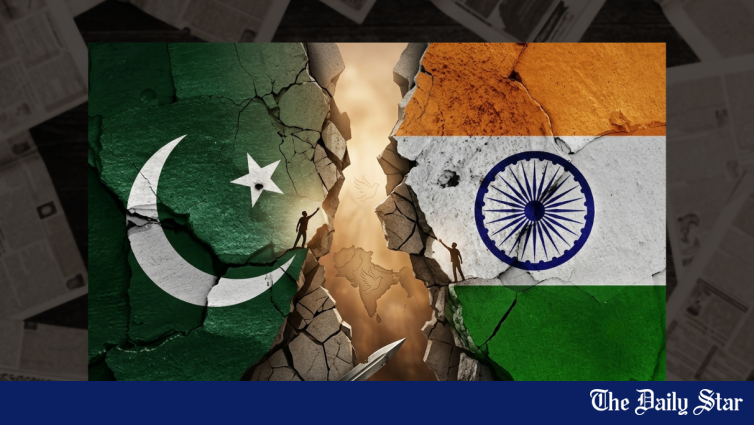
Scores of public intellectuals, former diplomats and erstwhile denizens of the deep state from India and Pakistan renewed a call recently for the resumption of peace talks and friendlier relations between their strained countries. They sought restoration of full diplomatic ties and reopening of trade routes with improved transportation links. They sought to make it easier to get visas to encourage and enable people from both countries to visit each other. The statement argued that continued tension hurts millions of young people. The activists asked leaders to put the welfare of the people ahead of conflict. What could be worthier than the charter of utterly reasonable demands for a more harmonious and integrated South Asia? It’s an increasingly overdue need.
However, the call for peace came at a time when Pakistan had locked up the main opposition party in the person of its charismatic leader. India on its part has preferred a similar route but by locking out the opposition from its critical role inside and outside parliament. In a blow to the pit of popular will that could maim a democracy, India’s election commissioner is now handpicked by Prime Minister Narendra Modi, while the judiciary appears to have surrendered to his right-wing agenda. Similar undermining of democratic institutions has been observed in Pakistan. Therefore, the question compels to be posed. How many of the peaceniks have the wherewithal or the interest to change the domestic realities that deter peace, and how many see India-Pakistan peace as a possibility despite regressive governments in their corners?
There is a third category in my field of vision, one which prefers cross-border support for democracy in their troubled neighbourhood. Camaraderie of the people is most needed, according to this lot, to shore up democracy on both sides. There was indeed a time when Ayub Khan’s military regime saw Indians linking up with Pakistani masses to challenge the usurper. A popular poem by India’s Majrooh Sultanpuri harks to the time. Borrowed from mediaeval poet Kabir’s dohas, the lines expressed solidarity boldly with those fighting Ayub — “Jala ke mishal-i-jaa’n hum junoo’n sifaat chale/ Jo ghar ko aag lagae hamarey saath chale”. To clarify, Majrooh was also an ardent critic of Jawaharlal Nehru whom he described in a potent poem as a grovelling slave of the British Commonwealth. Majrooh spent time in jail for writing the poem but used the incarceration to pen unforgettable lyrics for a blockbuster movie of the 1950s, Andaz.
On the larger canvas of bilateral ties (or their absence) the call for peace seems an old one, but the circumstances are newly minted. India and Pakistan have been at daggers drawn virtually since their birth, but May 2025 was when Modi ordered air and missile strikes inside Pakistan and called it Operation Sindoor. India blamed Pakistan for the terror attack in Pahalgam in April last year. The military stand-off was touted as its revenge. The May 7-10 air and missile battles saw Pakistan responding robustly with its own Operation Bunyan um Marsoos, or impenetrable defence.
That there are two opposite views among progressive activists on this issue dawned on me the day I sped off from JNU in Delhi with Pakistan’s leftist poets Fahmida Riaz and Ahmed Faraz in my jeep to rescue them from a right-wing mob incensed by a poem Fahmida recited at the university mushaira. ‘Tum bilkul hum jaisey nikley’ would become hugely popular with progressive intellectuals across India. But Faraz was livid with Fahmida, saying she had got him involved in an event staged by leftist critics of the Vajpayee government, which had issued them their visas. Fahmida asserted that it was only by standing with the comrades in India and by fighting their battles with empathy and moral support jointly that one could hope for genuine peace. Both poets had fought dictatorships in Pakistan but took opposite positions on the question of democracy on the other side of the fence.
On the larger canvas of bilateral ties (or their absence) the call for peace seems an old one, but the circumstances are newly minted. India and Pakistan have been at daggers drawn virtually since their birth, but May 2025 was when Modi ordered air and missile strikes inside Pakistan and called it Operation Sindoor. India blamed Pakistan for the terror attack in Pahalgam in April last year. The military stand-off was touted as its revenge. The May 7-10 air and missile battles saw Pakistan responding robustly with its own Operation Bunyan um Marsoos, or impenetrable defence. It claimed downing several Indian warplanes with sophisticated China-made radars and air-to-air missiles. India’s defence minister denied losing any plane or personnel at the time though the government has now admitted to the death of at least six soldiers in the episode.
From Pakistan’s perspective, India’s move to disregard or annul the Indus Waters Treaty poses an equally threatening existential challenge. When Shailendra Singh, a former high commissioner to Pakistan demanded after his retirement that India stop the Indus water flow into Pakistan, Dr Mubashir Hasan, the late public intellectual and water minister in Z.A. Bhutto’s cabinet, warned it would be an act of war. That warning still stands as Modi says the Operation Sindoor has been paused but not ended. Under the circumstances, what any peace activist may at best hope for is an armistice à la the Koreas where the 1950s war hasn’t technically ended. Nehru had helped bring about the continuing tense peace, but for better or worse, it has lasted.
However, the call for peace came at a time when Pakistan had locked up the main opposition party in the person of its charismatic leader. India on its part has preferred a similar route but by locking out the opposition from its critical role inside and outside parliament. In a blow to the pit of popular will that could maim a democracy, India’s election commissioner is now handpicked by Prime Minister Narendra Modi, while the judiciary appears to have surrendered to his right-wing agenda. Similar undermining of democratic institutions has been observed in Pakistan.
The Pakistani component seeking peace with India has a better chance of kindling a public debate in their country on the issue of peace as opposed to Indians. As the cookie crumbles, the opposition in Pakistan still has support in the mainstream media, crucially the TV channels. In India, the washout seems complete, and the opposition uses online channels to express its views on domestic and foreign policies though peace with Pakistan is not quite their priority. The Shiv Sena and other members of the INDIA alliance are struggling to keep their heads above the nationalist current, politically speaking. Worse, the online channels they lean on are also being increasingly targeted, and laws are on the anvil to gag them.
Do the peaceniks have anyone capable in their ranks to unravel the Gordian Knot of stubborn aloofness? In the Greek legend, it took Alexander the Great to do the needful. When he couldn’t untangle the knot, he cut it with a single stroke of his sword.
This article was first published under the title “Looking for an Alexander ” in Dawn, an ANN partner of The Daily Star, on July 7, 2026.
Jawed Naqvi is Dawn’s correspondent in Delhi.
Send your articles for Slow Reads to [email protected]. Check out our submission guidelines for details.