
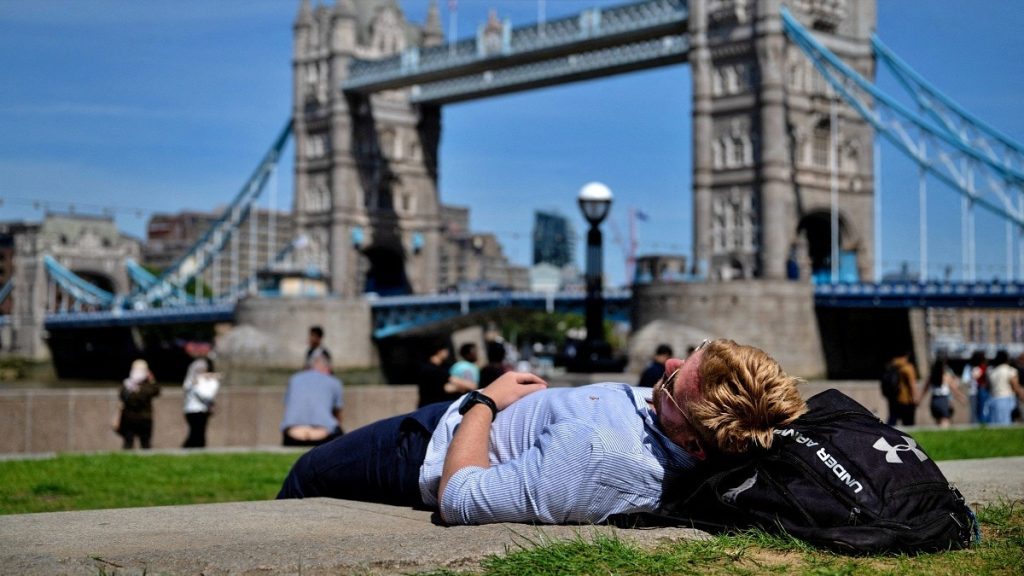
Britain and Switzerland recorded their hottest June days on Thursday as a deadly early summer heatwave gripped much of Western Europe, killing dozens, disrupting power supplies, and forcing schools and cultural landmarks to shut.
Britain is baking under temperatures of around 35 degrees Celsius, while large parts of India routinely endure summer highs above 45 degrees Celsius. Yet, many people in the UK say the heat feels unbearable, prompting a familiar question every time a heatwave strikes: Why does 35°C in Britain feel worse than 45°C in India?
The answer lies in a combination of humidity, housing design, long daylight hours and how well people are adapted to heat, experts say.
Unlike many parts of southern Europe or India, Britain is surrounded by the Atlantic Ocean and several seas, which means its weather often carries much more moisture. On a hot day, cities like London can record relative humidity above 40%, while a city such as Madrid may experience similar temperatures with humidity closer to 20%.
That extra moisture makes a significant difference to how the human body experiences heat.
Sweating is the body’s primary cooling mechanism, but sweat only cools the skin when it evaporates. In humid conditions, evaporation slows because the air is already holding large amounts of moisture.
As a result, the body struggles to lose heat efficiently, increasing the risk of heat exhaustion, dehydration, cardiovascular stress and respiratory illnesses, even when temperatures are lower than those seen in tropical countries.
Meteorologists often use wet-bulb temperature, a measure that combines air temperature and humidity, to estimate heat stress.
During the current British heatwave, wet-bulb temperatures in southern England are expected to approach 25°C. While well below the theoretical survival threshold, they are high enough to pose health risks for older adults and other vulnerable groups.
In much drier climates, the air temperature would often need to exceed 40°C to produce a similar level of physiological stress.
However, humidity is only one part of the story.
HOW DOES BRITISH HOMES MAKE HEAT WORSE?
Britain’s buildings were designed for cold, damp winters, not increasingly frequent heatwaves. Typical brick homes, tiled roofs and concrete apartment blocks retain heat throughout the day and slowly release it overnight, turning homes into what scientists describe as “thermal batteries.”
Air conditioning also remains relatively uncommon in British homes, unlike in many hotter countries, where it is considered essential.
In contrast, countries such as India have spent generations adapting to extreme summer heat. Buildings often incorporate thick walls, shaded courtyards, external blinds and better natural ventilation to reduce indoor temperatures.
Daily routines are also adjusted, with outdoor work and travel often avoided during the hottest afternoon hours.

The seasonal evolution of heat also differs dramatically.
Across much of India, temperatures rise gradually through spring before peaking in May and June, allowing people, infrastructure and public health systems to acclimatise over several weeks.
Britain’s heatwaves, however, often arrive abruptly after cool, wet weather. This year, temperatures swung from chilly nights and even late frosts in May to record-breaking heat within weeks, leaving little time for people to adapt physically.
Another factor is Britain’s unusually long summer days.
During June and July, daylight extends well into the evening, allowing roads, buildings and pavements to continue absorbing solar energy for several extra hours. Even after sunset, stored heat is gradually released into the atmosphere, making nights warmer than expected.
These so-called “tropical nights,” when temperatures remain above 20°C, prevent the body from recovering from daytime heat exposure.
Urban areas are particularly vulnerable because of the urban heat island effect, where concrete and asphalt trap and slowly release heat. High overnight humidity further limits the body’s ability to cool itself.
As climate change drives more frequent and intense heatwaves across Europe, scientists say Britain’s greatest challenge is not simply hotter temperatures but a country whose homes, infrastructure and daily routines were built for a much cooler climate.
That mismatch means a 31°C British heatwave can feel far more oppressive than a much hotter day in parts of India, despite the large difference on the thermometer.
– Ends