
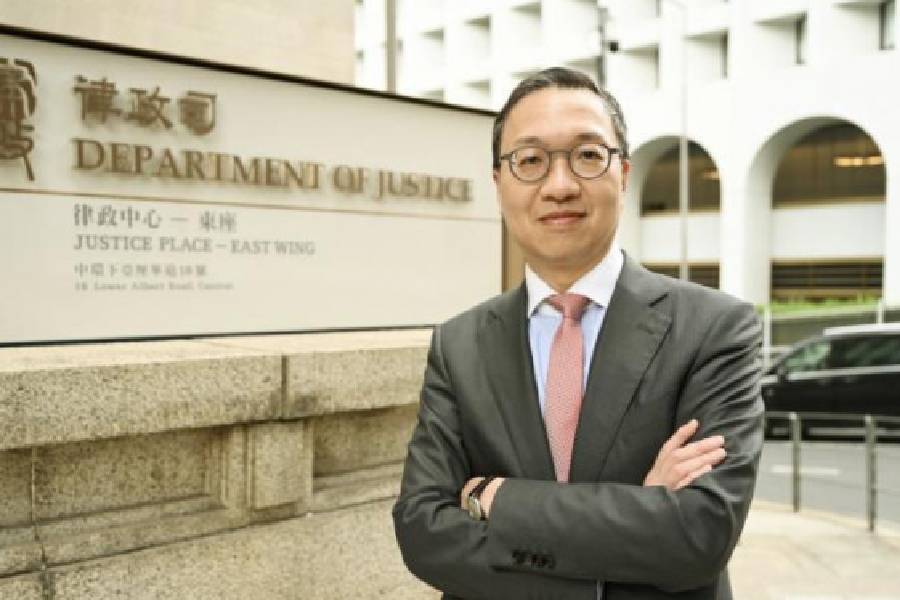
The United States has lifted sanctions on nine government officials from Hong Kong and mainland China following the expiration of a 2020 executive order that declared a national emergency regarding the city.
The administrative change, which leaves thirty-nine individuals still under penalty, has been welcomed by Chinese authorities as a positive step toward stabilizing bilateral trade relations.
The US Department of the Treasury’s Office of Foreign Assets Control confirmed the removal of the nine individuals from its sanctions list after the emergency order, originally enacted during the Trump administration, lapsed.
Among those no longer facing penalties are Hong Kong’s Secretary for Justice Paul Lam Ting-kwok, the head of the Office for Safeguarding National Security in Hong Kong Dong Jingwei, and former Commissioner of Police Raymond Siu Chak-yee.
The updated list also cleared national security committee secretary-general Sonny Au Chi-kwong, current and former national security police assistant commissioners Dick Wong Chung-chun and Margaret Chiu Wing-lan, former police chief Stephen Lo Wai-chung, as well as former Liaison Office deputy directors Qiu Hong and Yang Jianping.
American officials clarified that allowing the national emergency to expire was an administrative effort to streamline procedures rather than a broader policy reversal.
A Treasury Department representative explained that the expired executive order heavily overlapped with the Hong Kong Autonomy Act of 2020.
The agency emphasized that both the Hong Kong Autonomy Act and the Hong Kong Human Rights and Democracy Act of 2019 remain fully in effect, meaning individuals penalized under those specific legislative acts are still subject to restrictions under a separate sanctions list.
In response to the development, China’s Ministry of Commerce expressed its appreciation for the decision not to renew the emergency declaration.
A ministry representative described the expiration as a significant milestone in realizing the consensus reached during recent bilateral economic and trade discussions.
The spokesperson emphasized that maintaining stability and prosperity in Hong Kong serves the mutual interests of both nations, adding that the adjustment in American policy aligns with broader international expectations.
Chinese officials also conveyed their hope that the US would continue to adhere to international conventions, respect Chinese sovereignty and the rule of law in Hong Kong, and work toward restoring normal economic exchanges.