
by Helen Li
語言:
English
Photo Credit: Taiwan Association for Human Rights/Facebook
IN THE RAINY darkness of Taipei’s 228 Memorial Park’s amphitheatre, echoes of songs rang out.
Mr. L stood there handing out flyers. On the back of the paper holding lyrics to the song《祭英烈》or ”Remember the Martyrs,” by Lo Kwok-cheung, a Hong Kong social movement song sung each year in Victoria Park.
“My mother tongue is Cantonese. It’s very hard to find an all-Cantonese-speaking event in Taipei,” the 37-year-old said.
For the past decade, every June 4th has brought a vigil near Taipei’s Chiang Kai-Shek Memorial Hall. During the last two years, there has been another event organized by the Hong Kong diaspora in Taipei. While there is comfort in solidarity standing up onstage with the Taipei vigil organizers at CKS, there’s a certain familiarity at the 228 Memorial Park that they can’t find elsewhere.
“There’s another gathering, but to a Hong Konger, this one has its own special meaning,” Mr. L said. For the twenty or so people who attended, it was a continuation of a ritual that has all but disappeared. The two gatherings at the Chiang Kai-Shek Memorial and 228 now occur annually in Taipei. However, there are other non-June 4th monthly or so gatherings sponsored by various Cantonese-language specific associations around the city.
Since 1990, thousands of people have gathered for a candlelight vigil in Victoria Park to remember the deaths during the June 4th Tiananmen student protest movement in 1989. 2019 had the largest turnout amid national security law protests, with more than 180,000 people gathering, according to the Alliance data.
In 2020, government authorities banned the annual vigil that usually would gather upwards of 10,000 people in Hong Kong, citing social distancing and COVID-19 pandemic control measures. Facing investigations of foreign interference under the new sweeping national security law, the Hong Kong Alliance in Support of Patriotic Democratic Movements of China, the original vigil organizers, officially voted to disband. Since then, there has been an absence of this tradition.
“Each year, attendance levels at the vigil were a glimpse into the levels of dissatisfaction with the government. Now that window has disappeared.”
Five years ago, Mr. L came to Taipei to work. He decided to stay. In 2021, more than 11,000 Hong Kongers moved to Taiwan. The number of Hong Kongers applying for residency in Taiwan has also increased annually in the last five years, according to past reports by the Mainland Affairs Council.
Ms. Cheung, a woman in her 50s, also recounts a common experience that brings her and other Hong Kongers her age together: a vivid recollection of watching TV on June 4, 1989. “I’ll never forget that moment.” She belts out the chorus at the 228 Memorial Park.
“Every song lyric represents what we want to say,” she explained.
Mr. Lam, the coordinator for the 228 Hong Konger vigil, was a former district councilor before leaving for Taiwan. He said that he keeps the songs from the Victoria Park vigil to create a place for Hong Kongers to continue their traditions, even if they have disappeared.
“We follow that vigil as closely as possible. Although we do have to adjust for park regulations, like we can’t burn letters for those who have passed,” he said. “Our long-term goal is that if a Hong Konger wants to participate, Taiwan is just an hour flight away.”
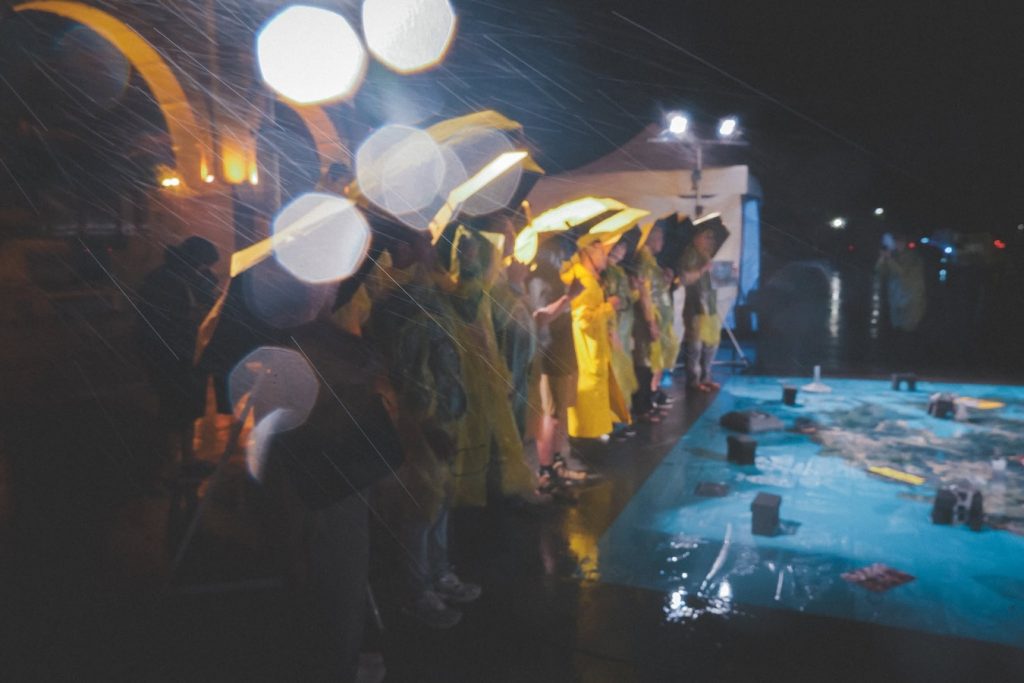
On a wet June 12 in front of Chiang Kai-shek Memorial Hall, Sky Fung stands in the rain holding an umbrella. In front of him was a spread map of Hong Kong, with different pieces showing landmarks. Turnout is lower than expected, as Taipei experienced two weeks of straight plum rain. Thankfully, one of Hong Kong Outlanders’ members livestreams the event.
Fung came to Taichung in 2013 to study commercial design. Initially, he said he was not super involved in any social movements or protests. Part of starting Hong Kong Outlanders in 2019 was to give the Hong Kong diaspora a way to build connections with Taiwan civil society.
“Maybe starting from this year, we hope that the 12th of June will become one of the traditions of Hong Kongers to commemorate Hong Kong,” he said over Zoom after the event. Since 2019, Fung has decided not to go back and visit Hong Kong due to his concerns about safety with his activism in Taiwan.
Trust is also a common issue, he says, even at Hong Kong-specific community events in Taipei. It’s hard to know who is who, even if you share a common language or background. Some people have a fear that if you get your picture taken, another fellow member may post it and endanger their safety.
What Hong Kong was and is is also lived through the lives of the people who have left.
“Because when we start to forget everything, Hong Kong will not exist anymore,” Fung said. “It is not only talking about the movement, it’s more like everything we have experienced in Hong Kong.”
Last week, Causeway Books owner and democracy activist Lam Wing-Kee died from cancer in Taipei’s MacKay Memorial Hospital. As more public commemorations face pushback from governments and the older generation passes on, it’s further important for the Hong Kong diaspora with lived memories to gather and share to keep their spirit alive.