The launch of
Shenzhou-23, carrying
Hong Kong’s first astronaut Lai Ka-ying to the
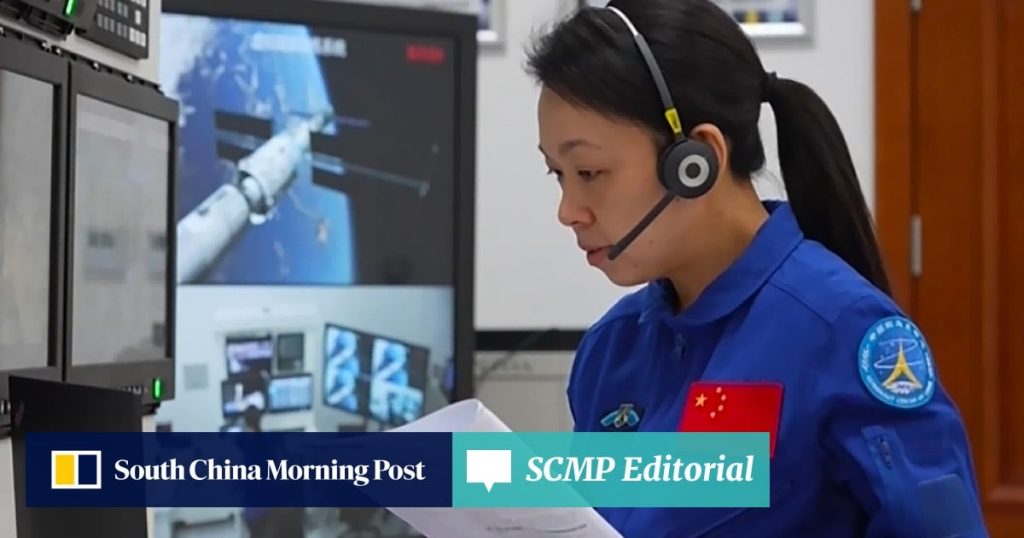
Tiangong space station, is more than a technical milestone; it is a turning point for the city that has transformed Lai overnight into a landmark role model. Her selection and rigorous preparation – 1,700 training hours and a demanding flight qualification assessment – mark Hong Kong’s active participation in China’s expanding human space-flight programme. For young people in the city, that defines the horizon of possibility. In Lai’s words, the space dream is “not that distant”.
A Hong Kong police superintendent and mother of three, with a doctorate in computer science, 43-year-old Lai embodies a blend of public service, academic excellence and technical skill. Her doctoral work on data science and computer forensics speaks to the practical, data-driven expertise space missions require.
In a video call with Lai in which he expressed Hong Kong’s pride in her achievement and sent blessings, Chief Executive John Lee Ka-chiu also said it showed recognition of her, as well as “our country’s trust and support for Hong Kong”.
As a payload specialist, Lai will help conduct over 100 scientific studies aboard Tiangong, which range from biomedical experiments on mice and artificial embryos to materials testing and new energy storage systems. Her presence underscores how disciplines such as computing and data analysis are central to 21st-century exploration.
Lai is the fourth woman to enter China’s space station. The combination of gender and Hong Kong representation will resonate across a city forging a future as a superconnector. Young women who study STEM (science, technology, engineering and mathematics) subjects can point to a contemporary role model who navigated gruelling training. Lai’s comment that the space dream is not far away resonates because it is grounded in effort and persistence.
Hong Kong’s universities and research bodies already contribute to national projects, from
multispectral carbon monitoring to potential quantum experiments in orbit. Lai’s flight makes those institutional links tangible: students can see a pathway from local labs to national platforms. When young people see someone they can identify with trained to the highest standards and entrusted with complex scientific tasks, it reframes what is achievable. The Shenzhou-23 mission is a message to the next generation that space is within reach and that Hongkongers – including women – belong in the orbit of scientific endeavour. If policymakers and educators expand STEM outreach, internships and scholarships, Lai’s flight could be a catalyst for a generation of Hong Kong scientists, engineers and explorers who will boldly help shape the city’s future.