
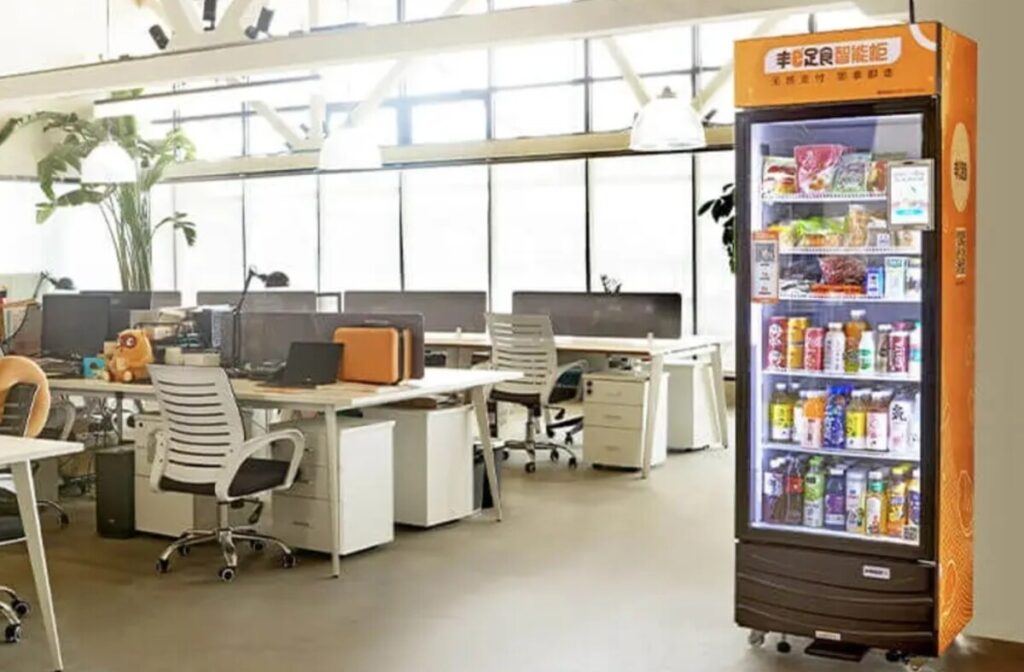
The company is part of a second generation of unmanned retailers, as its Hong Kong IPO tests investor appetite for a cabinet network offering help-yourself snacks and drinks
image credit: Bamboo Works
Key Takeaways
- Fengyi Technology has filed for a Hong Kong IPO, after building China’s largest smart retail cabinet network with nearly 184,000 cabinets and 2 billion yuan in annual revenue
- The company’s business metrics are all moving in the right direction, but its thin margins show the difficulties of wringing profits from thousands of low-sales cabinets
In office buildings, factory rest areas and campus corridors across major Chinese cities, a familiar ritual is playing out. A worker or student scans a QR code on a glass-fronted cabinet, which unlocks the door. She then opens the door, takes a bottle of tea, packet of biscuits or other drink or snack of choice, closes the door and walks away. The machine uses sensors to detect what was taken, and payment happens automatically.
That makes the company less a hardware maker and more like a retailer whose stores happen to be tiny, unmanned and algorithm-managed. Nearly all of its revenue comes from selling goods through its cabinets, with advertising and other services still just small contributors. The company’s pitch is that AI can turn a logistics-heavy retail model into a scalable network able to operate both reliably and profitably.
Rocky history
The company is still losing money, though its earnings trend is more nuanced than the headline loss suggests. Its revenue rose 32.9% in 2024 and 21.6% in 2025. Gross margin improved from 52.4% in 2023 to 55.8% in 2025. And most importantly, it swung from a 14.2 million yuan operating loss in 2023 to operating profits of 48 million yuan in 2024 and 50.8 million yuan in 2025.
Fengyi is still losing money on a net basis due to non-cash financing items. But it’s profitable on an adjusted basis, including an adjusted net profit of 118.6 million yuan in 2025, up from 77.4 million yuan in 2024.
AI as efficiency tool
That matters in a business where it’s time-consuming and costly to manage thousands of small locations by hand. AI can reduce products running out of stock, improve selection and make refill routes more efficient for restockers. But it can’t make a quiet office corridor behave like a busy convenience store. The cabinet still needs enough real consumers reaching for enough drinks and snacks every day to create a profitable business.
Fengyi’s broader context operating in a Chinese environment also matters. The smart cabinet model fits China’s dense workplaces and schools, ubiquity of mobile payments and strong delivery networks.
To subscribe to Bamboo Works weekly free newsletter, click here
Benzinga Disclaimer: This article is from an unpaid external contributor. It does not represent Benzinga’s reporting and has not been edited for content or accuracy.