
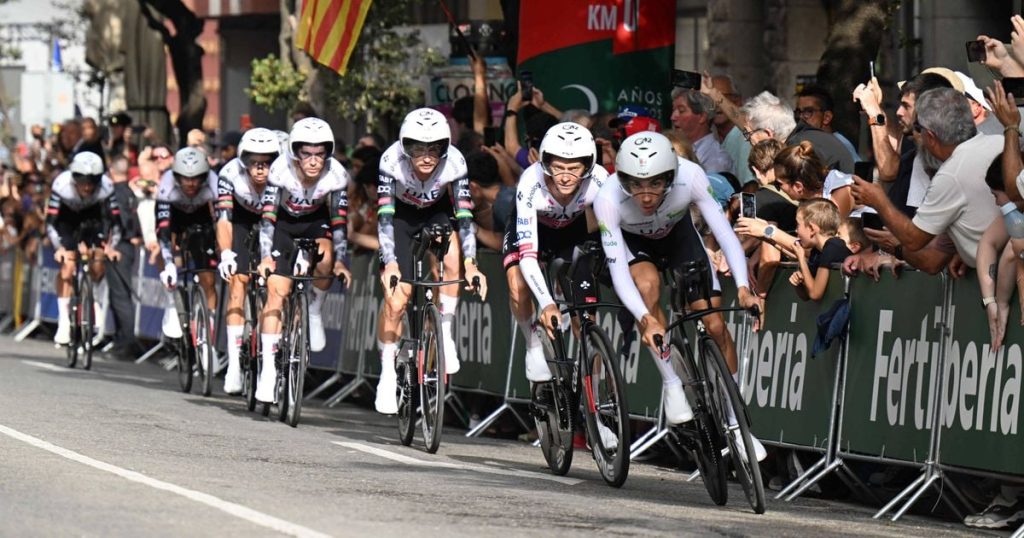
In the aftermath, attention shifted — at least partly — to UAE’s equipment choice.
‘I really don’t understand that decision’
“UAE were riding TT tyres,” said Rowe. “We all know they’re faster. They are faster. They always use them. They’re the one team who use them under almost any circumstances — but they do have less grip. And the first guy down was a UAE guy. Lost both wheels.”
Thomas admitted the issue was not unique to UAE. “It’s been a bit of a topic in our team,” he said. “We started using TT tyres, and then you use them more and more, and before you know it, it becomes standard. It’s definitely something to consider — especially in Bulgaria, not knowing exactly how the roads are.”
Rowe’s frustration centred on one key detail: the rain was not a surprise.
“Was the rain a surprise? Were you on the ground — was it in the forecast?” he asked Thomas.
“No,” Thomas replied. “It was forecast that it could be wet. All the boys knew.”
Rowe’s verdict was blunt. “I don’t understand that decision. I really don’t. A wet day and TT tyres — that seems like a strange call. And again, this is harsh to say, because half the team ended up on the deck.”

What are TT tyres — and why are they dangerous in the wet?
On a normal road stage, most riders use all-round tyres: built for a balance of speed, grip and durability across different conditions. TT — or time trial — tyres are different. They are built purely for speed. Narrower, run at higher pressure, and with a smoother surface and minimal tread, they reduce rolling resistance and aerodynamic drag.
In dry conditions, that trade-off is worth making. In the wet, Luke Rowe would argue, it is not.
Grip depends on a tyre’s ability to maintain contact with the road. In wet conditions, water sits between the tyre and the tarmac. A tread pattern channels that water away and preserves grip. A smooth TT tyre cannot do that. Higher pressure makes things worse — it reduces the surface area in contact with the road at precisely the moment when you need the most traction.
On a wet descent at race speed, the margin for error disappears very quickly.
Risk versus reward
UAE’s willingness to push the boundaries on equipment is well documented, and in dry conditions, faster tyres can be decisive.
Thomas framed the broader dilemma thoughtfully. “Risk versus reward — what route do you go down? The Giro compared to the Tour is a bit different. The Tour generally has better-quality roads.” Bulgaria, by contrast, was unknown territory for the professional peloton.
Neither Thomas nor Rowe suggest UAE acted with reckless disregard. Both acknowledged it is a judgement call that every team faces. But when the rain was forecast, and the roads unknown, that calculation looks harder to defend.
With three of their own riders sent home before the race reached Italian soil, and many other teams effected, those questions may come back to haunt the team.