
Your next insurance premium could be shaped by what satellites can see from space.
UAE insurers are beginning to use satellite imagery and artificial intelligence to assess flood, fire and property risks more accurately, raising hopes of faster claims and fairer pricing – but also concerns over privacy, transparency and whether some customers could be priced out of cover.
Analysts say the technology could make insurance more precise, but warn that without clear rules it may also lead to higher premiums, denied coverage or discriminatory pricing in areas seen as more exposed to climate risk.
Proponents say satellite data is a win for risk accuracy and climate resilience – and that’s a valid point. But critics warn it is a privacy minefield and a potential tool for redlining, potentially resulting in discriminatory practices.
“With great data comes great responsibility – or great temptation. Insurers can use satellite insights to justify premium hikes or deny coverage, especially in climate-vulnerable areas like wild fire zones or flood plains,” Inci Kaya, a research manager for insurance digital strategies at the International Data Corporation, told The National.
“This is understandable as they would be assuming greater risk, but [it is] difficult to explain to policyholders who will see it as a money grab. Unchecked, advanced data can become a shield for discriminatory practices.”
Data collection
In the age of Big Data, the collection of personal information is important for companies as it helps them understand their base and, in common PR speak, “help serve them better”.
“In most cases, better data leads to more accurate, not higher, pricing. Insurance pricing depends on how well risk is understood and how effectively it is managed, and improved data supports both,” Aoun Al Smadi, chief executive of UAE digital insurance platform Shory, told The National.
At last month’s Make it in the Emirates summit, Shory signed a preliminary agreement with Abu Dhabi’s space and defence manufacturer Orbitworks to explore opportunities on satellite imaging and insurance.
Regulators, however, have been repeatedly warning companies not to misuse data. For instance, the EU AI Act is expected to become a global template for regulating AI and data use in insurance, with strict requirements for transparency, bias mitigation and consumer rights, Ms Kaya said.
However, modern high-definition and high-resolution imagery is blurring the line, thanks to that constant monitoring of assets, said Oliver Cornock, editor in chief of Oxford Business Group.
“Increasingly, gone are the days of a one-time home inspection; satellites offer the option of continuous monitoring. This can raise concerns with regard to invasion of the right to privacy in one’s own backyard,” he told The National.
Shory, meanwhile, is deep into developing its own AI models in-house, seeking to use Big Data to assess risk, Mr Al Smadi said.
“Over time, this should help reduce uncertainty, lower claims and potentially lead to more competitive pricing for customers, rather than increasing premiums,” he said.
“As such, privacy risks are considered limited, and any future applications or opportunities explored within the domain would remain subject to applicable local insurance and data protection regulations.”
Is its pricing fair?
For now, consumer awareness remains limited, partly because most clients are not involved in the survey or risk assessment stage of the quotation process, Hitesh Khanchandani, co-founder of Dubai-based NewTech Insurance Brokers, told The National.
“And because the technology has its limitations, insurers don’t tend to lead with it in client conversations,” he said.
“Where you do see awareness is among larger, more sophisticated clients – particularly those with experienced, well-informed insurance managers who understand how risk is being assessed and are engaged enough to ask the right questions.”
The IDC notes that satellite data is increasingly quantifiable, increasing premium variability across geographies by enabling more granular, risk-adjusted pricing. AI and satellite-powered models are driving a shift from pooled, averaged risk pricing to individualised, real-time pricing.
The Boston-based research company predicts that by 2029, 30 per cent to 40 per cent of insurers globally will launch AI and satellite-data-powered climate risk covers. Climate-exposed regions will feel the effects most profoundly, and will continue to, as adoption of AI and satellite powered models grows.
Globally, insurance companies are increasing their use of satellite and aerial imagery to drive efficiencies. Viewing the Earth from above gives them quick and efficient means to monitor and assess insured assets and surrounding environments, according to Space Imaging Middle East, a Dubai-based geospatial solutions provider.
But more data does not necessarily translate to fairer pricing, because without full transparency in place, granular risk models – those that are diversified across a number of assets – can just as easily become tools for excluding policyholders from future coverage, Ms Kaya said.
“Satellite imagery promises precision for insurers, which is great, but on the flip side we have to think about fairness. These two factors will colour how models are built and governed, beyond the data.”
Explain with AI
This is where explainable AI – which is used to describe an AI model’s expected impacts and potential biases, which in turn helps characterise accuracy, fairness, outcomes and transparency – comes into play, especially as regulators are tightening the screws on AI use.
“Explainable AI isn’t a buzzword; it’s the new baseline for pricing models if insurers want to avoid regulatory heat … insurers and regulators must ensure that pricing models are explainable, auditable and regularly tested for bias,” Ms Kaya said.
Mr Al Smadi acknowledged that insurance is complicated – and some types of risk are “really complicated”.
But, “[AI] helped us … ensure some risks that we were not able to insure before because now we’re able to assess [them much faster], cutting the time from weeks to days and sometimes hours”.
Be proactive
Insurers can adopt the technology without building satellite infrastructure themselves by working with specialist InsurTech and geospatial companies, said Vidya Veerapandian, co-founder and host of the FS Brew Insurtech and Insurance Podcast, based in Dubai.
“To ensure it is viable to adopt these technologies, insurers can collaborate with the vibrant InsurTechs and wider geospatial tech start-ups, which are producing highly accessible, API-driven tools that mid-tier and smaller insurers can plug into without building satellite infrastructure themselves,” she told The National.
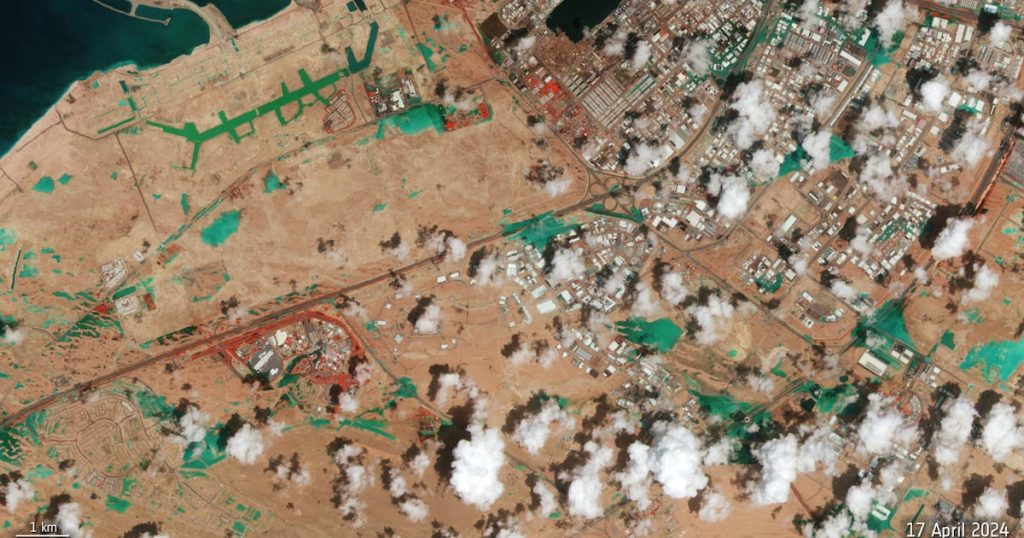
Natural catastrophe risks – earthquakes, hurricanes, cyclones and floods – are the biggest concerns, and the UAE floods of 2024 were a prime example.
“Insurance has always been priced on what we can’t see, including a customer’s questionnaire, photos, postcode average and claims history – but satellites change that,” Mr Khanchandani said.
“Underwriters can now look at the actual roof, the actual neighbourhood, the actual flood path. After the April 2024 floods, this isn’t a future conversation in the UAE – it’s already happening.”
According to analysts at France’s Axa, one of the world’s biggest insurance companies, imagery can help underwriters model the impact of a flood on a site and visualise the risk in the context of the surrounding environment.
“Used in combination with high-resolution aerial or drone imagery, it provides an unprecedented situational awareness in time and in space,” they said.
“The better underwriters understand the risk, the more able they are to apply appropriate premiums and conditions, or recommend loss prevention actions.”
In the UAE, Abu Dhabi’s Space42 – formed from a merger between Bayanat and Al Yah Satellite Company – is the premier provider of the service.
“When we combine insurance technology with robust data that we can read from the satellite data that we receive, that’s what will make the difference,” Mr Al Smadi said.
“There is always a way to ensure [accuracy] even in high risks when we have enough data around those risks … this type of big data cannot be dealt with without the right AI technology in place.
According to industry estimates, remote assessment can cut the processing time of claims by as much as 70 per cent, with most straightforward claims potentially settled in days.
“That speeds up legitimate claims and reduces inflated ones – and the cost of fraud is something every policyholder currently pays for in their premium,” Mr Khanchandani added.
For customers, the promise is faster claims and more accurate pricing. The risk is that the same technology could make insurance harder or more expensive to obtain if models are not transparent, explainable and closely regulated.
As satellite data becomes part of the insurance process, the question is no longer whether insurers can see more – but how they use what they see.