
One of the many legacies left by UAE Founding Father, the late Sheikh Zayed bin Sultan Al Nahyan, was his restoration in 1946 of Al Ain’s ancient falaj water system.
As the Ruler’s Representative in the Eastern Region, Sheikh Zayed also ordered that water should be free. A study has shown that, in nearly six decades serving in positions of authority, including Ruler of Abu Dhabi and UAE President, Sheikh Zayed’s actions covered all 17 sustainable development goals (SDG) later adopted by the UN.
Released in Frontiers in Environmental Science, the research pinpoints 31 policy decisions, from tackling poverty and hunger, promoting health care, providing education and taking steps to improve gender equality, that relate to one or more SDG.
The first, the falaj restoration and declaration that water should be free, links to the SDG on “clean water and sanitation”.
Another key milestone, relating to the SDG on good health and well-being, was the move to set up Oasis Hospital in Al Ain in 1960, which sharply reduced infant mortality.
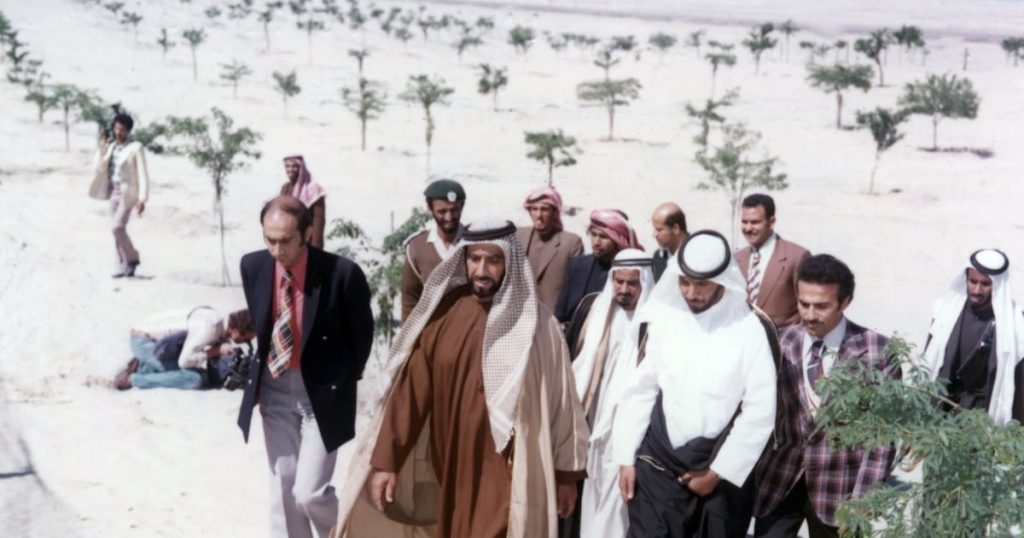
One of Sheikh Zayed’s best-known initiatives, greening the desert, began in 1962 and involved the planting of tens of millions of trees over four decades.
This work, which covers the SDG about “life on land”, was a key reason why the World Wildlife Fund for nature awarded Sheikh Zayed its Golden Panda conservation accolade in 1997.
The environmental report was written by Jasim Mohamed, founder of the Aiwah Foundation, a non-profit organisation that promotes sustainability through cultural and community projects.
Mr Mohamed told The National that Aiwah decided to look at progress on the SDGs after a UN report this year found that, while they have sparked progress, around the world only 36 per cent of those aims are on track to be met.
More than an environmentalist
He said Sheikh Zayed became a focus of the research because of his “well-known love of nature”. But Mr Mohamed said that reputation as an environmentalist, while “deserved … was incomplete”.
“We expected to find the record of a pioneering environmentalist,” he said. “That was the story everyone knew. Then the evidence began leading us somewhere much larger.
“He was dealing with water, education, housing, public health, women’s participation, prosperity, conservation, peace and the welfare of future generations. The environmentalist label captured something real, but it captured only one part of the record. We went looking for examples of sustainability and found a whole approach to governing.”
That the SDGs were adopted in 2015, more than a decade after Sheikh Zayed passed away, is seen as an indication of his forward thinking. The paper has been peer-reviewed, meaning it has been analysed by academics not connected to the research.
It draws comparison with five other well-known national leaders, including former Indian prime minister Indira Gandhi and Lee Kuan Yew, who spent more than three decades as the Singaporean prime minister.
The actions of the other five leaders each covered between six and nine SDGs, significantly fewer than the number accounted for by Sheikh Zayed’s record of governance.
Other milestones discussed in the study include the founding of the UAE in 1971. The research notes that the constitution stated, among other things, the need for equality and equal opportunity, compulsory free education, equal access to public office and equality before the law.
These relate to the SDGs on quality education; peace, justice and strong institutions; and partnership for the goals. Also highlighted are Sheikh Zayed’s efforts to stop gas flaring, where gas is burnt during oil drilling, producing large amounts of carbon dioxide and soot, and the 1974 Treaty of Jeddah, which resolved border issues with Saudi Arabia.
“As we document in the paper, World Bank satellite data place the country among the major hydrocarbon-producing economies with the lowest absolute and intensity-adjusted flaring rates,” Mr Mohamed said.
Sheikh Zayed’s 1990 personal donation to the Carter Centre, set up by former US president Jimmy Carter to combat guinea worm disease, and a 1999 federal law to protect biodiversity, each align with several SDGs, the research shows.
Ahead of his time
The paper does not suggest that Sheikh Zayed anticipated the SDG checklist, Mr Mohamed said. “He did not know the language of the SDGs because it did not yet exist,” he added. “But he understood the relationship between human dignity, prosperity, social stability and the natural world.
“In some ways, that makes the finding more significant. He reached across the whole framework without being instructed by one.”
Although Sheikh Zayed was well-known for his concern for the natural world, the development of the UAE put environmental matters into focus, including those related to carbon emissions.
Mr Mohamed said the transformation of the country that brought education, health care, housing, mobility and economic security required energy, infrastructure and construction. He said “both sides” of that history should be acknowledged.
“Sustainable development has never meant that human society can have no impact on the environment,” he said. “It is about balance – improving human life while protecting the natural systems and resources on which future life will depend. The difficult task is to recognise the costs of development and to continue correcting them as knowledge and technology improve.”
The UAE continues to take action to protect the environment, Mr Mohamed said. Initiatives included the 2024 climate law that professional services firm KPMG has said mandates businesses across the UAE “to measure, track and manage their greenhouse gas” emissions.
Mr Mohamed also noted that the UAE recently submitted its third voluntary national review of its progress towards the SDGs. “None of that cancels out the emissions,” he said. “It demonstrates that the response is being translated into law, measurement, public reporting and action.”
Sheikh Zayed’s legacy is the “standard against which the present should be judged”, Mr Mohamed said.
On August 6, exactly 60 years after Sheikh Zayed became Ruler of Abu Dhabi, Aiwah unveiled a “digital museum of his sustainability legacy” as it relates to the SDGs. It goes live at fatherofsustainability.com.
“Anyone in the world will be able to move through the history, examine the documented actions and see the evidence for themselves,” Mr Mohamed said.